
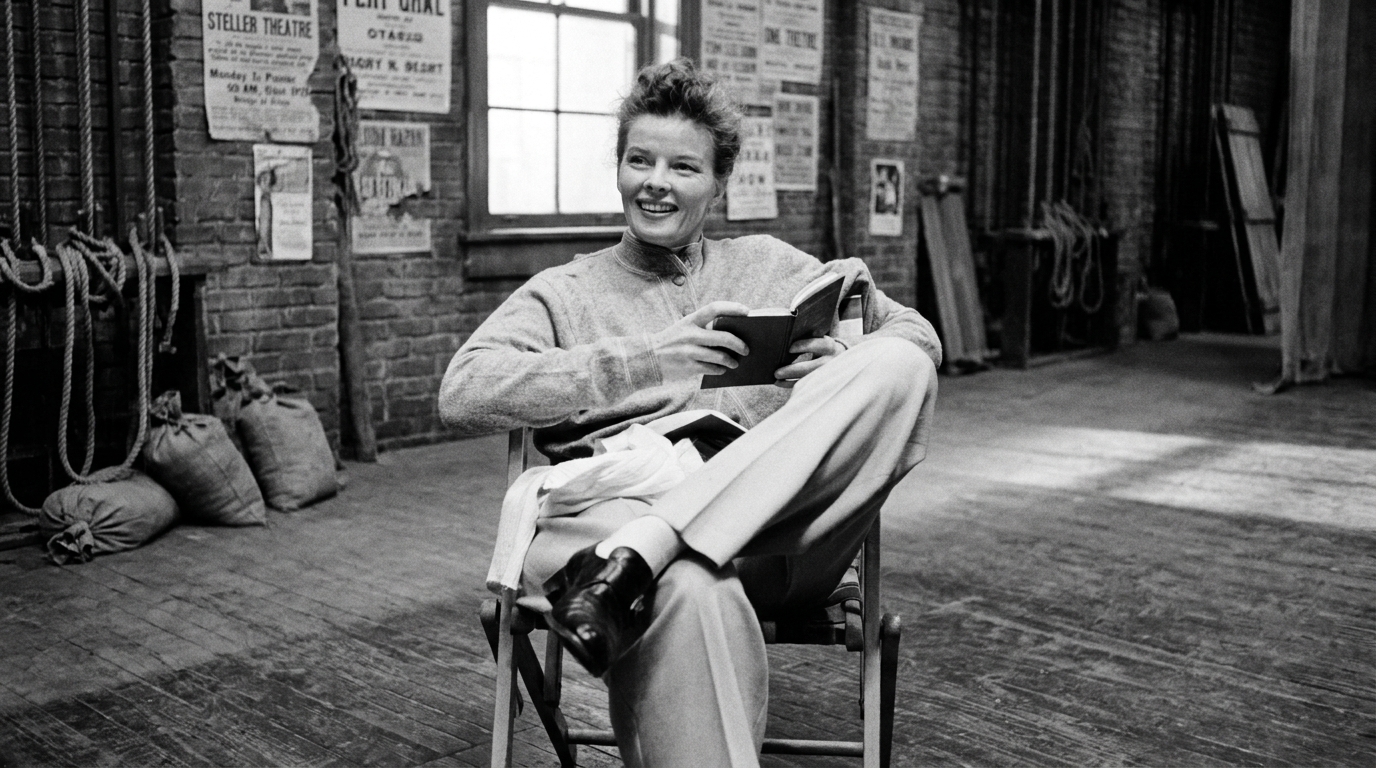
Katharine Hepburn is one of the most admired actresses in the history of cinema. During a screen career that lasted more than sixty years, she won four Academy Awards for Best Actress, more than any other performer in a lead acting category, and she became a symbol of independence, wit and determination. This guide covers her early life, her biggest films, her Oscar wins, her long relationship with Spencer Tracy, her personal style and the legacy she left behind, so you can understand why people still search for her name today.
Quick Facts About Katharine Hepburn
| Detail | Information |
|---|---|
| Full name | Katharine Houghton Hepburn |
| Born | May 12, 1907, in Hartford, Connecticut, USA |
| Died | June 29, 2003, in Old Saybrook, Connecticut, aged 96 |
| Profession | Actress on stage, film and television |
| Education | Bryn Mawr College (graduated 1928) |
| Film debut | A Bill of Divorcement (1932) |
| Academy Awards | 4 wins for Best Actress, 12 acting nominations |
| Best-known partner on screen | Spencer Tracy (nine films together) |
| Famous films | Bringing Up Baby, The Philadelphia Story, Adam’s Rib, The African Queen, Guess Who’s Coming to Dinner, On Golden Pond |
Early Life and Family Background
Katharine Hepburn was born in Hartford, Connecticut, as the second of six children. Her father, Thomas Norval Hepburn, was a respected urologist, and her mother, Katharine Martha Houghton Hepburn, was a well-known campaigner for women’s right to vote and for access to birth control. Growing up in a household where women were encouraged to speak their minds and where physical activity was valued, Hepburn learned early to trust her own opinions. She enjoyed swimming, golf, tennis and diving, and these habits stayed with her for most of her life.
One painful event shaped her youth. In 1921, her older brother Tom died at the age of fifteen, and Hepburn was the person who found him. For many years she gave her own birthday as November 8, 1909, which was her brother’s birthday, and only later did researchers confirm that she was actually born on May 12, 1907. Many biographers see this choice as a sign of how deeply the loss affected her.
She studied history and philosophy at Bryn Mawr College in Pennsylvania and graduated in 1928. While at college she became interested in acting, and soon after graduation she began working in theater, first in smaller stage companies and then on Broadway. Her early stage career was uneven, and she was fired from at least one production, but a leading role in the 1932 play The Warrior’s Husband drew the attention of Hollywood talent scouts.
How Katharine Hepburn Rose to Fame in Hollywood
Hepburn made her film debut in A Bill of Divorcement (1932), directed by George Cukor and starring opposite John Barrymore. Cukor would remain one of her closest professional friends and directed her in several later films. Her distinctive voice, strong cheekbones and confident manner made her stand out from other actresses of the period, who were often expected to be softer and more polite on screen.
Her breakthrough came very quickly. In 1933 she won her first Academy Award for Best Actress for Morning Glory, in which she played an ambitious young actress, and in the same year she starred as Jo March in Little Women, a film that was both a critical and commercial success. By the middle of the decade she had earned a second Oscar nomination for Alice Adams (1935) and was being treated as one of the studio system’s most important stars.

The “Box Office Poison” Label and Her Comeback
Hepburn’s path was not smooth. After several films that did not perform well financially, including Sylvia Scarlett (1935), an exhibitors’ group listed her among actors considered “box office poison” in 1938. Ironically, Bringing Up Baby (1938), a fast-paced screwball comedy with Cary Grant that failed at the box office on release, is now regarded as one of the greatest comedies ever made.
Instead of accepting a weaker career, Hepburn took control of her own future. She left Broadway audiences wanting more with the stage play The Philadelphia Story, which writer Philip Barry created with her in mind. She then secured the film rights, so that when the movie version appeared in 1940 alongside Cary Grant and James Stewart, she had a major say in how it was made. The film was a hit, earned her another Best Actress nomination and effectively restored her standing in Hollywood. James Stewart won the Oscar for Best Actor for his role in the same film.
Katharine Hepburn and Spencer Tracy: Hollywood’s Famous Pairing
In 1942, Hepburn appeared with Spencer Tracy for the first time in Woman of the Year, and the two began a relationship that lasted until Tracy’s death 25 years later. They made nine films together, including Adam’s Rib (1949), Pat and Mike (1952) and Desk Set (1957). Their on-screen chemistry, built on quick conversation and mutual respect between equals, is still used as a model for romantic comedy.
Tracy remained legally married to his wife Louise throughout his life, and the couple never married. Hepburn kept the relationship largely private and did not discuss it publicly until after Tracy’s death. In his later years, when Tracy’s health declined, she stepped back from her own work for a time to care for him. Their final film together, Guess Who’s Coming to Dinner (1967), dealt with interracial marriage and was released in a year when such stories were still sensitive in American society. Tracy died only days after filming ended, and Hepburn later said she could not bring herself to watch the finished movie.
Katharine Hepburn’s Four Oscar Wins
Hepburn’s Academy Award record is one of the main reasons people still search for her name. She won Best Actress four times, for the following films:
- Morning Glory (1933) – her first win, at the beginning of her career.
- Guess Who’s Coming to Dinner (1967) – her second win, which came after Tracy’s death.
- The Lion in Winter (1968) – she played Eleanor of Aquitaine and shared the award with Barbra Streisand, who was honored for Funny Girl, in one of the rare ties in Oscar history.
- On Golden Pond (1981) – she starred opposite Henry Fonda in a story about aging and family, and Fonda also won the Best Actor Oscar for this film.
In total she received twelve nominations for acting. She was famously uninterested in attending the ceremonies and generally stayed away from them, although she did appear once in person to present an honor in 1974.
Other Important Roles and Awards
Beyond the Oscars, Hepburn built a remarkably varied body of work. In The African Queen (1951), directed by John Huston and filmed on location in Africa, she starred with Humphrey Bogart, who won the Best Actor Oscar for his performance. She received acclaimed nominations for Summertime (1955), The Rainmaker (1956), Suddenly Last Summer (1959) and Long Day’s Journey into Night (1962), the last of which was based on Eugene O’Neill’s play.
She never abandoned the stage. She performed in Shakespeare productions and returned to Broadway in the musical Coco (1969), in which she played designer Coco Chanel, earning a Tony nomination. Television also became part of her later career, and she won an Emmy Award for the 1975 production Love Among the Ruins, in which she acted with Laurence Olivier. In 1990 she was recognized with the Kennedy Center Honors, and in 1999 the American Film Institute ranked her as the greatest female screen legend of classic Hollywood cinema.
Her Style, Personality and Public Image
Hepburn became known for wearing trousers at a time when many studios and social norms expected women to wear dresses. Her relaxed, practical clothing, including wide-legged pants and simple tailored jackets, now looks surprisingly modern and is often mentioned in fashion history. She also had a famously direct manner, a strong New England accent and a habit of speaking honestly to reporters, which sometimes cost her popularity but built long-term respect.
In later life, Hepburn developed a noticeable tremor in her head and voice, which is commonly described as essential tremor. She continued acting despite it, including in On Golden Pond. Her final appearances came in the 1990s, with her last major theatrical film being Love Affair (1994) with Warren Beatty.
Katharine Hepburn’s Writing and Later Years
Hepburn also wrote about her life and work. She published The Making of The African Queen (1987), a lively account of filming the adventure classic in difficult conditions, and her autobiography Me: Stories of My Life (1991), which became a bestseller. She lived mostly in New York City and at her family home in Fenwick, a seaside community in Old Saybrook, Connecticut, where she spent many summers.
Katharine Hepburn died on June 29, 2003, at the age of 96. She is buried at Cedar Hill Cemetery in Hartford, Connecticut. Following her death, Broadway theaters dimmed their lights as a tribute to her stage and screen career.
Why Katharine Hepburn Still Matters Today
Hepburn’s influence reaches well beyond her trophies. She showed audiences that a leading woman could be intelligent, athletic, funny and unafraid to disagree with powerful people, and she often controlled her own career decisions at a time when few actresses did. Modern actors, directors and fashion designers still refer to her as a model of artistic independence. Her films remain widely watched, classic film festivals continue to screen them, and her name appears regularly in lists of the greatest performers in film history.
If you are new to her work, a good starting path is to watch Bringing Up Baby for comedy, The Philadelphia Story for romance and wit, The African Queen for adventure, and On Golden Pond for a moving late-career performance.
Frequently Asked Questions About Katharine Hepburn
How many Oscars did Katharine Hepburn win? She won four Academy Awards for Best Actress, for Morning Glory, Guess Who’s Coming to Dinner, The Lion in Winter and On Golden Pond. This is still the highest number of wins by any performer in a lead acting category.
Were Katharine Hepburn and Spencer Tracy married? No. They had a long personal and professional relationship that lasted from the early 1940s until his death in 1967, but Tracy never divorced his wife and the two never married.
When and how did Katharine Hepburn die? She died on June 29, 2003, at her home in Old Saybrook, Connecticut, aged 96. Her death was attributed to natural causes related to age.
What was Katharine Hepburn’s first film? Her first film was A Bill of Divorcement, released in 1932, directed by George Cukor.
Which is the best Katharine Hepburn movie to watch first? The Philadelphia Story is often recommended because it combines comedy, romance and an excellent supporting cast, while Bringing Up Baby is a favorite for pure comedy.
Did Katharine Hepburn have children? No. She was briefly married to Ludlow Ogden Smith from 1928 until their divorce in 1934, and she never had children.
Conclusion
Katharine Hepburn built one of the longest and most respected careers in entertainment history through talent, discipline and a refusal to follow the rules others set for her. From her early Oscar win to her late-career triumph in On Golden Pond, her work still offers something for both classic film fans and new viewers.
Disclaimer
This article is written for general information and educational purposes only. It is based on widely documented biographical records, including Katharine Hepburn’s own writings, major film histories and Academy Award records. Dates, awards and details were checked against well-known sources at the time of writing, but small differences may appear between sources, and readers who need exact facts for academic, legal or commercial use should confirm them with primary sources such as the Academy of Motion Picture Arts and Sciences or published biographies. All film titles and names mentioned belong to their respective owners, and no affiliation with Katharine Hepburn’s estate or any studio is implied.
EXPLORE MORE: Rashmika Mandanna: Biography, Career, Movies, Marriage and Upcoming Films (2026 Update)

I’m Muhammad Ubaid, founder of YBR Magazine. I research and write detailed guides on America’s National Parks — covering entry fees, permits, best times to visit, and planning tips — using official NPS sources and up-to-date information.