
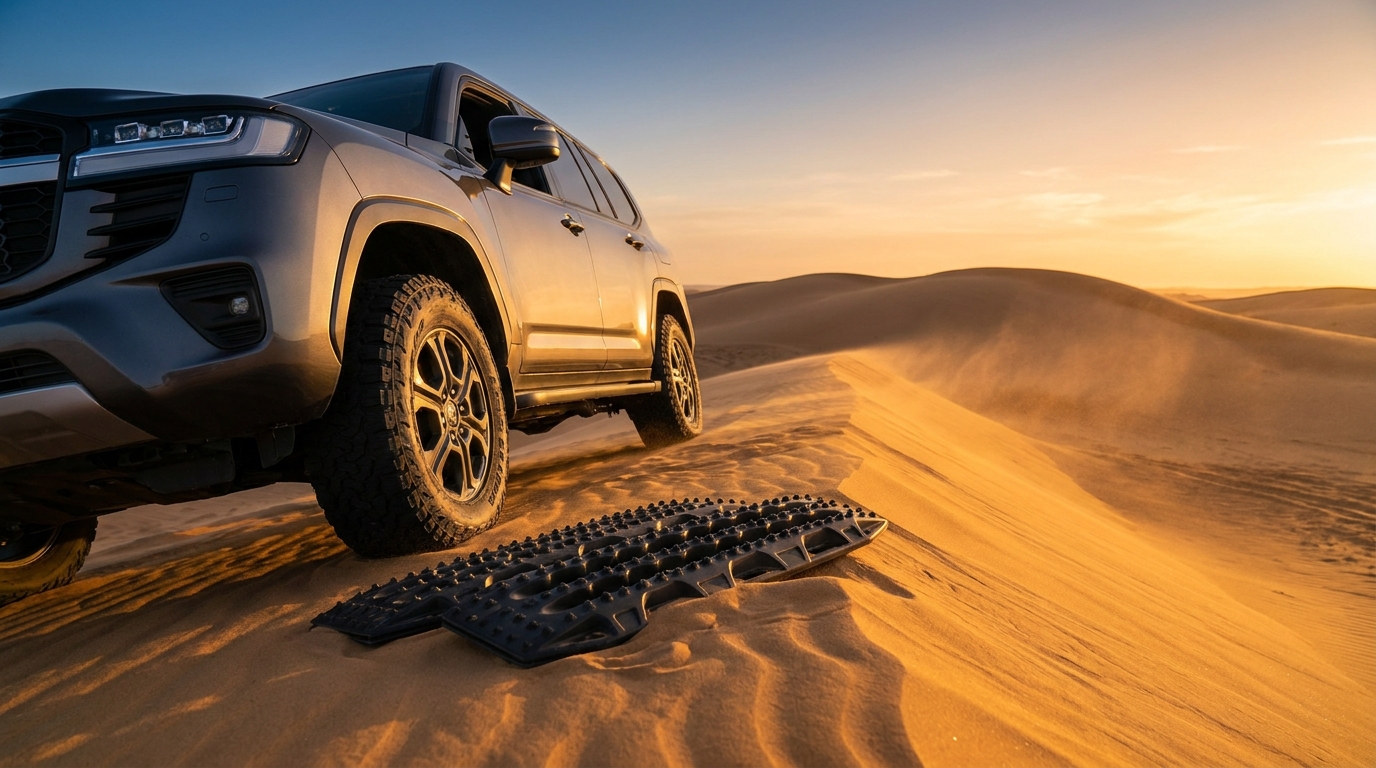
If you search for “sandlader”, you are most likely looking for a sand ladder, a simple tool that helps a stuck vehicle get a grip on soft ground. People also call it a sand track, a recovery board, a traction board or a traction mat. The names differ, but the job is the same: to give your tyres something firm to hold on to when the ground beneath them has turned loose. This guide explains how a sandlader works, which types exist, how to use one properly, and what to check before you buy.
What Is a Sandlader?
A sandlader is a flat, rigid panel that you place under or in front of a stuck tyre. Its surface is covered with holes, ridges, knobs or lugs, so the tyre can bite into it instead of spinning in loose sand. The panel also spreads the weight of the vehicle over a wider area, which stops the wheel from sinking deeper. Once the tyre grips, the vehicle can climb out of its rut and roll onto firmer ground.
The idea is not new. After the Second World War, aluminium sand ladders became the most common type of vehicle recovery aid, mainly because aluminium is both strong and light. These early ladders were often perforated with holes, and the tyres could catch on the edges of those holes. They worked well enough to stay popular for decades, and the name “sand ladder” has stuck even though many modern products no longer look like ladders at all.
Why Vehicles Get Stuck in Sand

Understanding the problem makes it easier to use the tool well. In most cases a vehicle becomes stuck because the tyres dig in until the underside of the vehicle rests on the sand. At that point the weight is no longer carried by the tyres, so they spin freely and find no traction. Spinning faster only digs a deeper hole.
A sand ladder fixes this in two ways. It gives the tyre a surface with real grip, and it lifts the wheel slightly so the vehicle can move forward instead of down. That is why the technique of placing the board partly under the tyre matters so much, and why the digging step before it should never be skipped.
The Main Types of Sand Ladders
The market today offers several materials and designs, and each one suits a different driver.
Aluminium sand ladders are the traditional choice. They are light for their strength and easy to store, and the perforated surface gives the tyre edges to grip. Their weaknesses are well known, though. They can be bulky and stiff, and a smooth or wet surface may offer less grip than a lugged board, especially in mud.
Plastic recovery boards are now the most common type. They usually have a pattern of knobs or ridges that lock into the tyre tread, and many include built-in handles so you can also use them as a small shovel. Well-known brands in this group include MaxTrax, TRED and Exitrax. Different makers use different plastic blends, and some boards flex slightly so they keep contact with the tyre while the vehicle moves over them. One maker recommends its boards for vehicles up to 3.5 tonnes, so always check the weight rating of any set you consider.
Roll-up mats, made from fabric, rubber or similar materials, are the third group. They pack down small and suit drivers with limited storage space. Some of these mats work best on soft surfaces such as sand, mud and snow, and they usually cannot double as a bridge or ramp unless you pack firm support underneath them.
How to Use a Sandlader Step by Step

Using a sand ladder correctly takes only a few minutes, and the order of the steps matters.
Start by lowering your tyre pressure if you have not already done so. Softer tyres have a bigger contact patch, which spreads the vehicle’s weight and also helps the tyre grip the board. Use a proper tyre deflator and follow the guidance for your vehicle and tyres, and remember to pump the tyres back up once you reach firm, sealed road.
Next, clear the way. Dig out the sand in front of each tyre with a long-handled shovel, or use the edge of the board itself if it is made for digging. In sand, digging is easy, so do not hold back. Your goal is a gentle ramp running from the bottom of the tyre up to the surface, so the board can slide well underneath the wheel.
Then push the angled end of the board as far under the tyre as it will go, with the grip surface facing up. If you have only two boards, put them under the driven wheels at the end of the vehicle that is doing the pulling. With four boards, use all of them, since more grip makes the job easier. If the board sags or sits at a poor angle, pack some sand underneath it for support.
Now drive off slowly. Select a low gear, ideally low-range first gear if your vehicle has it, and apply steady, gentle throttle. As the tyre takes hold, it will drag the board down into the sand while the vehicle rises and moves forward. Heavy throttle and wheel spin are the biggest mistakes here, because they can damage both your tyres and your boards. If the vehicle does not climb out straight away, the ramp may be too steep or the board may not be far enough under the tyre, so stop, adjust and try again.
Finally, once you are on firm ground, stop and collect your boards. Shake off the sand and mud, check for cracks or bends, and strap them securely to the vehicle. A tie or leash connected to each board makes retrieval much easier, because the tyres often bury the boards as you drive away.
Common Mistakes to Avoid
Most failed recoveries come from a short list of errors. Drivers try to use the boards without digging first, so the underside stays on the sand and the tyres never reach the board. Others keep their boards packed away where they cannot reach them quickly, or leave them unlocked on a roof rack where they can be stolen or lost. Some forget to collect the boards before driving off, and some spin the wheels so hard that the board shoots out or breaks. Planning ahead for each of these takes very little effort and saves a lot of frustration.
Where Sand Ladders Work Best, and Where They Do Not
Sand ladders are made for soft surfaces such as sand, mud and snow. A beach, a dune track or a muddy farm lane is the kind of place where they shine. They are not meant for every job, however. Several manufacturers state that their boards should not be used as bridges or ramps over gaps, because the material is not designed to carry weight without full ground support underneath. Some also warn against using plastic boards on hard, stony ground or in extreme cold, since the plastic can be damaged. Read the manual of your specific product, because limits differ from one brand to another.
How to Choose the Right Sandlader
Before you buy, think about how you will use the set. A driver who only visits the beach a few times a year has different needs from someone crossing remote desert tracks. The following points help you decide.
Check the weight rating first, and make sure it covers your fully loaded vehicle, including passengers, fuel and camping gear. Next, look at the grip design. Lugs, knobs and deep ridges tend to hold tyres better than a smooth surface, especially when the ground is wet. Consider storage as well, since solid boards need a roof rack or rear mount while roll-up mats fit inside a bag. Finally, look at the extras, such as handles that double as digging tools, mounting brackets that lock to the vehicle, and carry bags that keep the dirt out of your car.
Price is another factor, and it varies widely between simple aluminium sets and branded plastic boards. A lower price can be fine for occasional use, but remember that the boards are a safety item. If you regularly drive in remote areas, a stronger and better-tested set is usually worth the extra cost.
Care and Storage
A good set of sand ladders can last for many trips if you look after it. Wash off mud and sand after each use, and let the boards dry before packing them away. Inspect them for cracks, bent edges or broken lugs, because a damaged board can fail at the worst moment. Keep plastic boards away from long periods of intense heat when you can, and store them where they will not be crushed under heavy gear. Take care of the mounting brackets and locks too, since a loose board can fall off during a bumpy drive.
Other Meanings of “Sandlader”
In German, “Sandlader” also means a sand loader. In online shops the word most often refers to a toy sand-loading vehicle for young children, and collectors also search for vintage toy models of this kind. Because of that, some search results for this word show toys rather than off-road gear. If you landed here while looking for a toy, this guide is about the real-world recovery tool instead.
Final Thoughts
A sandlader is a small and simple tool, yet it can turn a stressful breakdown into a ten-minute job. It works by giving your tyres grip and spreading your vehicle’s weight, and it works best when you pair it with lower tyre pressure, a good shovel and slow, steady driving. Whether you choose a classic aluminium ladder, a modern plastic recovery board or a flexible mat, pick a set that matches your vehicle’s weight and the terrain you drive on, and learn how to use it before you really need it. A short practice session on safe, open sand is the best preparation you can give yourself.
Disclaimer: This article is for general information only and does not replace the advice of vehicle manufacturers, equipment makers or trained off-road instructors. Off-road driving and vehicle recovery carry real risks, including injury and vehicle damage. Always read the instructions and weight ratings that come with your equipment, follow local rules about where you may drive, and seek professional help if you are unsure or if a situation feels unsafe.
Explore More
Fivebpeol Meaning: What the Term Really Is and Why Online Definitions Disagree

I’m Muhammad Ubaid, founder of YBR Magazine. I research and write detailed guides on America’s National Parks — covering entry fees, permits, best times to visit, and planning tips — using official NPS sources and up-to-date information.