


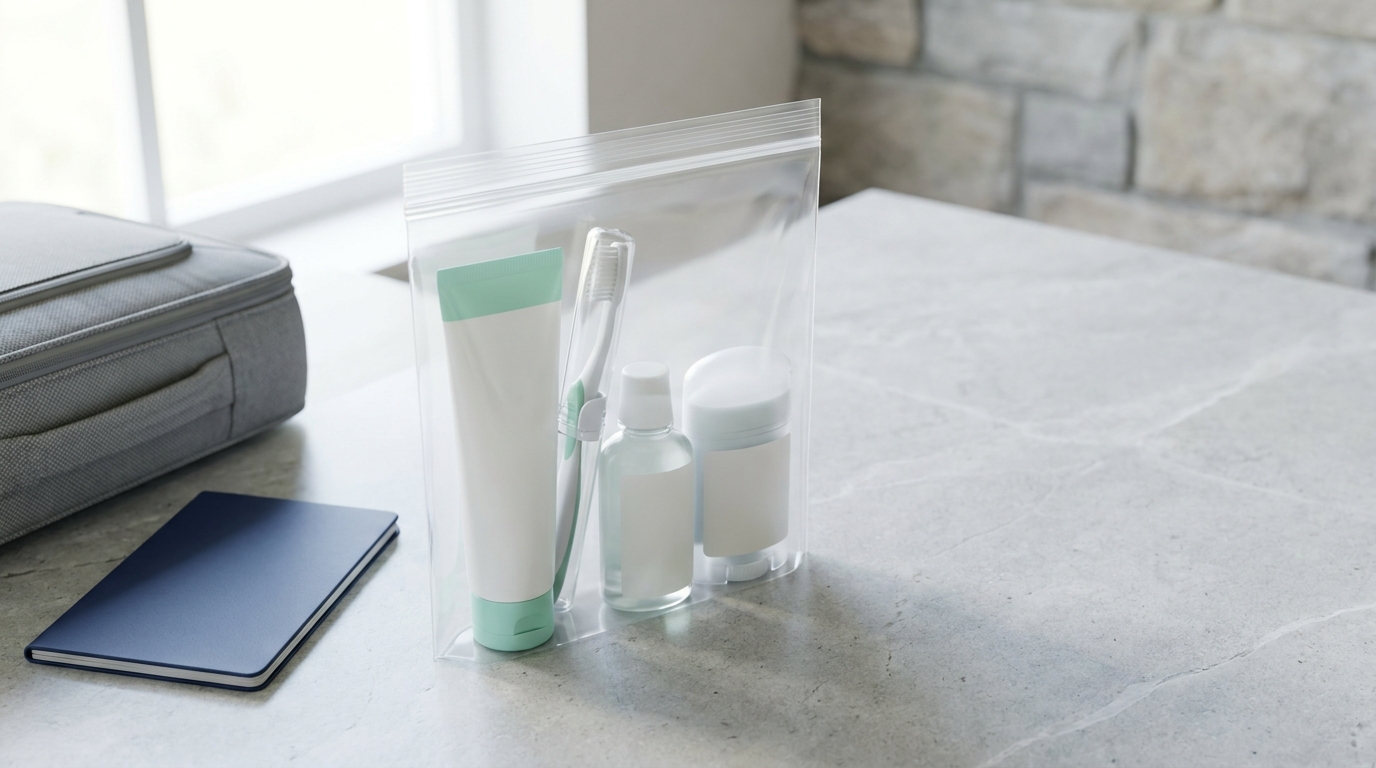
Almost every traveler pauses at some point to ask, can you bring toothpaste on a plane? The short answer is yes, but the size of the tube decides where it is allowed to go. In the United States, the Transportation Security Administration (TSA) treats toothpaste as a paste, which places it under the same liquids rules as shampoo and lotion, so a full-size tube that is perfectly fine in a checked suitcase can be thrown away at the security checkpoint. This guide explains the rule, the common exceptions, and what changes when you fly outside the US.
Quick Facts: Toothpaste and Air Travel
| Question | Answer |
|---|---|
| Allowed in a carry-on bag? | Yes, in containers of 3.4 oz (100 ml) or less |
| Allowed in a checked bag? | Yes, with no size limit under TSA guidance |
| Bag requirement for carry-on | One quart-sized clear bag per passenger for all liquids, gels, and pastes |
| Solid options (tablets, powder) | Not treated as liquids, so the size rule does not apply |
| Rules outside the US | Often 100 ml as well, but some airports with newer scanners allow more |
Why Toothpaste Counts as a Liquid at Security
The TSA’s public guidance describes the 3-1-1 rule: containers of 3.4 ounces (100 milliliters) or less, all placed in one quart-sized clear bag, with one bag allowed per passenger. The rule is written to cover liquids, gels, aerosols, creams, and pastes, and toothpaste sits in the last two groups because it can be squeezed and spread. That is why it is handled the same way as deodorant, sunscreen, and mouthwash.
Many pages that rank for this topic copy each other’s wording, and a few mix in made-up stories or unsourced estimates. The core rule is consistent across the reliable ones, and it matches what the TSA publishes, so it is the part you can trust. Where the pages disagree, mostly about individual airports outside the US, this article says so.
Can You Bring Toothpaste on a Plane in a Carry-On?

Yes, as long as the tube or bottle is labeled 3.4 oz (100 ml) or smaller and fits inside your clear liquids bag. A typical retail tube is often around 6 ounces, according to several travel guides, which is why a regular family-size tube usually fails the check. Travel-size tubes are sold in most pharmacies and supermarkets and fit comfortably within the limit.
The limit applies to the size of the container and not to how much paste is left inside. Travel publications that cover TSA rules point out that a large tube you have squeezed or rolled up is still a large container, so officers can still ask you to discard it. An unopened tube gets the same treatment, because sealing it does not change its size.
At the checkpoint you may be asked to take the liquids bag out of your carry-on so it can be screened separately. Keeping it near the top of your bag makes this quick, and it spares you from digging through your things while a line forms behind you.
Can You Bring Toothpaste on a Plane in Checked Luggage?

Checked bags are the easiest place for a full-size tube, because the TSA’s liquid limit applies to carry-on items rather than to checked baggage. You can pack your usual brand without worrying about the ounce count.
The main risk is leakage rather than rules. Pressure changes in the cargo hold can push paste out of a loosely capped tube, so closing the cap firmly and sealing the tube in a zip-top bag protects your clothes. Checked bags can also be delayed or lost, so many travelers keep one small tube in their carry-on as a backup for the first night.
What Happens if Your Tube Is Too Big
Officers will generally ask you to throw an oversized tube away before you continue, since it cannot go through the checkpoint in a carry-on. If you realize the problem before screening and have time, you can sometimes return to the airline counter and move it into a checked bag, although this depends on the airline and how close you are to departure. Another option is to buy a small tube after you clear security, which is convenient but often more expensive than a pharmacy.
The most reliable fix is to avoid the problem altogether by transferring paste from your full-size tube into a small reusable travel container before you leave home. Any container you fill must itself be 3.4 oz or smaller, and it goes in the clear bag like any other travel-size item.
Alternatives to Regular Toothpaste
Toothpaste tablets, tooth powder, and similar solid products are not liquids or pastes, so the 3-1-1 rule does not apply to them. Travel guides commonly recommend tablets for people who want to skip the liquids bag entirely, and they are light and leak-free. They do work differently, since you chew the tablet and then brush with a little water, so it is worth trying one at home first.
Can You Bring Toothpaste on a Plane if It Is a Prescription Formula?
The TSA publicly states that medically necessary liquids, gels, and pastes are allowed in reasonable quantities above 3.4 ounces, and travelers should tell the officer about them at the start of screening. Some travel blogs describe prescription toothpaste as a clear exception, but a blanket rule for it is not publicly confirmed, and the final decision rests with the officer. Carrying your prescription label or a doctor’s note can make the conversation smoother, and a checked bag remains the safest choice if you are unsure.
Can You Bring Toothpaste on a Plane to Another Country?
Rules outside the US are less uniform. Many countries still limit carry-on containers to 100 ml, which matches the US limit in practice. The complication is a newer type of CT scanner that can allow containers of up to two liters, and where it is in use, some passengers no longer need to remove liquids from their bags.
Online reports about which airports have made this change do not agree with each other. Travel outlets in 2026 report that London Heathrow lifted its 100 ml limit in early 2026, while their lists for other UK airports such as Manchester, Bristol, and Stansted contradict each other. Reporting on the EU adds another layer: according to coverage of European Commission decisions, the 100 ml cap was reinstated in September 2024 for technical reasons, and adoption of the newer scanners since then has been uneven, with some airports allowing larger liquids only in certain lanes. Because of this, the exact status of any given airport is not reliably confirmed by these secondary sources, and the airport’s own website is the only dependable check.
In the US, the TSA continues to apply its 3-1-1 rule at checkpoints, and a trip with a connection can pass through more than one set of rules. The safest plan for any international itinerary is to pack toothpaste in containers of 100 ml or less in a clear bag, and then enjoy a larger allowance as a bonus if your airport turns out to offer one.
Quick Packing Tips
- Pack a small tube you can finish on the trip, or buy toothpaste at your destination to save space.
- Keep the clear bag sealed and easy to reach, with the cap on every tube tightened.
- Remember that mouthwash follows the same liquid limits, so decant it into a small bottle as well.
Frequently Asked Questions
Is there a limit on how many travel-size tubes I can carry?
The TSA’s public guidance sets no separate cap on the number of tubes. The practical limit is that everything must fit in one quart-sized bag, and officers have the final say at the checkpoint.
Can you bring toothpaste on a plane if you have TSA PreCheck?
Yes, and the size rule still applies. PreCheck passengers can generally leave their liquids bag inside the carry-on, although an officer may still ask to inspect it.
Can you bring toothpaste on a plane in a refillable travel bottle?
Yes, provided the bottle holds 3.4 oz or less and goes in the clear bag. Labeling it can help the officer recognize what it is.
Does mouthwash follow the same rule as toothpaste?
Yes, because mouthwash is a liquid. It must be in a container of 3.4 oz or less in a carry-on, or it can go in checked luggage in any size.
Do airlines set their own toothpaste rules?
Liquid limits come from security regulators rather than airlines. Airlines mainly affect your baggage size and weight, so check your airline’s checked-bag allowance if you are adding bottles.
Conclusion
So, can you bring toothpaste on a plane? Yes: travel-size tubes of 3.4 oz or less go in your carry-on, full-size tubes go in checked luggage, and solid tablets avoid the issue entirely. For flights from or through other countries, a quick look at your airport’s official website is the best way to confirm the current liquid limits.
Disclaimer: Airport security rules can change and may be applied differently by individual officers and airports. This article is general information based on public guidance and reports available in October 2026, so please check the TSA, your airline, and your departure airport’s official pages before you travel.
Explore More
Embassy Suites Panama City Beach: Suites, Fees, Location and What to Expect

I’m Muhammad Ubaid, founder of YBR Magazine. I research and write detailed guides on America’s National Parks — covering entry fees, permits, best times to visit, and planning tips — using official NPS sources and up-to-date information.

