


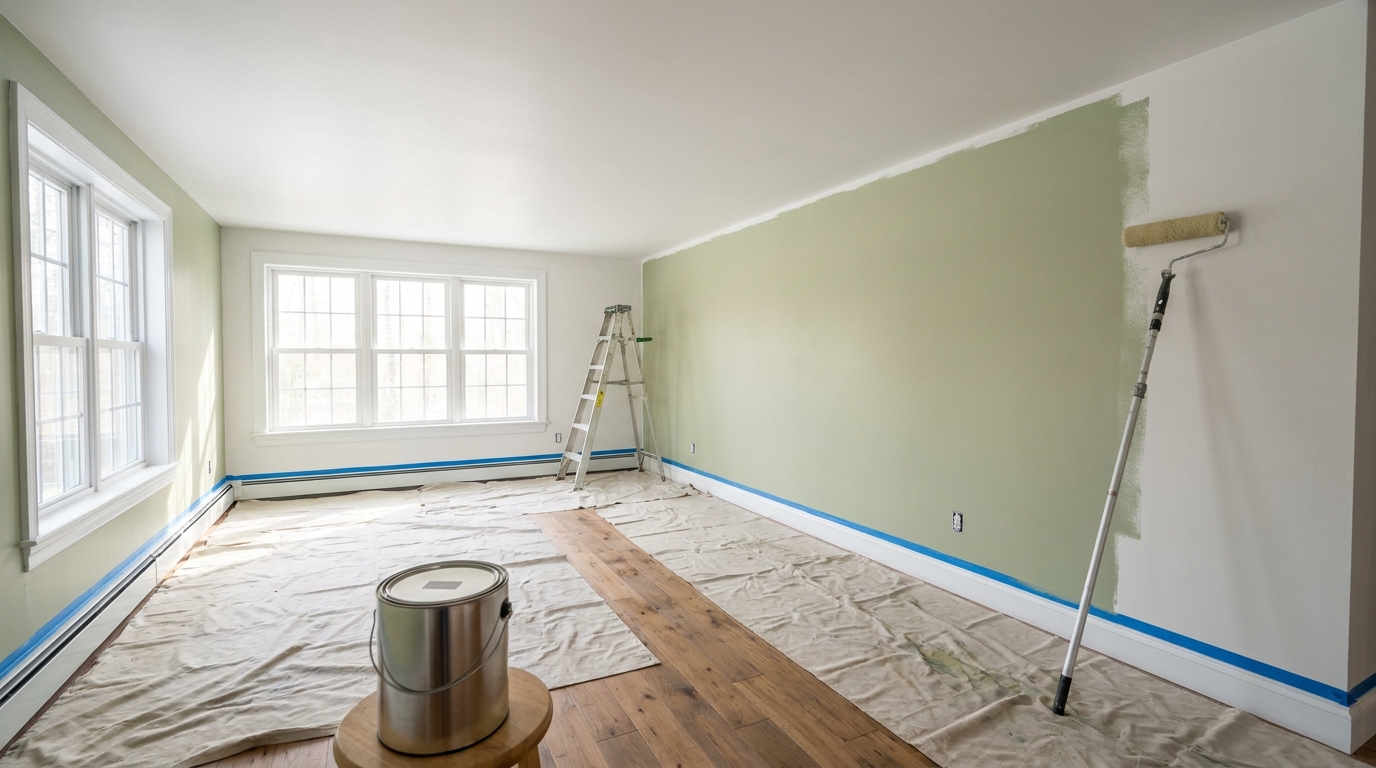
Searching for home wall and ceiling painting Farmington can be less simple than it looks, because many American communities share the name. Contractor listings that appear for this search cover places called Farmington in New Mexico, Minnesota, Utah, Connecticut, Michigan, Georgia and Arkansas, and the separate city of Farmington Hills, Michigan, also shows up. This guide therefore focuses on what stays true wherever you live: realistic costs, safety checks for older houses, the right order of work, and how to hire a painter. Where a rule or price depends on your state or town, the article says so instead of guessing.
The pages that rank for this search are mostly contractor websites and lead-generation directories such as Thumbtack and HomeAdvisor. They are handy for finding painters, but they say very little about lead paint, asbestos in textured ceilings, or why two quotes for the same house can differ so much. One result was a machine-garbled “best painting company” article with placeholder company names and a made-up comparison table, so it should not be trusted for recommendations.
Quick Facts
| Topic | What is publicly confirmed | Notes |
|---|---|---|
| Which Farmington? | Several US places share the name | Confirm your state before relying on any local rule or price. |
| Local price data | No reliable Farmington-specific average was found | National figures are used below as a starting point only. |
| Small job time | A small bedroom or one or two walls can take about half a day, according to Thumbtack | Larger homes take longer. |
| Contractor licensing | Rules differ by state and sometimes by city | Not confirmed as a single standard for every Farmington. |
Home Wall and Ceiling Painting Farmington Costs: What National Data Shows

No trustworthy source publishes one average price for a specific Farmington, so national guides are the best available benchmark. NerdWallet puts interior painting at roughly $2 to $6 per square foot, or about $2,000 to $6,000 for every 1,000 square feet of living space, and notes that accent walls, trim and ceilings may cost extra beyond a basic wall-only quote. Thumbtack, using data from the estimating company Xactware, reports a higher whole-home range of about $3.86 to $6.45 per square foot for a 1,400 square foot home, which shows how much the result depends on what a quote includes.
Ceiling prices are where published guides disagree most. A TaskRabbit cost guide lists ceilings at $1 to $2 per square foot in one place and $1 to $3 in another, and it adds that rooms with ceilings above 10 feet can cost 20 to 40 percent more overall. Another guide says walls taller than 10 feet add roughly $0.75 to $1.25 per square foot. These differences come from different assumptions, so it is wise to treat any single number as a rough guide rather than a promise.
Paint itself is a smaller part of the bill than many people expect. Thumbtack says a gallon can cost anywhere from about $20 to more than $100 depending on brand and quality, while labor and prep make up most of a professional quote. Be careful with the many near-identical “2026 cost guide” pages from small or unknown sites, which repeat templated ranges with no stated method and often contradict each other. Asking for an itemized quote that lists walls, ceilings, trim, repairs and the number of coats is a far better way to compare real offers.
Safety Checks Before Painting an Older House

Lead paint in homes built before 1978
If your home was built before 1978, federal rules matter. The Environmental Protection Agency requires firms that are paid to disturb painted surfaces in pre-1978 homes, child care facilities and schools to be lead-safe certified and to use trained renovators. This applies to every paid firm, including sole proprietors, and it has been in force since April 22, 2010. Trade coverage of the rule says it is generally triggered when more than six square feet of paint is disturbed in a room, which can happen quickly when sanding or scraping a wall. The EPA also says the rule generally does not cover homeowners working on their own houses, although it still recommends lead-safe practices for them.
How common lead paint is depends on which EPA page you read. One EPA guide says about half of pre-1978 homes contain it, while another page says roughly three-quarters, so the exact share is not settled in the agency’s own public messaging. The same guide does agree that the likelihood rises with age, with about two in three homes from 1940 to 1960 and about nine in ten homes from before 1940 affected. Some states run their own versions of the program, so check with your state environmental or health agency if you are unsure.
Asbestos in popcorn and textured ceilings
Sprayed “popcorn” ceilings are common in houses from the 1950s through the 1980s, and many installed before the early 1980s contain asbestos. You cannot tell by looking, so most guides advise treating an older textured ceiling as suspect until a lab test says otherwise. The cutoff year is not consistent online: Angi says the EPA banned this use in 1973 but that leftover stock stayed in use for years, and other guides say homes from the 1980s are uncertain, so a house from that decade is worth testing too. Because taking a sample disturbs the material, an inspector or lab-guided method is safer than scraping a piece off yourself.
Advice on painting over a suspect ceiling is also mixed. The Consumer Product Safety Commission, as cited by several guides, says asbestos material in good condition is best left alone, and one older real-estate article argues that paint seals the texture in. A regional clean-air agency, however, warns that paint can make the texture harder to wet, which complicates safe removal later. If the test is positive, hire a licensed abatement professional rather than scraping it yourself.
Preparing Walls and Ceilings Properly
For home wall and ceiling painting Farmington homeowners handle themselves, preparation takes up a large share of the effort. Thumbtack advises washing walls first in most cases, since dirt and grime can stop primer and paint from sticking, and a wall washer helps with hard-to-reach areas near the ceiling. After washing, fill holes and cracks, sand the patches smooth, and spot-prime them so they do not show through as dull spots in the finished coat.
Primer is worth using on new drywall, stained areas, and any job that goes from a dark color to a light one, according to Home Depot’s project guidance. Many brands sell paint and primer in one product, although stains and heavy color changes still tend to do better with a dedicated primer. Cover floors and furniture, tape the tops of walls if you are painting the ceiling first, and remove or mask light fixtures and vents.
Painting Order and Technique
Most home-improvement guides, including Home Depot and Sherwin-Williams, recommend working from the top down: ceiling first, then walls, then trim. The main reasons are that drips and spatter fall onto surfaces that are still unfinished, and it is easier to cut in wall paint along a fresh ceiling than the other way around. A few professionals and one popular home-improvement guide do the trim first because tape is easier to place on trim than on freshly painted walls, so both sequences are used in practice. Whichever you choose, let trim dry for at least 24 hours before taping over it.
On both ceilings and walls, the usual technique is to brush a band about two to three inches wide along the edges and corners, then roll the larger area while that band is still wet. Keeping a wet edge, which means overlapping each new stroke onto paint that has not dried, prevents visible lap marks. Home Depot suggests rolling ceilings in diagonal strokes from the edge toward the middle of the room, and many guides suggest a W-shaped pattern to spread paint before filling it in. If the ceiling and walls are the same color, the junction can be cut in like any other corner, though Home Depot recommends testing the color first.
How Long the Work Takes
Time needed for home wall and ceiling painting Farmington projects depends mostly on room size, wall condition and the number of coats. Beyond the half-day estimate for a small room, one beginner-oriented guide estimates around 12 working hours spread over two days for a standard bedroom, which is a single source and not a rule. Drying time adds to the schedule, since most paints need a full day before a second coat or before furniture goes back against the walls. First coats often look patchy and thin, and a second coat is normal rather than a sign that something went wrong.
Cold-weather towns should read the paint label, which lists the lowest recommended application temperature, and keep the room heated. No Farmington-specific guidance on seasonal timing was found, so the label is the best authority.
Hiring a Painter for Home Wall and Ceiling Painting Farmington Projects
Start by getting at least two written estimates, and compare what each one covers instead of only the total. A clear estimate should name the surfaces, the prep work, the paint brand and finish, and the number of coats. This Old House notes that many experienced painters also handle drywall and plaster repair, crown molding and popcorn ceiling removal, which are worth asking about if your ceilings need more than a fresh coat.
For pre-1978 homes, ask directly whether the firm is EPA lead-safe certified and what methods it will use to contain dust. A Loyola University health-law guide also suggests asking for references from at least three recent jobs on similar older houses and speaking to those customers yourself. Local licensing and insurance rules differ from state to state, so check with your state or city office instead of relying on a directory badge. Badges such as “background checked” are set by each platform, and what they cover varies, so confirm licensing and insurance directly.
Finally, coordinate the practical details ahead of time. One contractor directory notes that painters can often help with moving furniture and minor repairs, but arranging that in advance saves time and avoids surprises on the day.
FAQ
Can I paint the walls and ceiling the same color?
Yes, it is acceptable, and some people like how it makes a room feel. Home Depot suggests testing a small area first, because the same paint can look different overhead under different light.
How many coats will I need?
Most walls need two coats, and the first coat usually looks uneven. Hometips notes that a good-quality primer can sometimes reduce this to a single coat of paint.
Can I paint over water stains?
Not directly. Home Depot warns that mildew and water stains can bleed through even good paint, so a stain-blocking primer is needed, and the leak that caused the stain should be fixed first.
Do I need a license to paint houses in Farmington?
It depends on your state and sometimes your city, and no single rule was confirmed for every Farmington. Contact your state contractor board or local building office to check.
Is it safe to paint in winter?
Interior painting can be done in cold months if the room is kept within the temperature range printed on the paint can. Ventilation still matters, so open windows briefly or run fans when practical.
Should I move the furniture myself?
You can, and it reduces the quote or visit time. If you prefer not to, ask the painter in advance whether moving furniture is included or billed separately.
Conclusion
Good results from home wall and ceiling painting Farmington residents can be proud of come down to three things: checking the age of the house before disturbing anything, preparing surfaces carefully, and comparing itemized quotes from properly certified painters. National cost data gives a useful starting range, but only written local estimates will tell you what your own house will cost.
Disclaimer: This article is for general information only and is not professional, legal, health or safety advice. Prices, licensing rules and lead or asbestos regulations vary by location and change over time, so confirm details with your state or local authorities, a certified contractor, or an accredited inspector before starting work. Always follow the paint manufacturer’s instructions and safety labels.
Explore More
Kitchen Remodeling Contractor Davenport FL: How to Vet, Budget, and Hire With Confidence

I’m Muhammad Ubaid, founder of YBR Magazine. I research and write detailed guides on America’s National Parks — covering entry fees, permits, best times to visit, and planning tips — using official NPS sources and up-to-date information.

