


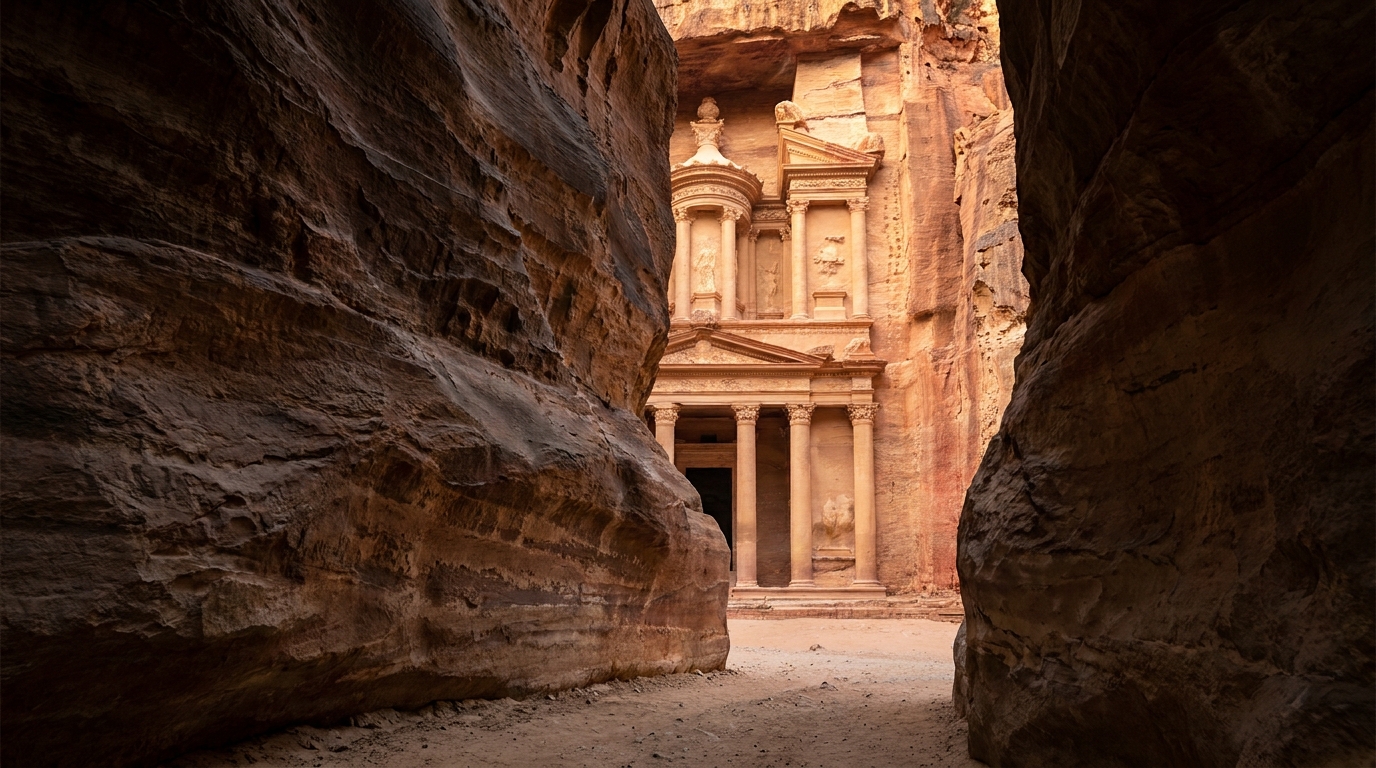
Jordan is a small country, but the list of things to do in Jordan is long enough to fill a week or two without feeling repetitive. Within a few hours’ drive of each other, you can walk into a city carved from rose-coloured rock, float on the lowest land surface on Earth, ride a jeep through a red desert, and wander along the columned streets of one of the best-preserved Roman cities outside Italy.
Many ranking guides repeat the same short lists, and some still carry outdated details, such as old Petra by Night prices or no mention of the current travel advisories. This guide checks those points against official tourism pages and flags the places where sources disagree, so you can plan with a clearer picture.
Quick Facts Before You Plan
| Topic | What to know |
|---|---|
| Capital and main airport city | Amman |
| Currency | Jordanian dinar (written JD or JOD) |
| Best seasons for most visitors | March to May and September to November |
| Classic first-timer route | Amman, Jerash, Dead Sea, Petra, Wadi Rum, Aqaba |
| Suggested trip length | About one week to see the main sites without rushing (a planning suggestion, not an official figure) |
| Entry | Visa on arrival, or the Jordan Pass bought online in advance |
| Biggest planning caveat | The U.S. State Department rates Jordan at “Reconsider travel,” so check current advice before booking |
Petra and Little Petra: The Headline Attraction
Petra is the reason many people book a flight, and it deserves a full day at minimum. The Nabataeans carved the city into sandstone more than two thousand years ago, and the approach is part of the drama: you walk through the Siq, a narrow gorge more than a kilometre long, until the Treasury appears in a gap between the cliffs. Beyond it, the trail continues past the Street of Facades and the Royal Tombs, and a longer climb of several hundred rock-cut steps leads to the Monastery, which many visitors find quieter and more impressive than the Treasury.
According to the official Jordan Tourism Board, visitors who stay overnight in Jordan pay 50 JD for a one-day Petra ticket, 55 JD for two days and 60 JD for three days, and multi-day tickets must be used on consecutive days. A different rate applies to people who do not stay overnight in Jordan, so day-trippers should check the current price table before they travel. Little Petra, a smaller Nabataean site a short drive to the north, makes a relaxed add-on if you have the time.
Petra by Night is the part of the trip where online information conflicts the most. Older blogs describe a Monday, Wednesday and Thursday show costing about 17 JD, but the official Visit Petra website now lists the evening experience on Sunday to Thursday nights, from 8:30 PM to about 10:30 PM, at 30 JD per person. The Jordan Tourism Board also says the show was reimagined in 2025 with projection mapping and narration added to the candlelit walk. A daytime Petra ticket or a Jordan Pass is required to buy the night ticket, so confirm the schedule and price at the Visitor Centre on the day.
Wadi Rum: Jeep Tours, Camps and Desert Skies

Wadi Rum is a protected desert landscape of sandstone mountains, rock bridges and wide sandy valleys, and it holds UNESCO World Heritage status. Most visitors explore it by jeep with a Bedouin driver, and the choices range from a short highlights loop to a full-day route with lunch. Camel rides, short hikes and sunset viewpoints are common additions, and many people stay overnight in a camp to see the night sky, which can be extraordinarily clear. Some camps now offer dome-shaped “bubble” tents for a more private stay.
The protected area charges an entrance fee at the Visitor Centre, which sits about 6 km before Wadi Rum Village. Listings disagree on the amount, with some quoting 5 JD and others 7 JD per person, while the fee is waived for Jordan Pass holders. Jeep tour prices vary widely with length, group size and the camp you book through, so compare a few options and confirm what is included before you agree. Desert nights get cold from autumn to early spring, and mobile signal drops in remote valleys, so pack warm layers and download offline maps.
The Dead Sea and Wadi Mujib
The Dead Sea shoreline is the lowest land elevation on Earth, at roughly 430 metres below sea level. Published figures range from about 420 to 440 metres because the water level keeps falling, by around one metre a year according to several sources. The water is about nine to ten times saltier than the ocean, which is why you float without effort. Plan on short dips, avoid shaving beforehand, keep the water out of your eyes, and skip the swim altogether if you have fresh cuts. Resorts and public beaches line the Jordanian shore, and it is roughly an hour from Amman.
Wadi Mujib, a canyon reserve that drains into the Dead Sea, offers one of the more adventurous things to do in Jordan. The Siq Trail is a self-guided wet walk through a narrow gorge that ends at a waterfall, and the reserve’s operator lists it as a two-to-three-hour route. It is typically open from 1 April to 31 October and closes in the wet season because of flash-flood risk, even on some days within the season. In the cooler months, the guided Ibex Trail is the usual alternative. Wadi Mujib is not covered by the Jordan Pass, and guides quote the Siq Trail fee at about 21 to 23 JD, so treat the exact amount as something to confirm on site. Water shoes are useful, and swimwear is accepted on this trail even though modest dress is advised elsewhere.
Amman, Jerash and the North

Amman is often treated as a landing pad, but a day or two here is worthwhile. The Citadel hill holds the Temple of Hercules and other ruins with wide views over the city, the Roman Theatre sits downtown, and Rainbow Street is a popular place for cafés and an evening stroll. Food is a highlight in its own right, from hummus, falafel and knafeh to mansaf, the lamb-and-yogurt dish widely regarded as Jordan’s national meal.
Jerash, about an hour’s drive north of the capital, is the best-known Roman site in the country. You enter beneath Hadrian’s Arch, which was built to honour the emperor’s visit in 129 CE, then pass the hippodrome, which could hold around 15,000 spectators, before reaching the Oval Plaza and the long colonnaded Cardo. A daily Roman Army and Chariot Experience is staged in the hippodrome and usually costs extra. Entry is quoted at either 10 JD or 12 JD depending on the guide, and it is included in the Jordan Pass, so confirm the current price if you are not buying the pass. Many day tours pair Jerash with Ajloun Castle or the Roman Decapolis ruins at Umm Qais.
Madaba, Mount Nebo and the Baptism Site
South of Amman, the town of Madaba is known for its Byzantine-era mosaic map of the Holy Land, which is displayed inside a church and is listed among the official tourism board’s top experiences. Mount Nebo is nearby and is a popular stop for its views toward the Dead Sea and the Jordan Valley on clear days.
Bethany Beyond the Jordan, near the river, is widely described as the baptism site of Jesus and is a major pilgrimage stop. It is on UNESCO’s World Heritage list, and the three places fit naturally into a single morning on the way to the Dead Sea.
Things to Do in Jordan Outside the Famous Sites
Dana Biosphere Reserve, in the southern highlands, is often described as Jordan’s largest nature reserve. The stone village of Dana sits on a ridge above a deep valley, and the trails drop toward Wadi Feynan, where an ecolodge and ancient copper-mining ruins are the main landmarks. The Jordan Trail organisation says the Dana-to-Petra section has been named by National Geographic as one of the 15 best hikes in the world, which is a claim worth treating as a recommendation rather than a ranking you can verify.
The wider Jordan Trail runs from Umm Qais in the north to Aqaba in the south, and its length is quoted anywhere from about 650 to 675 km depending on the source, with roughly 40 days needed for the full route. You do not need to do all of it, because many operators offer guided sections of three to five days. Karak Castle, a Crusader fortress with underground passageways, is another worthwhile stop on the King’s Highway between the Dead Sea and Petra.
Aqaba and the Red Sea
Aqaba is Jordan’s only coastline, and its warm, clear water suits snorkelling and diving. Reef sites are close to shore, and the desert mountains rising behind the sea give it a different feel from beaches elsewhere. Winter stays mild here, with daytime temperatures commonly around 20°C, while summers are very hot, and several travel guides name September and October as comfortable months for diving. Aqaba works well as the final stop after Wadi Rum.
Jordan Pass and Costs: Is It Worth It?
The Jordan Pass is an official tourist pass that bundles the visa fee waiver with entry to more than 40 sites. It comes in three tiers priced at 70, 75 and 80 JD, and the only difference between them is whether you get one, two or three days at Petra. The standard visa on arrival costs 40 JD, and the fee is waived only if you stay at least three nights in Jordan. For anyone whose things to do in Jordan include Petra, the pass pays for itself on a typical itinerary, because Petra alone is 50 JD for one day, and every other included site is a bonus.
Several limits catch people out. Petra by Night and Wadi Mujib are not included, and the pass is reported to be unavailable at the border or airport, so it needs to be bought online before you fly. It also does not replace the visa itself, only the fee, so you still join the visa queue on arrival and show the pass there.
Best Time to Visit
Spring and autumn are the safest choices for most travellers. Daytime temperatures in these seasons are generally pleasant for walking Petra and exploring Jerash, with spring bringing wildflowers in the hills and autumn being a busy period. Summer can push temperatures toward 40°C in the desert and Dead Sea areas, which makes early starts important, though it also means thinner crowds at Petra.
Winter is the quietest season, and it can be properly cold. Petra and Amman can fall below freezing at night and see occasional snow, while Wadi Rum nights drop to around 4°C according to one travel guide. Aqaba and the Dead Sea stay far milder, so a winter trip can still work if you pack for the highlands and build in flexibility for rain.
Is Jordan Safe Right Now?
Safety is the most important thing to check before booking, because the advice has shifted during 2026. The U.S. State Department lists Jordan at Level 3, “Reconsider travel,” citing terrorism and armed conflict, and its page shows an update dated August 29, 2026. The text has been revised several times this year, and different versions have named different areas to avoid, including border zones with Syria and Iraq in an earlier version and the Rusayfah city area and part of Ayn Basha in the later one. The department also ordered non-emergency government employees to leave on March 2, 2026, and later said family members could rejoin staff in the country.
Other governments have taken varied positions. A report in Jordan News said the United Kingdom updated its guidance to class most of the country as safe for travel, while reports about Canada and Australia describe more cautious wording tied to regional conflict. Some tour company blogs say Jordan is entirely safe, but those pages are selling trips, so it is better to rely on official advisories and check them again shortly before departure. The Independent notes that travelling against official advice can invalidate insurance, so read your policy carefully, and consider flexible bookings for whichever things to do in Jordan you prefer to lock in early.
How to Fit the Best Things to Do in Jordan Into One Week
The route below is a planning suggestion rather than an official itinerary. It keeps driving times reasonable, uses at least three nights for the visa waiver, and takes the Dead Sea road before Petra so that Wadi Rum and Aqaba come last. The drive from Wadi Rum to Petra takes about an hour and a half, which is useful if you want to reverse the order.
| Day | Plan |
|---|---|
| 1 | Arrive in Amman, then Citadel, Roman Theatre and dinner on Rainbow Street |
| 2 | Jerash in the morning, with Ajloun Castle or Umm Qais if time allows |
| 3 | Madaba, Mount Nebo and the Baptism Site, then a Dead Sea afternoon |
| 4 | Wadi Mujib in season, then Karak Castle and the King’s Highway to Wadi Musa |
| 5 | Full day in Petra, with the night show if the schedule suits |
| 6 | Little Petra, then a jeep tour and overnight camp in Wadi Rum |
| 7 | Aqaba for the Red Sea, or return to Amman for departure |
Frequently Asked Questions
How many days do I need for the main sites?
Four days is enough to see Petra, Wadi Rum and the Dead Sea in a rush, but five to seven days allows time for Jerash, Amman and a slower pace, especially because distances are short but roads can be winding.
Do I need a guide at Petra?
A guide is optional, though it adds historical context you will not get from signs. The official tourism board lists guide tickets by trail and duration, with the Main Trail taking about 2.5 hours and costing 50 JD.
Can children visit Petra and the night show?
Yes. Children under 12 enter free during daylight hours, and the night show is free for children under 10, according to the official pages.
What should I wear?
Modest clothing that covers shoulders and knees is recommended in cities and at heritage sites, while swimwear is fine at resort beaches and on the Wadi Mujib Siq Trail. Light layers help, since temperatures change sharply between day and night.
Will my phone work at the main sites?
Coverage is good in cities, but signal can drop deep inside the Siq at Petra and in remote parts of Wadi Rum. Download offline maps and save a screenshot of your Jordan Pass QR code before you go.
Is Aqaba worth adding if I am short on time?
It is worth including if you enjoy snorkelling or diving, since it is the country’s only sea access. If you only want historic and desert highlights, you can skip it without missing a major site.
Conclusion
The most rewarding things to do in Jordan are spread across a compact map, which makes it easy to build a trip that mixes history, desert and water without long travel days. Check the current advisory, book the Jordan Pass before you fly, and leave a little slack in the schedule for weather and seasonal closures.
Disclaimer: This article is for general information only and is not travel, legal, medical or insurance advice. Prices, opening hours, visa rules, trail seasons and government travel advisories change often, and sources do not always agree, so confirm details with official tourism authorities, your government’s travel advice and your insurer before you book or travel.
Explore More
What to Do in Oklahoma City: A Practical Guide to Museums, Districts, Parks and Olympic Venues

I’m Muhammad Ubaid, founder of YBR Magazine. I research and write detailed guides on America’s National Parks — covering entry fees, permits, best times to visit, and planning tips — using official NPS sources and up-to-date information.

