

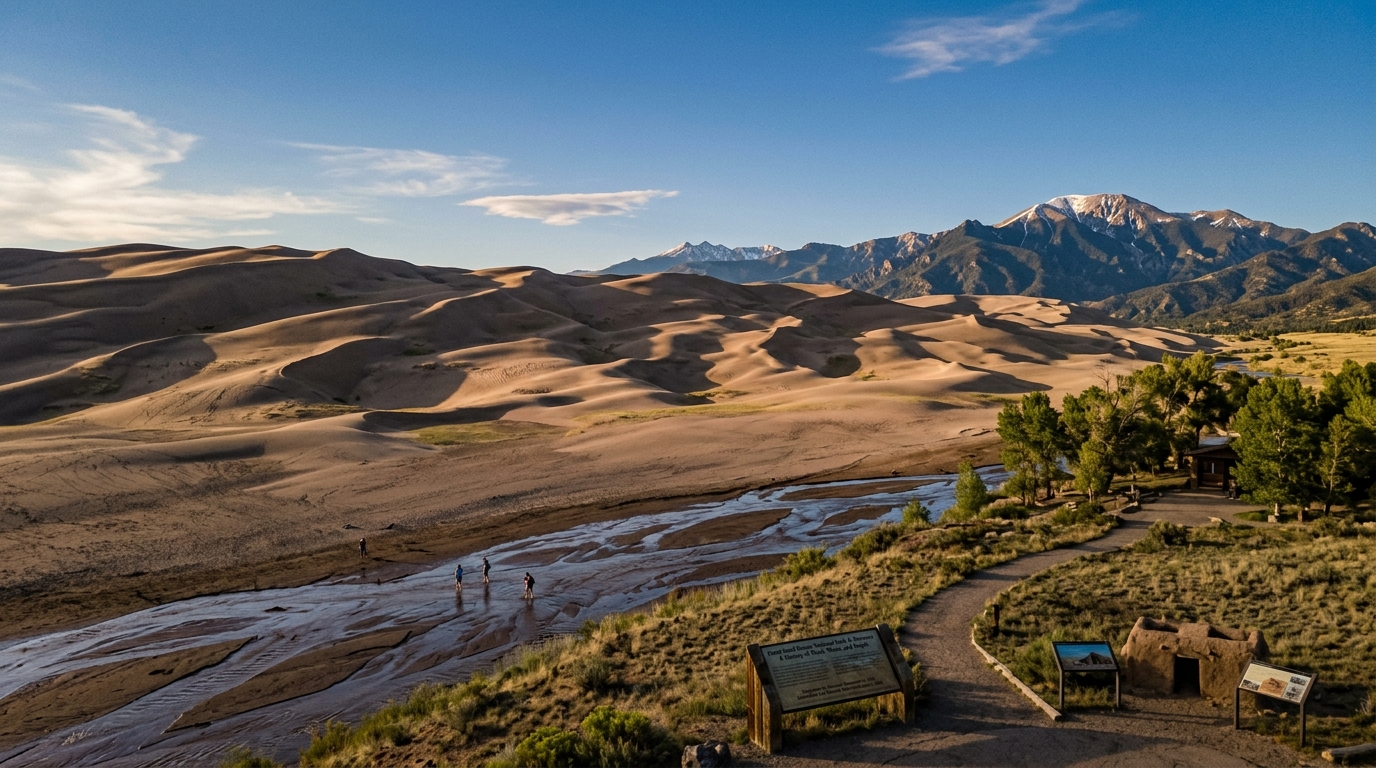
How Ancient Geology Built the Tallest Dunes in North America
Great Sand Dunes National Park History began tens of thousands of years ago when massive lakes and rivers deposited layers of sediment across the open floor of the San Luis Valley.
Strong southwesterly winds picked up the loose sand grains and blew them steadily toward the crook of the towering Sangre de Cristo Mountains. Because the high mountain barrier trapped the wind currents, the air dropped its heavy load of sand in one specific corner of the valley. A unique hydrological loop involving Medano Creek and surrounding streams helps wash stray sand grains back toward the main dune field after heavy storms. This continuous cycle of wind and water prevents the landscape from blowing away permanently, keeping Great Sand Dunes National Park a dynamic, living geological system rather than a static pile of earth.
For travelers planning a trip to experience these shifting sands firsthand, looking into nearby regional accommodations can help ground the journey, and you can learn more about local options by reading our guide on where to stay near Great Sand Dunes National Park to find suitable valley stays and remote desert realities.
Centuries of Indigenous Life in the Valley Shadow
Native American tribes inhabited the San Luis Valley for millennia before European explorers ever set foot in southern Colorado, utilizing the region for seasonal hunting and spiritual gathering.
Ancestral peoples and later tribes such as the Ute, Apache, and Comanche traveled through the valley to hunt bison, gather wild plants, and seek shelter near the mountain streams. The Ute people, in particular, hold profound spiritual connections to the sand fields, viewing the towering dunes as a place of great power and reverence. Archaeological surveys throughout the surrounding valley floor continue to uncover ancient campfires, stone projectile points, and other artifacts that prove human interaction with the dunes stretches back deep into antiquity.
Early Spanish Exploration and the Trials of Homesteading
European presence in Great Sand Dunes National Park History arrived slowly as Spanish explorers and nineteenth-century American trappers navigated the harsh, isolated terrain of the San Luis Valley.
Spanish explorer Zebulon Pike documented the towering sand mountains during his 1807 military expedition, writing about the immense difficulties of traveling through the freezing, arid valley. Later in the nineteenth century, optimistic homesteaders and cattle ranchers attempted to settle the surrounding valley floor to farm and raise livestock. However, the fierce winds, lack of dependable irrigation water, and bitter winter cold made survival exceptionally difficult, forcing many early pioneer families to abandon their homesteads after years of poor crop yields.
Grassroots Conservation Battles Against Commercial Sand Mining
Local citizens launched a fierce grassroots conservation movement in the twentieth century to protect the dunes from destructive commercial extraction projects.
By the mid-1900s, outside industrial corporations recognized the massive volume of clean sand and gravel in the valley and proposed commercial mining operations to supply concrete for regional construction. Residents living in San Luis Valley towns strongly opposed these industrial plans, arguing that commercial mining would permanently scar a fragile natural treasure. Their dedicated community activism, public protests, and political pressure successfully halted the mining proposals, laying the essential groundwork for permanent federal protection.
The Long Road from National Monument to National Park Status
Federal protection for the region began as a modest national monument in 1932 before finally expanding into a full national park and preserve in 2004.
President Herbert Hoover signed a presidential proclamation establishing Great Sand Dunes National Monument in March 1932 to safeguard the central dune field from industrial exploitation. Decades later, local conservationists, lawmakers, and park advocates pushed for a much larger designation that would protect not just the sand piles, but also the surrounding alpine tundra, forests, and wetlands. Congress officially authorized the transition, and the area became Great Sand Dunes National Park and Preserve in September 2004, vastly expanding its protected boundaries.
Practical Rules, Weather Realities, and Visiting Guidelines Today
Visitors exploring the park today must navigate strict regulations and seasonal weather challenges set by the National Park Service to protect the fragile desert ecosystem.
According to the National Park Service, standard entrance fees apply to visitors entering the main visitor center and dune field, though interagency annual passes are widely accepted. Weather patterns present significant practical hazards, as summer sand temperatures can soar past one hundred degrees Fahrenheit, while afternoon thunderstorms bring dangerous lightning risks to the open dunes. Additionally, pets are permitted in certain areas on a leash, but they are strictly prohibited on the high dune ridge to protect local wildlife and prevent paw burns from scorching hot sand.
Frequently Asked Questions About Great Sand Dunes National Park History
When were the sand dunes officially designated as a national park?
Congress officially upgraded the area to a national park in 2004, following decades of protection as a national monument established in 1932.
Which Native American tribes have historical ties to the dunes?
Tribes such as the Ute, Apache, and Comanche have long spiritual, cultural, and hunting connections to the San Luis Valley and the sand dunes.
How did the giant sand dunes actually form in Colorado?
Southwesterly winds blew sand from ancient lake beds toward the Sangre de Cristo Mountains, where mountain winds and Medano Creek trapped and recycled the grains.
Who was the first European explorer to document the dunes?
American explorer Zebulon Pike documented the towering sand formations during his official expedition through the region in 1807.
What major industrial threats did the dunes face in the twentieth century?
Commercial mining companies attempted to extract sand and water from the area for construction materials before local residents fought back and stopped them.
Are there current entry rules and restrictions visitors need to follow today?
According to the National Park Service, visitors must pay entrance fees, monitor severe summer weather conditions, and follow strict pet limitations on the dunes.

I’m Muhammad Ubaid, founder of YBR Magazine. I research and write detailed guides on America’s National Parks — covering entry fees, permits, best times to visit, and planning tips — using official NPS sources and up-to-date information.