

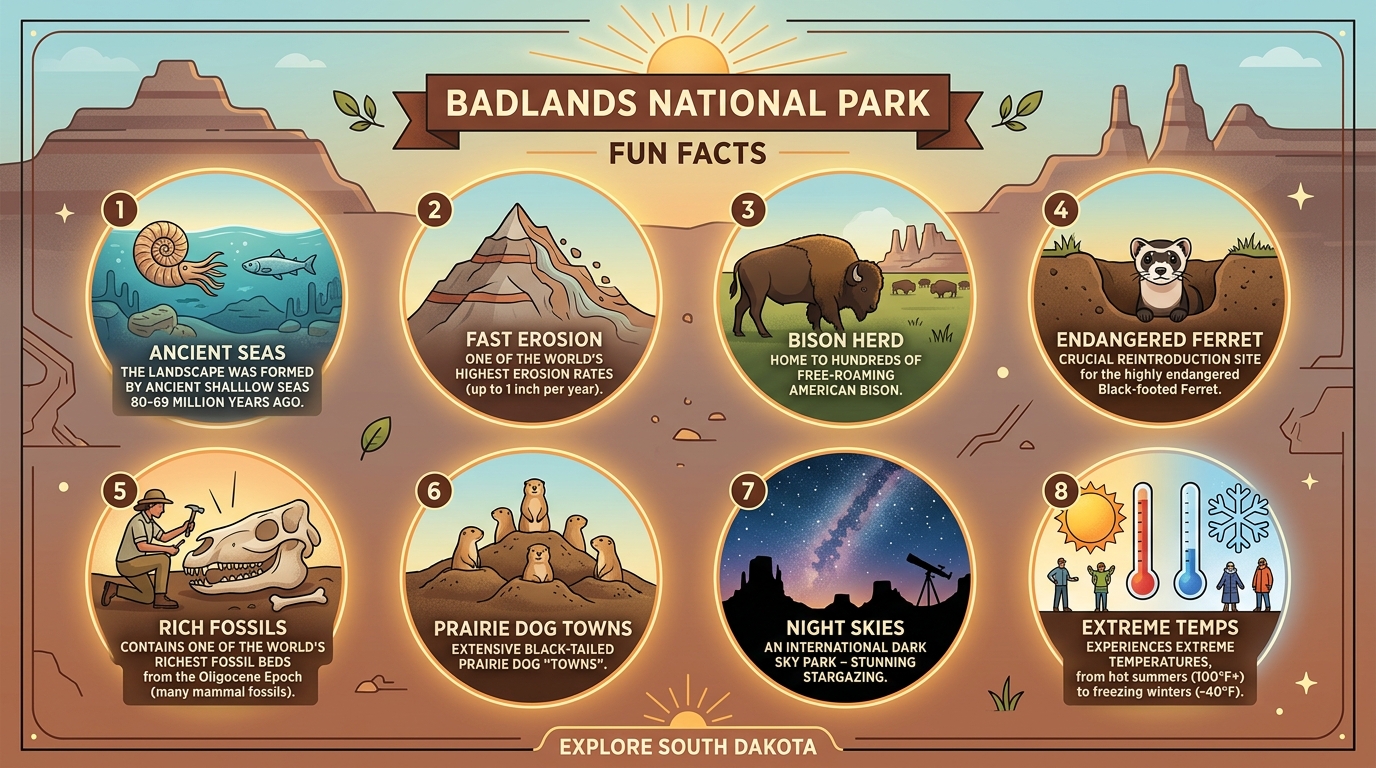
When travelers think about the American West, they often picture flat plains or tall green mountains. Badlands National Park offers something entirely different with its sharp spires, deep canyons, and layered colors of gold, purple, and cream. Exploring Badlands National Park Fun Facts reveals a wild landscape that looks like another planet, yet sits right in the heart of South Dakota. Learning about this unique place helps visitors appreciate why people have traveled here for generations to look at the rocks and wonder about the past.
Striking Visuals Along the Badlands Loop Road
Badlands National Park captivates travelers today because its striking visual features are constantly shifting right in front of visitors’ eyes.
The park covers hundreds of thousands of acres of protected mixed-grass prairie and heavily eroded rock formations. Wind and water constantly shape the soft clay and sandstone, creating a landscape that looks completely alien. Visitors driving along the main scenic drive can see sheer drop-offs and jagged walls that change color as the sun moves across the sky. According to the National Park Service, this dramatic scenery attracts close to one million visitors every year.
Ancient Rhinos and Saber-Toothed Cats in a Tropical Swamp
Badlands National Park holds a surprisingly tropical past that is packed with ancient fossils of extinct prehistoric creatures.
This dry and dusty wasteland used to be a warm, wet swamp millions of years ago. Ancient animals like saber-toothed cats, tiny three-toed horses, and rhinoceros-like mammals once roamed through thick jungles here. As rivers flooded and dried up over long periods, layers of mud and sand buried the bones of these animals. Today, paleontologists still discover well-preserved fossils tucked inside the eroding layers of rock, making the park one of the richest fossil beds in the world.
The Astonishing Speed of Desert-Like Erosion
Badlands National Park is one of the fastest-eroding landscapes on Earth, losing nearly an inch of sediment every year.
Geologists estimate that the sharp formations visible today began forming only a few hundred thousand years ago, which is a very short time in geological history. Scientists predict that wind and water will completely wash away these famous rock formations in another five hundred thousand years. This rapid pace means that every heavy rainstorm reshapes the canyons and valleys, ensuring the park never looks exactly the same way twice.
Weather Extremes and Sticky Clay Hazards
Visiting Badlands National Park requires careful planning because the environment poses distinct physical challenges and practical downsides.
Summer temperatures across the open landscape often climb dangerously high, and there is very little shade along the hiking trails. Rain creates another major hurdle because the soil is made of sticky clay. When this clay gets wet, it turns into a slick, heavy mud that cakes onto hiking boots and makes walking nearly impossible. Biting insects and rattlesnakes also live in the grass, so visitors must watch their step and bring plenty of drinking water.

Navigating Entrance Fees and Conservation Regulations
Official regulations and safety guidelines from the National Park Service help protect both visitors and the fragile natural environment.
Visitors must pay an entrance fee to enter the park, though passes are available for frequent travelers or military members. Regulations state that all rocks, fossils, and wildlife must remain untouched and in their natural homes. Climbing on the steep clay formations is allowed in many areas, but hikers must watch for loose rock and sudden drop-offs. For more details on park entry requirements and planning broader regional road trips, you can check out this guide on free camping options near badlands and regional destinations.
Common Questions About South Dakota’s Evolving Wilderness
How did Badlands National Park get its name?
Early French fur trappers called the area “les mauvais terres à traverser,” which translates to bad lands to travel across, because the terrain was so difficult to cross on foot or horseback.
Can you find real fossils in Badlands National Park?
Visitors frequently spot fossil fragments weathering out of the clay hills, but federal law strictly prohibits removing or damaging any fossils found in the park.
What kind of wildlife lives in Badlands National Park?
The park is home to bighorn sheep, bison, pronghorn, prairie dogs, and the highly endangered black-footed ferret.
Is Badlands National Park open all year round?
The park remains open twenty-four hours a day, three hundred sixty-five days a year, though visitor center hours change with the seasons.
Are pets allowed on hiking trails in the park?
Pets are restricted to areas near roads and parking lots to protect local wildlife and keep pets safe from cactus and rattlesnakes.
How much time do you need to see Badlands National Park?
Most visitors spend one to two days driving the scenic loop road, stopping at overlooks, and taking a few short hikes.
Disclaimer: Park rules, fees, and operational hours can change over time. Always verify current conditions directly through official sources like the National Park Service before planning your trip.

I’m Muhammad Ubaid, founder of YBR Magazine. I research and write detailed guides on America’s National Parks — covering entry fees, permits, best times to visit, and planning tips — using official NPS sources and up-to-date information.