

Traveling outside the United States as a lawful permanent resident is allowed, but it comes with limits that can put your status at risk. Green card travel rules mainly focus on two things: how long you stay away, and how well you can prove the U.S. is still your real home. If you get these two things wrong, a border officer can question whether you still qualify as a permanent resident at all. This matters more in 2026 because border screening has become stricter, and mistakes that used to go unnoticed are now getting flagged more often.
This guide walks through exactly what the rules are, what documents to carry, and how a trip abroad can affect your path to citizenship. It also covers a major 2026 update that green card holders need to understand, even though it does not apply to them the way it applies to visa holders.
What Are the Basic Green Card Travel Rules?
Green card travel rules allow permanent residents to leave and reenter the United States freely, as long as the trip does not create the appearance that they have abandoned their U.S. residence. A short vacation or business trip rarely causes problems. The trouble starts when a trip stretches past six months, and it becomes serious once it passes one year, because federal law treats a long absence as a sign that a person no longer intends to live in the United States.
There is no rule that requires a permanent resident to stay in the U.S. at all times. Instead, the government looks at the total picture: how long you were gone, why you left, and whether you kept real ties to the United States while you were away.
How Long Can a Green Card Holder Stay Outside the U.S.?
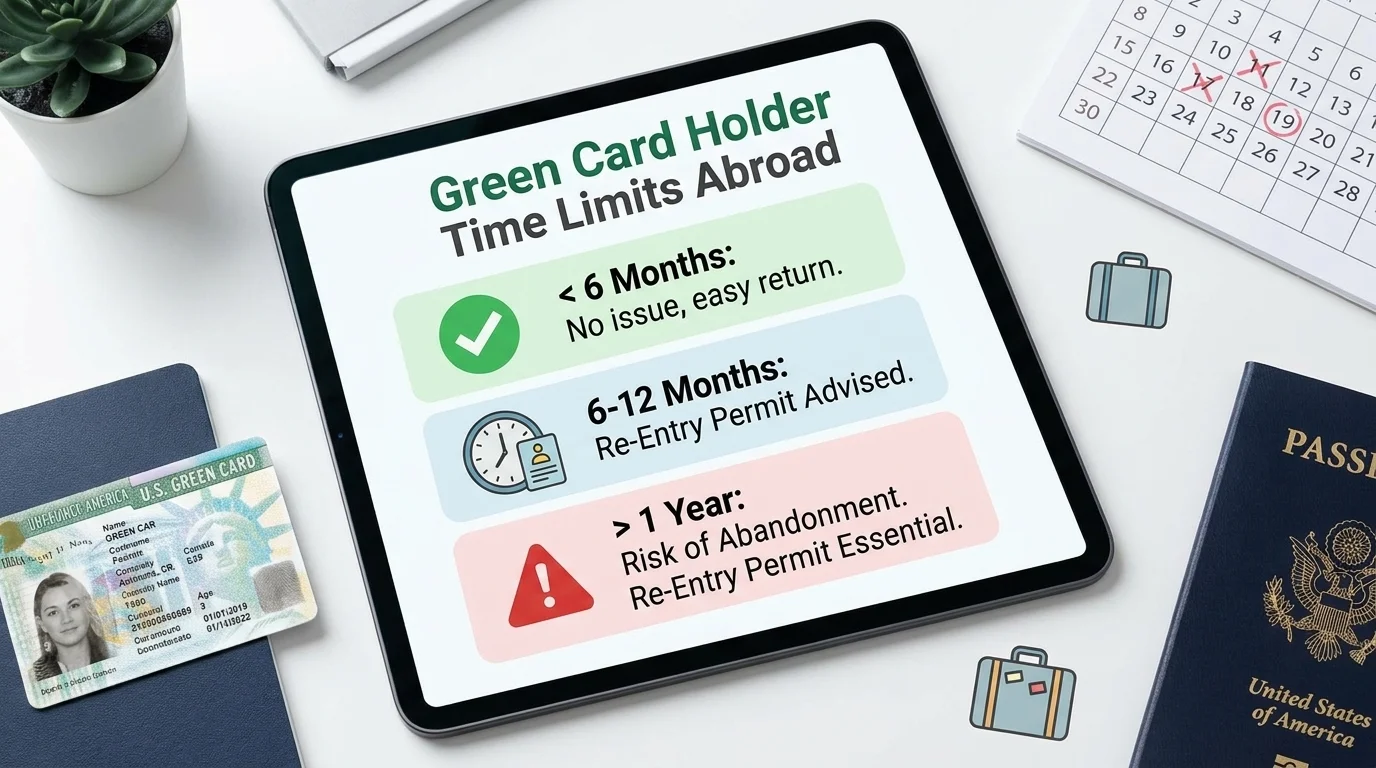
A green card holder can generally stay outside the United States for up to six months without much scrutiny, but absences approaching one year create a real risk that immigration officers will assume the person gave up their residence. Here is how the timeline breaks down:
| Length of Trip | What Happens |
|---|---|
| Under 6 months | Usually low risk; routine reentry |
| 6 months to 1 year | Border officers may ask more questions and request proof of U.S. ties |
| Over 1 year without a reentry permit | Presumption of abandoned residence; reentry can be denied |
| Over 1 year with a valid reentry permit | Travel is protected, but naturalization timing may still be affected |
Once an absence crosses the one-year mark, the legal presumption shifts against the traveler. At that point, the burden falls on the green card holder to prove they never intended to give up their U.S. home.
What Is a Reentry Permit and When Do You Need One?
A reentry permit is a travel document issued by U.S. Citizenship and Immigration Services (USCIS) that lets a permanent resident stay outside the U.S. for up to two years without being presumed to have abandoned their status based on length of absence alone. It is filed on Form I-131 and must be requested before leaving the country — filing from abroad is not allowed.
The process works like this:
- File Form I-131 with USCIS while you are still physically inside the United States.
- Attend a required biometrics appointment (fingerprints and photo) at a USCIS office, which can take weeks or months to schedule.
- Wait for approval, or arrange to pick up the approved permit at a U.S. embassy or consulate if you must leave before it’s ready.
- Use the permit as your proof of intent to return if a border officer questions a long absence.
A reentry permit is valuable, but it is not a guarantee of admission. Border officers can still ask detailed questions about your ties to the U.S. when you return.
What Documents Should You Carry When Reentering the U.S.?
Green card holders should carry their valid green card along with paperwork that proves ongoing ties to the United States, especially after a trip longer than six months. Useful documents include:
- Your valid, unexpired green card
- Proof of a U.S. address, such as a lease or mortgage statement
- Recent U.S. tax returns filed as a resident (not as a nonresident)
- Pay stubs, a job offer letter, or proof of an active U.S. business
- U.S. bank account statements
- Any pending USCIS receipt notices, such as for Form I-751 if you have a conditional green card
Filing U.S. taxes as a nonresident while abroad is one of the clearest red flags immigration officers look for, since it suggests the person no longer considers the U.S. their home for tax purposes.
Can a Long Trip Affect Your Path to Citizenship?
Yes, a long trip abroad can delay or reset the naturalization clock even if it does not cause you to lose your green card. Naturalization generally requires five continuous years as a permanent resident (three years if you got your green card through marriage to a U.S. citizen), with physical presence in the U.S. for at least half of that time.
A single trip of more than six months creates a presumption that your continuous residence was interrupted. A trip longer than one year breaks continuous residence for naturalization purposes automatically, even if you held a valid reentry permit the entire time. This means you could keep your green card but still have to restart the residency clock for citizenship.
What Happens If You’re Pressured to Sign Form I-407?
Form I-407 is a form that voluntarily gives up permanent resident status, and no green card holder is required to sign it at the border. If a border officer suggests signing it after a long absence, the traveler has the right to decline and ask to speak with a supervisor or an immigration attorney before deciding anything. Signing this form ends lawful permanent resident status immediately, so it should never be treated as routine paperwork.
How Does the 2026 Travel Proclamation Affect Green Card Holders?
The travel proclamation that took effect on January 1, 2026, restricts entry for nationals of 39 countries, but it does not apply to lawful permanent residents. Proclamation 10998, signed in December 2025, expanded an earlier order and added tighter screening for nationals of the listed countries. Green card holders are specifically excluded from this restriction, meaning the ban targets new visa applicants and certain nonimmigrant travelers, not people who already hold a green card.

That said, green card holders from an affected country should still expect longer secondary inspections and more detailed questioning at the border in 2026, since overall screening has increased across the board. Carrying complete documentation is more important now than it was even a year or two ago.
What If Your Trip Runs Longer Than Planned?
If a trip unexpectedly runs past the planned return date, contact the nearest U.S. embassy or consulate as soon as possible and keep records explaining the delay. Valid reasons include a medical emergency, a natural disaster, or a canceled flight beyond your control. If the absence will pass one year and you never applied for a reentry permit, you may need to apply for a Returning Resident (SB-1) visa instead, which requires proving the delay was caused by circumstances beyond your control.
Frequently Asked Questions
Can I lose my green card if I stay outside the U.S. too long?
Yes, staying outside the United States for more than one year without a reentry permit creates a legal presumption that you abandoned your permanent residence, and a border officer can act on that presumption when you try to return.
Do I need a reentry permit for a six-month trip?
No, a reentry permit is not required for trips under one year, but if you expect to be gone six months or longer, carrying strong proof of your U.S. ties makes reentry much smoother.
How long is a reentry permit valid?
A reentry permit is valid for up to two years from the date it is issued, and it must be applied for on Form I-131 before you leave the United States.
Will a long trip abroad affect my citizenship application?
Yes, a trip over six months can interrupt the continuous residence naturalization requires, and a trip over one year breaks it automatically, even with a valid reentry permit.
Does the 2026 travel ban apply to green card holders?
No, Proclamation 10998, which took effect January 1, 2026, specifically excludes lawful permanent residents from its entry restrictions, though longer border screening can still apply.
What should I do if a border officer asks me to sign Form I-407?
You can decline to sign Form I-407 and ask to speak with a supervisor or an immigration attorney, since signing it voluntarily ends your permanent resident status on the spot.
Can I travel while my Form I-751 is still pending?
Yes, you can travel while Form I-751 is pending as long as you carry the USCIS receipt notice extending your status, but you should be in the U.S. if USCIS requests an interview or more evidence.
Final Thoughts
Green card travel rules are not meant to trap permanent residents who simply enjoy visiting family or working abroad. They exist to draw a clear line between someone who is temporarily away and someone who has quietly moved on. Understanding the six-month and one-year thresholds, filing for a reentry permit when a long trip is planned, and keeping solid proof of U.S. ties will carry most green card holders through reentry without any trouble. When a trip runs longer than expected, acting early and documenting the reason is what protects your status the most.
This article covers legal and immigration-related topics involving green card travel rules. Immigration law changes frequently and individual cases vary widely, so please verify your specific situation with a licensed immigration attorney or directly with USCIS and U.S. Customs and Border Protection before making travel decisions that could affect your permanent resident status.

I’m Muhammad Ubaid, founder of YBR Magazine. I research and write detailed guides on America’s National Parks — covering entry fees, permits, best times to visit, and planning tips — using official NPS sources and up-to-date information.