


Introduction
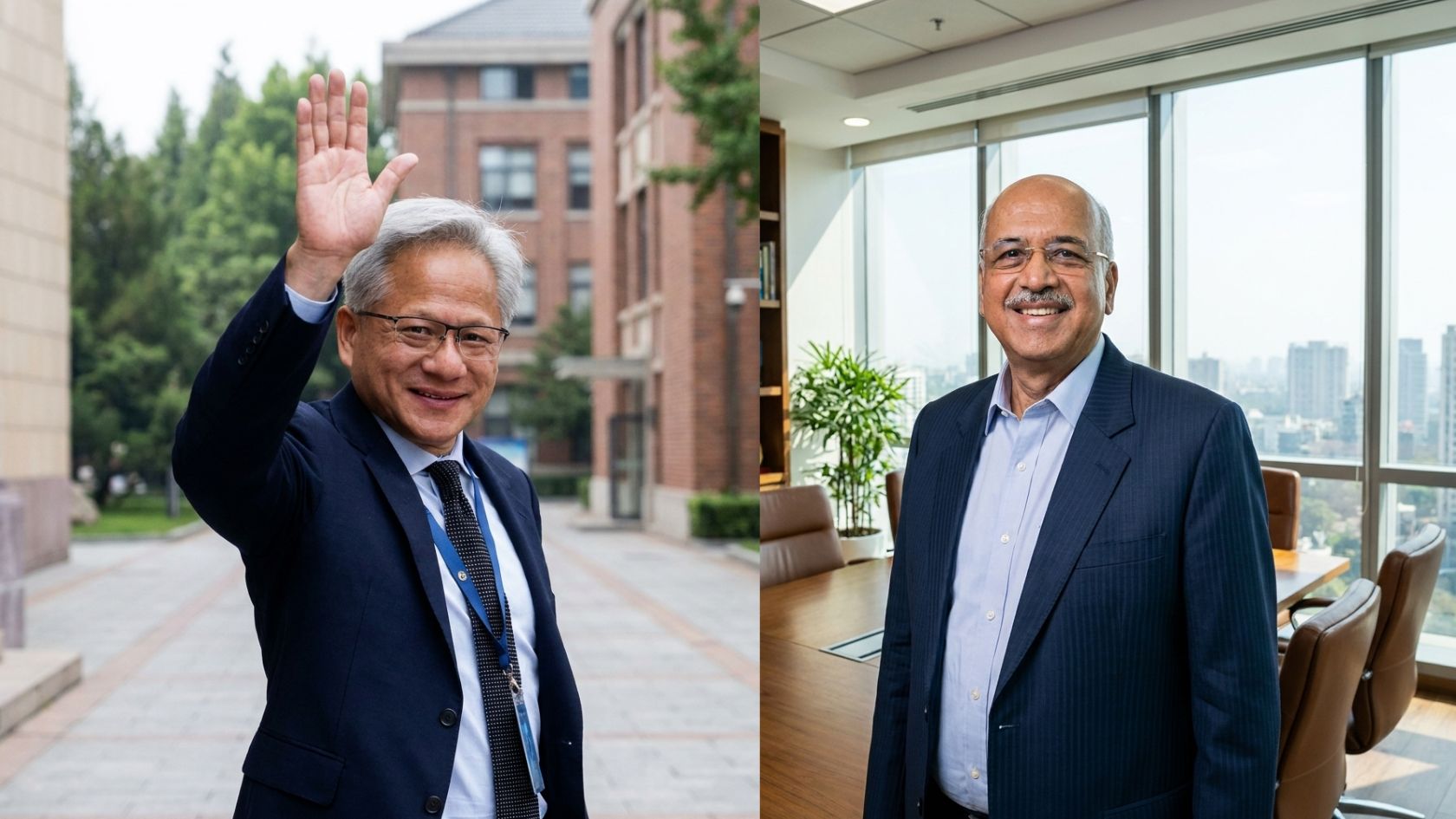
Dilip Shanghvi and Jensen Huang rarely appear in the same sentence for any real business reason — one runs a Mumbai-based pharmaceutical company, the other runs the chipmaker at the center of the global AI boom. But both men are billionaire founders who turned small, unglamorous startups into industry giants, and that shared arc of “founder who never sold out and never diversified away from the core business” is why the two names keep getting compared. This article lays out who they actually are, how they built their companies, how their wealth stacks up, and — just as importantly — what connects them and what doesn’t.
Who Is Dilip Shanghvi
Dilip Shanghvi was born on October 1, 1955, in Amreli, Gujarat, and grew up in Kolkata, where his father ran a small wholesale medicine distribution business. That early exposure to the pharmaceutical trade shaped his career path. He earned a Bachelor of Commerce degree from the University of Calcutta before starting out on his own.
In 1983, at the age of 27, Shanghvi founded Sun Pharmaceutical Industries in Vapi, Gujarat, reportedly with a loan of around ₹10,000 and a two-person team, focusing initially on a niche segment — psychiatric drugs — that larger players had largely ignored. That focus on underserved, specialty categories became the template for Sun Pharma’s growth for the next four decades.
Sun Pharma is now India’s largest pharmaceutical company and one of the world’s top generic drugmakers, headquartered in Mumbai and listed on both the BSE and NSE. For the financial year ending March 2025, the company reported revenue of roughly ₹52,578 crore (about $5.5 billion) and net income of around ₹11,984 crore. A defining moment in Shanghvi’s career came through the hard-fought, multi-year battle to take control of Israel’s Taro Pharmaceutical, and more recently, Sun Pharma agreed in April 2026 to acquire the U.S.-listed healthcare company Organon in an all-cash deal valued at $11.8 billion — a move expected to more than double the company’s annual revenue and push it into the ranks of the world’s 25 largest drugmakers.
Shanghvi has kept his personal life and public profile notably low-key for someone of his wealth. He was awarded the Padma Shri, India’s fourth-highest civilian honor, in 2016, and he chairs the board of governors at IIT Bombay. His son Aalok and daughter Vidhi both work within Sun Pharma’s business.
Who Is Jensen Huang
Jensen Huang (born Jen-Hsun Huang) was born on February 17, 1963, in Taipei, Taiwan, and moved with his family to the southern city of Tainan as a child before eventually relocating to the United States. He studied electrical engineering at Oregon State University and later earned a master’s degree from Stanford University.
In 1993, Huang co-founded NVIDIA with Chris Malachowsky and Curtis Priem, famously sketching out the company’s early plans at a Denny’s diner in San Jose. NVIDIA started out building graphics chips for video games, and for its first two decades that remained its core identity. The turning point came when the company’s CUDA software platform — originally built to make its GPUs useful for general-purpose computing — positioned NVIDIA’s hardware as the essential engine behind machine learning and, eventually, the generative AI boom.
That bet paid off on a scale few companies in history have matched. NVIDIA became the first publicly traded company to reach a $4 trillion market capitalization in July 2025, and by mid-2026 its valuation had climbed past $5 trillion, briefly touching $5.7 trillion — making it, at various points, the most valuable public company on earth. Huang’s own fortune, tied almost entirely to his roughly 3% ownership stake in NVIDIA, has risen alongside it. Forbes placed his net worth at approximately $197.6 billion in late August 2026, ranking him among the six richest people in the world, up from roughly $114 billion at the start of 2025.
Unlike Shanghvi, Huang has become one of the most recognizable executives in tech, known for his consistent black leather jacket and his frequent keynote appearances laying out NVIDIA’s roadmap — most recently around the Rubin GPU architecture unveiled in early 2026.
Net Worth and Company Scale: A Side-by-Side Look
The gap between the two companies’ scale reflects the gap between pharmaceuticals and AI infrastructure as industries right now, but both men built their fortunes the same way: by holding on to a large ownership stake in the company they founded rather than cashing out.
- Dilip Shanghvi: Estimated net worth of roughly $24–26 billion as of 2025–2026, built almost entirely from his family’s controlling stake (over 50%) in Sun Pharma, which he founded from scratch.
- Jensen Huang: Estimated net worth of roughly $166–198 billion through 2026, built from a smaller ownership percentage (around 3%) in a vastly larger company, NVIDIA.
- Sun Pharma: Revenue of about $5.5–6 billion (FY2025), set to roughly double following the Organon acquisition.
- NVIDIA: Revenue of well over $100 billion annually as of 2025–2026, with a market capitalization that has ranged between $4 trillion and $5.7 trillion through 2026.
Both men, notably, avoided the temptation to diversify far outside their core businesses. Shanghvi’s few outside bets, such as a stake in Suzlon Energy, remain small relative to his Sun Pharma holdings. Huang has likewise kept his wealth concentrated almost entirely in NVIDIA stock rather than spreading it across unrelated ventures.
Is There an Actual Connection Between Them?
This is the honest answer readers searching this keyword are usually looking for: no publicly documented business partnership, joint venture, or family relationship exists between Dilip Shanghvi and Jensen Huang. They operate in entirely separate industries — pharmaceuticals and AI hardware — and there is no record of the two collaborating on any deal. The comparison between them is a product of both men appearing repeatedly on global billionaire and “most powerful business leader” rankings, not any real-world business overlap. Any article suggesting a direct partnership, meeting, or joint venture between the two should be treated skeptically unless it links to a verifiable primary source.
Conclusion
Dilip Shanghvi and Jensen Huang represent two very different models of billionaire founder-leadership: one quiet, India-based, and built on four decades of steady expansion in generics and specialty pharma; the other globally visible, U.S.-based, and built on a single high-stakes bet on accelerated computing that turned into the defining infrastructure layer of the AI era. There’s no business relationship linking them — but their parallel stories of founder-led, decades-long focus on one industry make them a genuinely useful case study in long-term entrepreneurship, even if they’ve never done business together.

I’m Muhammad Ubaid, founder of YBR Magazine. I research and write detailed guides on America’s National Parks — covering entry fees, permits, best times to visit, and planning tips — using official NPS sources and up-to-date information.

