


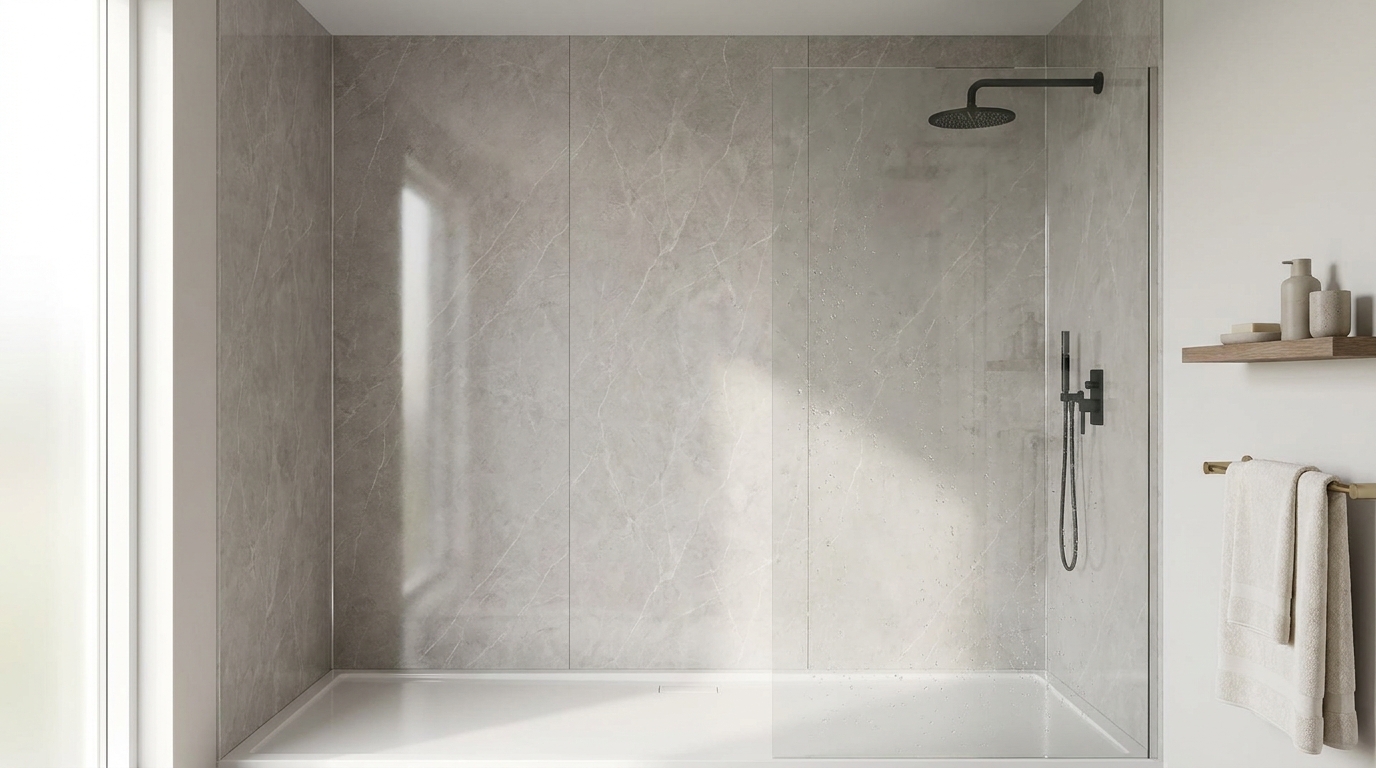
Choosing waterproof paneling for shower walls can save a great deal of time compared with tiling, because a few large prefinished sheets replace hundreds of tiles and all the grout lines between them. Most people who search for this topic want to know which material lasts, what the whole job really costs, and whether the panels will keep water out of the wall for years rather than months. This guide answers those questions using manufacturer instructions, trade publications, and retailer guides, and it points out the places where those sources disagree.
One point is worth keeping in mind from the start. Many product pages describe their panels as fully waterproof, which is usually true of the panel itself, but a finished shower is only as watertight as its seams, its sealant, and the wall hiding behind the panels. The sections below explain how that works in practice and how to avoid the most common failures.
Shower Panel Materials at a Glance
| Material | Typical build | Cost level | Main weak point |
|---|---|---|---|
| PVC | Lightweight hollow or honeycomb boards, roughly 5 to 10 mm in many retailer listings | Lowest | Can warp or fade under heat |
| Acrylic | Solid, glossy sheet, about 4 mm in several popular ranges | Low to mid | Surface can scratch |
| High-pressure laminate | Decorative laminate bonded to an MDF, plywood, or composite core, about 8 to 12 mm | Mid | Core can swell if water reaches a cut edge |
| Solid surface or cultured marble | Made to measure, thick and dense | Highest | Cost and longer lead time |
How Waterproof Paneling for Shower Walls Actually Works
The word “waterproof” on a product page normally describes the panel material, meaning it will not soak up water the way untreated wood or drywall would. It does not describe the installed system, and that difference explains most of the horror stories online. An inspection-focused guide on shower panels makes the point that neither tile nor panels are waterproof by default: with tile, the membrane or waterproof backer behind it is the real barrier, while with panels the risk sits in the vertical seams, the bottom edge at the tub or shower tray, and every opening cut for fixtures.
Manufacturer guides agree on the practical consequence. Trepanel, a PVC shower panel brand, strongly recommends a tanking system or waterproof membrane whatever the wall is made of, and Trusscore’s shower guide describes a stack of cement backer board, a liquid waterproof membrane, and silicone at trims and corners. Some retail pages go further and suggest that click-together panels make any extra protection unnecessary, which is best read as marketing language rather than a tested guarantee, since the perimeter and the wall behind the panels still matter.
The Main Types of Shower Wall Panels

PVC Panels
PVC is the lightest and cheapest route, with boards often weighing only 3 to 5 kg according to a UK tile retailer’s guide, which makes them manageable for one person. Some brands, such as Trepanel, use a honeycomb core that the manufacturer says improves moisture resistance and insulation. The trade-off, noted by Block Renovation, is that PVC is generally less durable than acrylic or solid surface and may discolor or warp over time, particularly where heat exposure is high.
Acrylic Panels
Acrylic sheets are denser and glossier than PVC, and several UK ranges are about 4 mm thick with a glass-like finish. One supplier describes a click-together joint system that leaves almost invisible seams and removes the need for grout, with more than 60 designs in the range. Flooring Clarity points out that acrylic is easy to clean but can scratch, so abrasive pads should stay out of the shower.
Laminate Panels on Wood-Based Cores
Wetwall, made by Wilsonart, is a well-known example. Family Handyman describes it as a wood and plastic composite topped with high-pressure laminate, about half an inch thick, and sold in many sizes and patterns. Other brands use plywood cores with antimicrobial treatment and waterproof adhesives, according to their own product pages. These panels feel solid and replicate stone, marble, and wood well, but a Block Renovation buying guide warns that wood cores swell once moisture reaches a cut edge, so the core type and edge sealing deserve a close look before you buy.
Solid Surface and Cultured Marble
These are the premium choices, and they are usually fabricated to your measurements, which means nothing is made until someone has measured the opening. That is why lead times are longer and why they suit custom shapes, benches, or niches. They are also described as seamless and repairable, which is a real advantage if a surface is ever damaged.
A few retailers also sell SPC (stone plastic composite) and porcelain shower panels. Their specifications vary widely between brands, so it is best to read each product’s technical sheet rather than assume it behaves like PVC or acrylic.
Panels or Tile: What Really Changes
Tile gives you almost unlimited design freedom, and Flooring Clarity notes that it often adds to a home’s appeal, though it can feel cold underfoot unless the floor is heated. Anyone comparing tile with waterproof paneling for shower walls should mainly think about maintenance and labor. Panels cut the number of joints down to a few seams and a perimeter bead, so there is far less grout to scrub, and Family Handyman presents panel installation as a way to skip much of the time and skill that tiling demands.
The lower effort has a catch. Because there are fewer joints, each one carries more responsibility, and a failed seam can let water run behind a large panel every time the shower is used. Tile can fail in a similar way when grout or the waterproofing layer breaks down, so neither option removes the need for careful preparation.
What Shower Panels Really Cost
Published prices are inconsistent, and that is the first thing to understand. Even Block Renovation gives quite different pictures on different pages, with one guide listing $150 to $600 for a standard shower surround in budget materials, and another listing installed planning ranges for a three-wall alcove of roughly $2,500 to $6,000 for laminated panels, $3,000 to $7,000 for cultured marble, and $4,500 to $10,000 for solid surface. An older Family Handyman article put fiberglass and FRP panels at $200 to $450, with solid surface and laminate reaching up to about $2,000 in materials.
The gaps come mostly from what each number includes, such as labor, trim, adhesive, waterproofing, and demolition, so these figures should be treated as rough guides rather than quotes. In the UK, Walls and Floors lists SPC tile-format packs from £24.95 per square meter and full-size PVC boards from £49.95, while an Australian retailer claims installed panels work out slightly cheaper per square meter than the cheapest tile; that second claim comes from a company selling panels and is not independently verified. Several low-quality pages also publish per-square-foot ranges with no stated source, and those are best ignored. The reliable approach is to ask two or three local installers for written quotes that list the membrane, trim, and sealant separately.
Installing Waterproof Paneling for Shower Walls Step by Step
The exact method depends on the brand, and following the manufacturer’s manual matters because warranties often depend on it. The outline below reflects what the Wetwall, Trepanel, and Trusscore guides have in common.
- Prepare the wall. The surface must be clean, dry, flat, and structurally sound. Trepanel and Trusscore both recommend adding a waterproof membrane or tanking layer over a suitable backer such as cement board.
- Dry-fit and cut. Test each panel in place before gluing anything. A fine-tooth saw or a circular saw with a guide handles the cuts, and hole saws make clean openings for the shower valve and the showerhead arm.
- Fix the panels. Wetwall’s manufacturer recommends a quarter-inch bead of adhesive every 10 to 12 inches, while Trepanel specifies a nail-free or panel adhesive. Start with the back wall and press each panel firmly into place.
- Finish corners and joints. Use the trim supplied with your system, or a trim such as the one-inch aluminum angle Family Handyman used on outside corners. Where the system calls for it, run an unbroken bead of silicone into the joint channel.
- Seal the edges and openings. Apply a compatible silicone along the base, corners, and around pipes and fixtures, then allow it to cure for the time stated on the tube before using the shower.
Family Handyman rated its Wetwall project as a full day of work, which gives a realistic idea of the effort for a confident DIYer.
Common Mistakes and Warning Signs of Hidden Leaks
Poor preparation causes most problems. One bathroom installation firm notes that many shower failures come from installation errors rather than defective products, and an installation guide from Flooring Clarity warns against fixing panels over loose or hollow tiles, which should be repaired first. Skipping the membrane because the box says waterproof is another frequent shortcut, and leaving a cut edge of a wood-core panel unprotected invites the swelling described earlier.
Sealant deserves regular attention because it ages faster than the panels do. Check the silicone lines around the tray, corners, and fittings every few months, and replace any that have cracked, lifted, or gone moldy. Signs that water may be getting behind waterproof paneling for shower walls include a musty smell, panels that feel soft or look bubbled, dark stains creeping out of seams, and trim that has started to loosen. If you notice these, stop using the shower and investigate the wall, since a panel can look perfect while the framing behind it is deteriorating.
Keeping Panels Clean
A soft cloth and a mild, non-abrasive cleaner are usually enough for gloss and matt surfaces, and gentle cleaning is especially important on acrylic because of its scratch risk. Running an extractor fan or opening a window after showers reduces the damp air that encourages mildew on sealant lines and trims. Always check the maker’s care sheet, since some textured finishes need a soft brush instead of a cloth.
Which Panel Suits Your Bathroom
For rentals, quick refreshes, or tight budgets, PVC and click-together acrylic systems are the usual starting points, as the lightweight boards are easy to carry and cut. A family bathroom with heavy daily use may justify spending more on laminate with a verified edge-sealing method or on solid surface, and a custom layout with a bench or niche is where made-to-measure materials earn their price. Whichever route you take, choosing waterproof paneling for shower walls works best when the budget also covers the membrane, trim, and sealant, because those details decide how long the result lasts.
Frequently Asked Questions
Can shower panels be installed over existing tile?
Sometimes. Retailer and manufacturer guidance says the tile must be firmly bonded and the surface flat, and Lowe’s lists some Wetwall kits as suitable over tile or drywall. Always confirm this in your specific panel’s instructions.
Do I need a vapor barrier behind the panels?
A waterproof membrane or waterproof backer is not the same thing as a vapor barrier. Trusscore’s guide says a plastic vapor barrier is generally used only when the shower sits on an exterior wall and local building codes require it, so check your local rules.
Are panels suitable for a steam shower?
There is no universal answer. Heat can warp or discolor PVC, according to Block Renovation, and no standard heat rating covers all panels, so ask the manufacturer in writing before using any panel in a steam enclosure.
Can I fit shower panels myself?
Many people do, using a drill, a saw, hole saws, and a caulking gun. Plumbing changes, a new shower tray, or repairs to a damaged or soft wall are better left to a qualified tradesperson.
How long do shower wall panels last?
No lifespan is publicly confirmed across the industry. Claims such as “decades” appear in some marketing, but real durability depends on the material, the wall behind it, and how well the seams and sealant are maintained, so compare each brand’s written warranty instead.
Can panels cover the shower ceiling too?
Some systems can. Trusscore’s shower guide covers walls and ceiling, but other brands only specify wall use, so confirm this with the maker before ordering.
Conclusion
Waterproof paneling for shower walls offers a faster, lower-maintenance alternative to tile when the wall behind it is sound and the seams are sealed properly. The material you choose matters, but the preparation, membrane, and sealant matter at least as much, so budget time and money for them from the beginning.
Disclaimer
This article is for general information only and is not professional building, plumbing, or legal advice. Prices, products, and building codes vary by country and region, so confirm details with the panel manufacturer, your local building authority, and a qualified installer before starting work.
Explore More
Picard Full-Steel Rip Hammer: Models, Specs, Uses and Buying Guide

I’m Muhammad Ubaid, founder of YBR Magazine. I research and write detailed guides on America’s National Parks — covering entry fees, permits, best times to visit, and planning tips — using official NPS sources and up-to-date information.

