


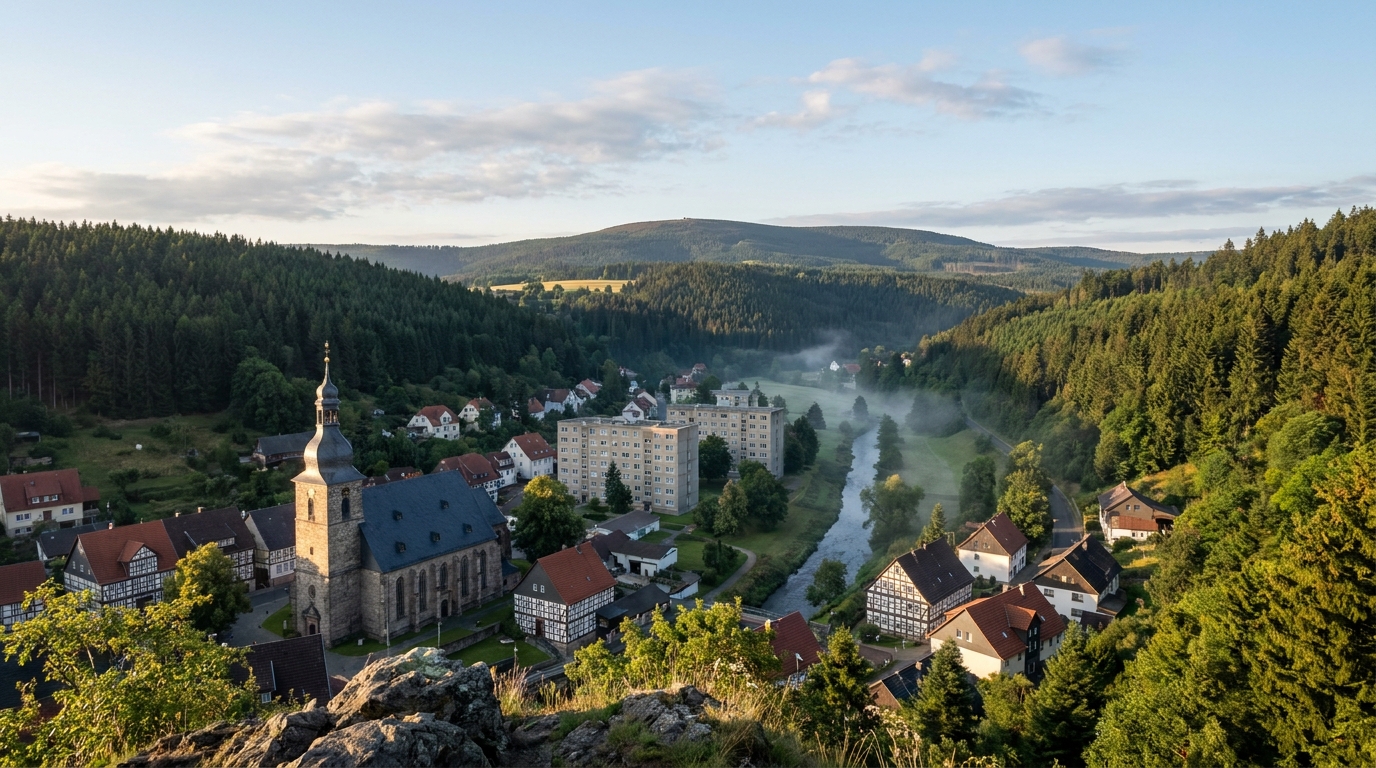
If you searched for sruhl, you most likely meant Suhl, a small city in the German state of Thuringia that is best known for centuries of gun-making, the legendary Simson mopeds, and its place on the edge of the Thuringian Forest. No official place, company, or public figure uses the spelling with an extra r, and the live search results lead almost entirely to Suhl or to the unrelated German surname Rühl. This guide clears up the confusion and then walks through the city’s history, its industrial legacy, what there is to see, how to get there, and which commonly repeated numbers do not match across sources.
Quick Facts
| Detail | What is publicly confirmed |
|---|---|
| Country and state | Germany, Thuringia |
| Status | Urban district (independent city) |
| Location | South-western edge of the Thuringian Forest, south-west of Erfurt |
| Elevation | About 422 m (1,385 ft) |
| Population | 34,685 according to Thuringian state statistics as quoted on Wikipedia (see the note on differing figures below) |
| Mayor | André Knapp (CDU), serving 2024 to 2030 after the May 2024 election |
| Known for | Firearms, Simson mopeds, East German district capital, shooting sports, winter sports nearby |
| Pronunciation | Roughly “zool” (German IPA: zuːl) |
| Postal codes | 98527 to 98530 and 98711 |
| Vehicle plate code | SHL |
What People Mean When They Search Sruhl
The correct spelling is Suhl, with no r, and an extra letter is an easy slip when typing an unfamiliar German name on a phone or keyboard. A second possibility is Rühl, a surname of Germanic origin that Wikipedia says is also written Ruehl, and Ryhl in Denmark. It belongs to unrelated people such as the German bodybuilder Markus Rühl and the American actress Mercedes Ruehl, so it has nothing to do with the city.
A third, more speculative explanation is that the hospital operator SRH, whose name appears in the title of the SRH Zentralklinikum Suhl, sometimes sits next to the city’s name in search results and may blur the spelling in people’s memory. That is only a guess, however, and it is not documented anywhere. If your search came from a brand, username, game term, or product called sruhl, no publicly documented meaning turned up, so any website claiming a confident definition should be treated with caution.
Where Suhl Is and What the Landscape Is Like
The city lies in southern Thuringia, in a valley where several small rivers meet: the Lauter, the Hasel, and the Mühlwasser. It sits on the southern edge of the Suhler Scholle, an uplifted block of granite that is part of the geological structure forming the south-western side of the Thuringian Forest. Mountains rise in almost every direction, and the Großer Beerberg, at 983 m the highest peak in Thuringia, stands about 5 km north-east of the city centre.
Because there is so little flat ground, the built-up area stretches along valleys and hillsides, which gives the city a scattered shape. About 63% of the municipal territory is forest, according to the Wikipedia summary of local data, and farming plays almost no role. The geology also explains the local economy: a band of iron ore runs along the edge of the granite block, with copper and silver deposits to the north-east, and this ore is what first drew metalworkers to the valley.
A Short History of Suhl
From Sulaha to a Market Town
The earliest trace of the settlement appears to be a place called Sulaha, mentioned in the records of Fulda Abbey at some point between the years 900 and 1155, while the first deed that names Suhl directly dates to 1318. A coat of arms from 1365 shows two hammers, a clear reference to metalworking. The land belonged to the Franconian counts of Henneberg, who made Suhl a small market town in 1445 and granted full town rights in 1527, which makes it one of the youngest cities in present-day Thuringia.
The Reformation arrived in 1544, and when the Henneberg line died out in 1583 the area passed to the electors of Saxony. After the Congress of Vienna it became Prussian in 1815, so for close to three centuries Suhl was a Saxon and later Prussian exclave surrounded by other Thuringian territories. A major setback came in 1634, during the Thirty Years’ War, when imperial mercenaries burned the city down, and rebuilding was supported from about 1690 by Duke Moritz Wilhelm of Saxe-Zeitz. The railway reached the city only in 1882 because the hilly terrain made construction difficult, which held back its industrial growth compared with other German towns.
War, Occupation and the GDR Years
Rearmament under the Nazi government after 1935 brought a new boom to the arms factories, and about 10,000 forced laborers were put to work in the city’s arms industry after 1940. United States troops reached Suhl on 3 April 1945 and were replaced by Soviet forces on 1 July of the same year. In 1952 East Germany replaced its states with 14 districts, and Suhl became the capital of Bezirk Suhl, a region of roughly 550,000 people stretching from Bad Salzungen to Sonneberg.
Government-directed growth followed. The population rose from about 25,500 in 1960 to 56,345 in 1988, and the old town around Friedrich-König-Straße was demolished in the 1960s and replaced with modern concrete buildings and large prefabricated housing estates. That concrete-heavy centre still defines the look of the city today.
After 1990
Reunification removed the city’s administrative role, and most of its factories closed. Wikipedia reports that the population has fallen by more than 35% since 1988, which puts Suhl among the most heavily shrinking cities in Germany, although that assessment comes from an older update and current numbers should be checked. The authorities responded by tearing down some of the prefabricated estates on the outskirts, a few of which were only about 20 years old, while empty shops in the town centre have remained a lasting problem.
The Gun-Making Heritage

Iron ore mining created the foundation of Suhl’s gunsmith trade, and by the early 17th century the output was large. A Small Arms Review article on the city’s weapons museum says that the gunmaker Simon Stohr received an order for 4,000 matchlock muskets in 1622 and that local makers had produced 28,950 muskets by 1631. Cannons were another major product for centuries and were used by many European powers.
Several famous names grew out of this tradition. Sauer & Sohn, founded in Suhl in 1751, is described as the oldest recorded gun maker in Germany, although the company moved away from the city at the end of the Second World War. C.G. Haenel and August Menz, the maker of the tiny Liliput pistol of the 1920s, were also based here, and the neighbouring town of Zella-Mehlis was home to Carl Walther. Merkel, founded in 1898 as Gebrüder Merkel, is the largest firearms producer still working in Suhl and has belonged to Caracal International of Abu Dhabi since 2007. Wikipedia lists 123 employees and revenue of 14.3 million euros for 2018, but these are older figures that may have changed.
The tradition also shaped sport. During the Cold War the East German national shooting arena was located in Suhl, and it hosted the 1986 ISSF World Shooting Championships. Wikipedia adds that the city still has Germany’s only school for armorers, which is a claim worth confirming with the school before relying on it.
Simson: From Rifles to the Schwalbe
Simson is the name most people connect with Suhl after guns. The brothers Moses and Löb Simson, members of the first generation of Jews in Prussia allowed to own property, bought a steel forge in Suhl in the mid-1850s and began making gun barrels. By the early 1920s their grandsons Arthur and Julius Simson ran the largest workforce in the city, and the company produced firearms, bicycles, cars, and even aircraft engines, according to the Leo Baeck Institute.
The family’s story took a dark turn in 1936, when the Nazi state confiscated the company and folded it into the Gustloff works, a trust that ran businesses taken from Jewish owners. From 1939 the Suhl plant concentrated on the MG34 and MG42 machine guns. After the war the factory came under Soviet control and later became a state-owned East German enterprise, and in 1955 it began building small motorcycles.
The Schwalbe (“swallow”) scooter appeared in 1964 as the first two-seat model of the factory’s bird-named series, with a top speed of 60 km/h. It was built in three main series, the KR 51 from 1964 to 1968, the KR 51/1 from 1968, and the KR 51/2 until 1986, and a museum collection record reports that more than 850,000 were made between 1964 and 1986. East German postal workers, police, and rural health staff all used it for daily work, which is a big part of why it became a cultural symbol of everyday life in the GDR.
After reunification the privatization agency excluded the Simson heirs from the bidding, and the company was awarded to a Dutch-French consortium for 27 million Deutsche Mark, according to the Leo Baeck Institute. The heirs did keep the rights to the Simson brand name, and the factory complex still has Bauhaus-style buildings from the 1920s and 1930s that survive between the Heinrichs and Mäbendorf districts.
How the City Earns a Living Today
Metalworking is still part of the picture, but the economy now rests on a mix of smaller firms and regional services. Wikipedia names a producer of data media (CDA), a meat producer (Zimbo), an industrial bakery (Gramss), a car-parts supplier (Paragon), and Merkel as important companies, though that list is dated and may no longer be accurate. Suhl also keeps some regional functions, including the chamber of commerce and regional offices of the employment and pension authorities.
Tourism adds a modest income thanks to the surrounding forest. The most recent hotel figures in the sources reviewed are from 2012, when the city had 93,000 hotel guests and 245,000 overnight stays, so they say little about the situation now. The unemployment rate fell from 16% in 2006 to 7% in 2013 according to the same older summary, and no newer figure was confirmed in this research.
Things to Do Around Sruhl
Museums and Landmarks
The Waffenmuseum (weapons museum) is housed in the Malzhaus, a building from around 1650 in the town centre. Visitors describe three floors that begin with the geology and the mining of iron ore, move through a reconstructed gunmaker’s workshop, and continue to modern hunting and sporting weapons, and a Small Arms Review article says the oldest gun on display dates to the 14th century. The Fahrzeugmuseum at the Congress Centrum shows vehicles built by Simson, and the Galerie im Atrium in the same building hosts temporary art exhibitions.
Other sights include the late-Baroque St. Mary’s Church (built 1753 to 1756), the Baroque Holy Cross Church (1731 to 1739) with its Gothic chapel from 1618, and the town hall at the Marktplatz, built between 1812 and 1817 and altered in 1913. Visitors interested in science can try the school and public observatory with its planetarium on Hoheloh hill, which still uses the first ZEISS SKYMASTER ZKP 2 projector, and the Tierpark Suhl zoo lies on the eastern edge of the city. The Heinrichs district west of the centre keeps a few picturesque timber-framed houses. Opening hours were not verified for this guide, so check each venue before travelling.
Mountains, Trails and the Thuringian Forest

The Großer Beerberg is the obvious target for hikers, and the Ringberg (745 m) is another local viewpoint, with a hotel on top that advertises panoramic views over the city and the forest. The long-distance Rennsteig ridge route runs close to the city, and the winter-sports venues around Oberhof, such as the Lotto Thuringia Arena am Rennsteig and the Kanzlersgrund ski jump hills, appear in travel listings as nearby attractions. Cyclists can follow the Hasel cycle track from Suhl to the Werra valley near Meiningen, and the forest has additional mountain-bike routes.
How to Reach Sruhl by Train and Road
Suhl lies about 110 km north-east of Würzburg and 130 km north of Nuremberg, and it sits where the A71 motorway between Erfurt and Würzburg meets the A73 toward Nuremberg. Both motorways opened during the 2000s and include impressive structures, such as the Rennsteig Tunnel north of the city and the 82 m high Haseltalbrücke near Heinrichs. A booking site lists Erfurt-Weimar airport about 43.6 km away from a hotel on the Ringberg, and Nuremberg about 127 km away.
The railway line through the city opened in 1882 toward Würzburg and in 1884 toward Erfurt, and it includes the 3,039 m Brandleite Tunnel north of town. According to Wikipedia, express services run about every two hours to Erfurt and Würzburg, with local trains to Erfurt and Meiningen on the same rhythm, but timetables change, so it is worth checking the current schedule on an official rail planner. Local buses link the centre with outlying districts and with Zella-Mehlis.
Facts That Differ From One Source to Another
Anyone researching sruhl or Suhl will notice that the numbers do not always agree. Many of the highest-ranking pages are hotel or tour listing pages that repeat the same attraction names, and several others copy older encyclopedia text, so a figure that appears in many places is not necessarily more reliable. The main conflicts are listed below.
- Population: The Wikipedia introduction still mentions about 37,000 residents, a real-estate site gives about 35,500, and the infobox gives 34,685. The same 34,685 figure was labelled as a 2024 value in one copy of the page and as a 2025 value in another, so the exact reference date is not publicly clear.
- Area: One source says the city covers 103 square kilometres and another says 141.62. The larger value probably reflects the 2019 incorporation of Gehlberg and Schmiedefeld am Rennsteig, but that is an inference rather than a confirmed explanation.
- First mention: Most sources say 1318, a German real-estate site says about 1300, and Fulda Abbey records mention Sulaha much earlier, so the “founding date” depends on what counts as a first mention.
- Simson forge: One source says the Simson brothers bought a one-third share in a hammer forge in 1854, while others say 1856, and it is not clear from the sources reviewed whether these describe the same transaction.
- Moped output: The museum figure of more than 850,000 Schwalbe scooters is for that one model between 1964 and 1986, while a retail article claims more than six million Simson mopeds and similar vehicles overall until 1991 or 1992. These cover different scopes, and the larger total was not confirmed by an official source. One wiki-based page also says moped production in Suhl lasted until 2002, which was not independently confirmed.
Frequently Asked Questions
Is sruhl the correct spelling of the city?
No. The city is spelled Suhl, and the extra r appears to be a typing slip, since no place or organization with the spelling sruhl turned up in public sources.
How big is Suhl compared with other Thuringian cities?
It is the smallest of the six urban districts in Thuringia. Together with its northern neighbour Zella-Mehlis it forms the largest urban area in the Thuringian Forest, with roughly 46,000 people according to Wikipedia.
Can a Simson Schwalbe still be ridden on German roads?
Yes. The DDR Museum notes that an AM driving licence is enough, even though the top speed of 60 km/h is above the usual 45 km/h moped limit, and that owners avoid frequent general inspections and moped tax. It estimated around 150,000 Schwalbe scooters were registered in Germany in 2015.
Which famous people are linked to Suhl?
Actress Sandra Hüller (born 1978), bobsledder André Lange (born 1973), and Wilhelm Cuno, German chancellor in 1922 and 1923, were all born there. The composer Georg Christoph Bach worked as a cantor and schoolmaster in the Heinrichs district from 1661 to 1668, and the city also appears in Eric Flint’s 1632 alternate-history novels.
Is there a major hospital in the city?
Yes, the SRH Zentralklinikum Suhl describes itself as the largest hospital in southern Thuringia and an academic teaching hospital of the University Hospital Jena. Its own listing gives two different bed counts, 519 in one place and 640 in the text, so the exact number is not clear.
Can you ski near Suhl?
Small local ski lifts exist, such as Goldlauter am Salzberg and Winterwelt Schmiedefeld, according to travel listings. Snow conditions and opening dates vary, so check with the operators in advance.
Conclusion
Whether a search for sruhl came from a typo or from curiosity about a half-remembered name, the city behind it is worth a closer look, because few towns of its size carry so much industrial, political, and cultural history in one place. For readers who enjoy mountain scenery, workshop-era craftsmanship, or the story of East German design, Suhl offers a compact and unusual destination in the Thuringian Forest.
Disclaimer
This article is for general information only and is based on publicly available sources reviewed in October 2026. Population figures, opening hours, train schedules, company details, and prices change over time, so please confirm them with official sources before planning a trip. References to firearms are historical and do not encourage the purchase or use of any weapon, and nothing here is travel, legal, or medical advice.
Explore More
AICOT Explained: The EU Cybersecurity Project and OMRON’s Solar Technology

I’m Muhammad Ubaid, founder of YBR Magazine. I research and write detailed guides on America’s National Parks — covering entry fees, permits, best times to visit, and planning tips — using official NPS sources and up-to-date information.

