


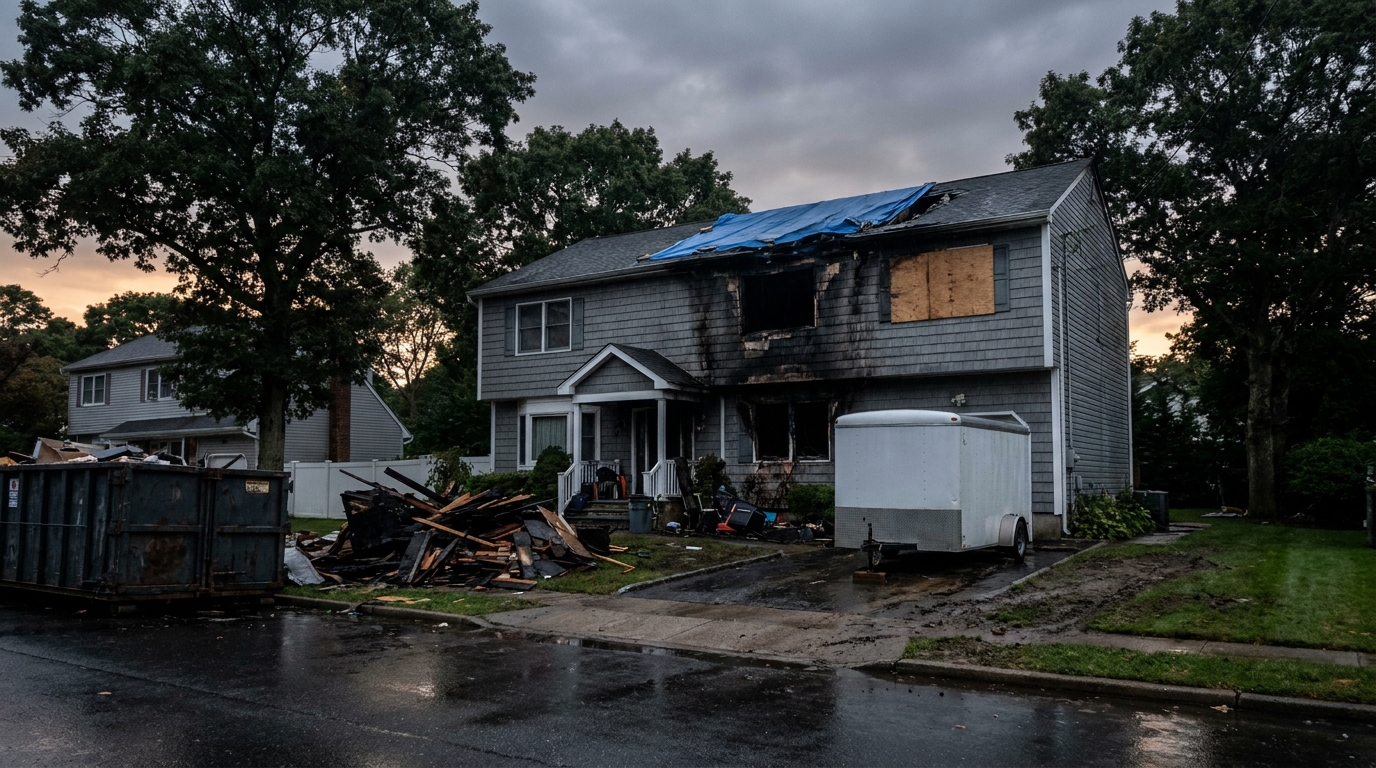
A fire rarely ends when the flames are out. Smoke, soot, and the water used by firefighters keep causing harm for days afterward, which is why fire damage repair Long Island property owners need is usually a sequence of safety checks, cleaning, insurance paperwork, and rebuilding rather than one single job. This guide explains what to do first, how the repair process normally unfolds, which New York and local rules matter, and how to choose a contractor without relying on marketing claims. It is written mainly for Nassau and Suffolk County homeowners, although most of it applies to any building in the region.
Quick Facts at a Glance
| Topic | What to know |
|---|---|
| Area | Locally, “Long Island” usually means Nassau and Suffolk Counties. Some contractors in Queens also use the name, so confirm where a company is licensed to work. |
| First priority | Stay out of the building until the fire department or a building official says it is safe. |
| Insurer’s response window | Under New York’s claims regulation (Regulation 64), an insurer must begin investigating within 15 business days of notice of the claim. |
| Proof of loss | Under Insurance Law § 3407, a sworn proof of loss is generally due within 60 days after the insurer’s written demand and form. |
| Contractor licensing | Nassau and Suffolk Counties each run their own home improvement contractor licensing programs. |
| Industry standard | ANSI/IICRC S700 covers professional fire and smoke damage restoration; its first edition was published in 2025. |
What to Do in the First Hours After a Fire

Safety comes before cleanup, and the most important rule is not to go back inside until the fire department or a building official confirms it is safe. Public fire-safety guides drawn from the American Red Cross and similar sources explain that fire can weaken roofs and floors, and that gas, electrical, and air-quality hazards can remain after the fire is out. If you smell gas, leave the area and tell the fire department right away. Utilities such as gas, water, and electricity should be shut off or checked by the proper provider before anyone uses them again.
Once you are safe, the next steps are practical ones. The Red Cross can help with immediate needs such as temporary lodging, food, and clothing, and it can assist with replacing prescription medicine. Any food, drinks, or medicine that were exposed to heat, smoke, soot, or firefighting water should be thrown away, according to guidance published by the North Carolina Department of Insurance and many local fire departments. Ask the responding fire department for an incident report, because insurers often request one, and call your insurance company or agent as soon as you reasonably can.
Documentation helps later, so it is worth starting early. Take photos and video of every room before anything is moved, and keep a written diary of each call with your insurer, including names, dates, and what was said, which is advice that has long been given by New York State legislators’ consumer guides after major storms. If you must make temporary protective repairs, such as covering a broken window or a damaged roof, save every receipt, and avoid permanent repairs until the insurer has had a chance to inspect the damage and you have agreed on the scope of work.
Why Local Conditions Matter
Long Island has a large stock of older homes, and restoration companies that work here point to aging electrical systems and oil-based heating as recurring risks. A local restoration firm in Huntington lists cooking accidents, electrical faults, heating equipment, and candles as common causes, and a Patchogue-area provider adds that winter heating and summer storms can both play a role. These claims come from company websites rather than from an official fire-statistics source, but they match the general pattern reported by fire-safety agencies that cooking is the leading cause of home fires.
The type of fire changes the work involved. Another local company describes oil furnace puff-back cleanup as a distinct service in older Long Island homes, because a puff-back spreads fine soot through a house without any visible flames. That kind of loss can look minor at first yet still require specialist cleaning of walls, ceilings, and ductwork. Anyone comparing quotes for fire damage repair Long Island contractors offer should therefore ask whether the company has handled the specific type of fire that occurred, not just fire damage in general.
The Stages of Fire Damage Repair Long Island Owners Should Expect
Securing the Property
The first job is to make the building secure and weather-tight. Board-up of broken windows and doors, roof tarping, and structural shoring are standard early services, and several local providers advertise round-the-clock emergency response for this stage. Speed matters because an open building invites rain, theft, and further deterioration, but the work should still be recorded with photos so the insurer can see the condition before and after.
Assessing the Damage and Setting the Scope
A proper assessment looks well beyond what is visible. Soot and smoke residue travel through wall cavities, attics, and heating and cooling ducts, and a good contractor will write a scope of work that covers all of it before cleaning begins. The ANSI/IICRC S700 standard, published by the Institute of Inspection, Cleaning and Restoration Certification, lays out a structured process that includes assessment, mitigation, source removal, HVAC and air-duct considerations, odor management, contents restoration, and a final evaluation. Because the standard is new in its current form and the institute began a revision in late 2025, a contractor who says it is “the” settled rulebook is simplifying the picture, although following it is still a reasonable sign of professionalism.
Cleaning Smoke, Soot, and Odor

Restoration companies commonly warn that soot can begin to stain and etch surfaces within hours, and that different fuels leave different residues, which is why a one-size-fits-all wipe-down often fails. Real odor removal means removing the residue at its source and treating porous materials and ductwork, while masking agents only hide the smell for a short time. The IICRC itself notes that its standard does not address every safety concern in restoration work, so anyone entering a damaged building should still follow the guidance of the fire department and their contractor.
Dealing With Water and Mold Risks
Firefighting water can soak insulation, drywall, and subfloors, and wet materials left in place can turn into a mold problem within days. Several Long Island restoration companies pair fire work with water extraction and drying for exactly this reason. Nassau County’s licensing categories list mold remediation as a separate type of work, which suggests that a company offering it should be able to show the right credentials rather than simply claim the skill.
Restoring Contents and Rebuilding
Belongings are sorted into items that can be cleaned, items that can be restored, and items that should be replaced, and the inventory you create here will feed directly into your insurance claim. The rebuilding phase then replaces drywall, flooring, wiring, and finishes. It is worth noting that the S700 standard explicitly does not cover reconstruction, so rebuilding work falls under building codes, permits, and your contract rather than under that cleaning standard.
Insurance Claims in New York: Timelines Worth Knowing
Insurance shapes almost every decision in fire damage repair Long Island owners face, and New York sets minimum claim-handling standards for insurers. Regulation 64, administered by the New York State Department of Financial Services, requires an insurer to start investigating within 15 business days of receiving notice of a claim. After the insurer has a properly executed proof of loss and every item it requested, it must accept or reject the claim in writing within another 15 business days, and if it needs more time it must say so in writing and explain why. When the insurer suspects arson, the regulation extends that decision window to 30 business days.
The proof of loss deserves special attention. According to commentary from a New York property-insurance law practice, an insurer that wants one must demand it in writing and supply a form, after which the policyholder generally has 60 days from receipt to return it under Insurance Law § 3407, and New York courts have been strict about late filings. Policies can contain their own deadlines and conditions, so read yours carefully rather than relying on a general summary. If an insurer delays, underpays, or denies a claim, the Department of Financial Services accepts consumer complaints, and a lawyer who handles property claims can explain the time limit for suing under your specific policy.
Restoration companies often say they will document damage and talk directly with your adjuster, and some local firms advertise this as part of their service. That can be genuinely useful, but you remain the policyholder, and your contract with the insurer is separate from your contract with the contractor. Ask in writing what the restoration company will and will not handle, and do not sign any assignment or direction-to-pay form you have not read.
Licensing and Permits for Fire Damage Repair Long Island Contractors Must Follow
Contractor rules on Long Island are set at the county level, which surprises many people. Nassau County requires a home improvement contractor license under its Local Law 6-1970, and the county’s rules and local building departments also expect contractors to carry liability insurance in addition to workers’ compensation and disability coverage. Suffolk County requires its own home improvement contractor license, issued through its Department of Labor, Licensing and Consumer Affairs. Both counties have online tools or offices where you can check a license number, and checking before you sign is one of the simplest ways to avoid trouble.
Permits come from the town or village building department, which enforces the New York State Uniform Fire Prevention and Building Code along with local codes. Requirements differ between municipalities, and some villages publish their own insurance rules for contractors, such as a Nassau village that asks for specific general-liability coverage naming the village as an additional insured. Ask the contractor who will pull the permits, and ask the building department directly whether your repairs need inspections or a certificate of occupancy before you move back in.
A written contract is also expected for home improvement work. A New York contractor-licensing guide reports that General Business Law § 771 requires a written contract for work of $500 or more outside New York City, and a good contract should describe the scope, materials, payment schedule, start and finish dates, and how changes are handled. Verify the current requirement with the county consumer-affairs office, since summaries online are not always up to date.
Choosing a Contractor and Understanding Cost
Many of the pages that rank for this topic are franchise or local company sites with similar wording, and they tend to focus on speed and 24/7 availability while saying little about costs, legal rules, or how to compare bids. At least one ranking result appears to be auto-generated content on an unrelated website, with company history claims that cannot be verified. For that reason, treat promotional statements such as “best” or “most trusted” with caution, and rely on things you can check yourself, such as license numbers, insurance certificates, references from recent local jobs, and written estimates.
When you compare companies, a few questions separate careful firms from careless ones. Ask whether they will provide a written scope based on a full inspection, whether they will test and clean the HVAC system, how they handle odor, who supervises the crew, and how they document the work for the insurer. Also ask whether the company handles cleaning only or rebuilding as well, because separating the two can make accountability harder if something goes wrong.
Cost is the question most owners ask first, and it is also the one the top-ranking pages avoid. No reliable public average exists for fire damage repair Long Island homes require, because a small kitchen fire with smoke cleanup and a structural fire with a full rebuild are entirely different projects. Anyone quoting a flat figure without inspecting the property is guessing, so collect two or three written estimates that break out cleaning, mitigation, contents, and reconstruction separately, and compare them line by line.
Frequently Asked Questions
How long does fire damage repair take?
There is no fixed timeline. Light smoke cleanup can be finished far sooner than a rebuild, and the schedule also depends on insurance approval, permit and inspection availability, and the supply of materials and trades. Ask any contractor for a written schedule and for what could change it.
Will my insurance pay for a place to stay?
Many homeowners policies include coverage often called loss of use or additional living expenses when a home is unlivable after a covered loss, but the limits and conditions vary by policy. Keep receipts for lodging, meals, and extra costs, and confirm the details with your insurer before you book anything long term.
Can I clean soot myself?
Light, surface-level smoke residue can sometimes be wiped with mild detergent, according to general fire-recovery guidance, but heavy soot, oily residue, and anything in ductwork or insulation is better left to trained crews. Wear gloves and a properly rated mask if you do any cleaning, and check with your insurer first so DIY work does not complicate a claim.
Should I hire a public adjuster?
A public adjuster works for you rather than the insurance company and is typically paid a percentage of the settlement. In New York, public adjusters are licensed, so ask to see the license, get the fee terms in writing, and decide whether the size and complexity of your loss justifies the cost.
Why does the smoke smell sometimes come back after cleaning?
Odor usually returns when residue is left in places that were never treated, such as insulation, wall cavities, and ductwork. Restoration companies say that true deodorizing requires removing or sealing the source, and a contractor who only runs fans or uses a masking spray may not solve the problem.
What if my insurer denies or underpays the claim?
Start by asking for the reasons in writing, then compare them with your policy and your contractor’s estimate. You can file a complaint with the New York State Department of Financial Services, and a law firm that commentary cites says suits on fire policies are commonly subject to a two-year limit, but your own policy controls, so confirm the deadline with a lawyer.
Conclusion
Recovering from a fire is easier when the steps happen in the right order: safety first, then documentation and notice to your insurer, then a licensed and insured contractor working from a written scope. Understanding the New York claim timelines and the county licensing rules gives you leverage that marketing pages rarely explain, and it helps you judge any estimate for fire damage repair Long Island contractors put in front of you. Take your time comparing written bids, check every license yourself, and keep a record of every conversation along the way.
Disclaimer: This article is for general information only and is not legal, insurance, financial, engineering, or health advice. Laws, regulations, licensing rules, and policy terms change and differ by municipality and by insurance policy, so confirm details with your insurer, your local building department, the county licensing office, and a qualified attorney or licensed professional before making decisions. Fire-damaged buildings can be dangerous, so follow the instructions of your fire department and building officials.
Explore More
Septic Tank Emptying Stockton on Tees: Rules, Costs and How to Hire Safely

I’m Muhammad Ubaid, founder of YBR Magazine. I research and write detailed guides on America’s National Parks — covering entry fees, permits, best times to visit, and planning tips — using official NPS sources and up-to-date information.

