


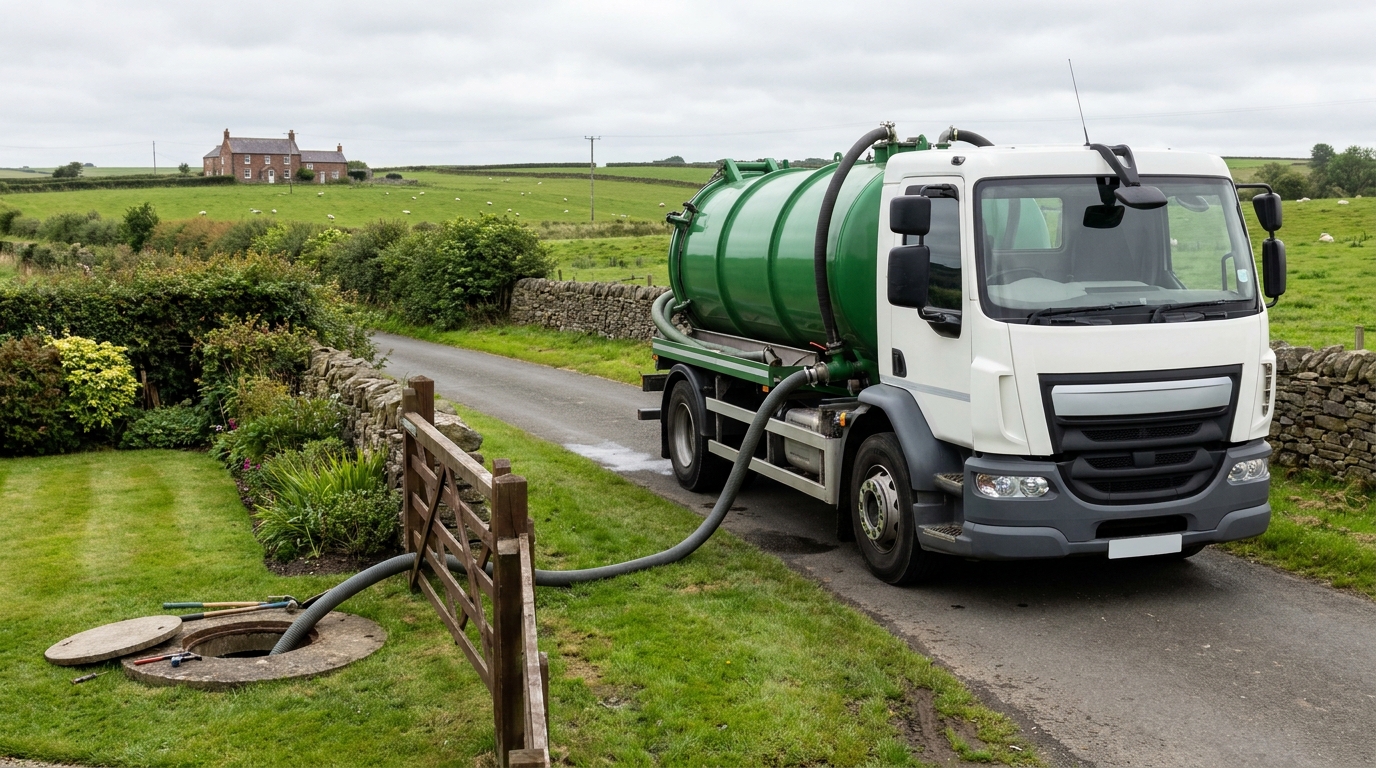
If your home or business in the Borough of Stockton-on-Tees is not connected to the public sewer, you are responsible for keeping your private drainage working, and that starts with regular, legal septic tank emptying Stockton on Tees residents can rely on. A neglected tank can cause smells, slow drains, soggy ground and, in the worst cases, pollution of a nearby ditch or stream. This guide explains what the law requires, how often emptying is really needed, what it usually costs, and how to check that the company you hire is allowed to take your waste away.
Most of the pages that currently rank for this search are directory listings with text that is almost identical from one town to the next, so they say little about local circumstances. This article draws on official government and Environment Agency guidance, council advice and published price guides, and it points out where information is general rather than specific to Stockton.
Quick facts at a glance
| Topic | What the sources say |
|---|---|
| Legal minimum for emptying | At least once a year, or as often as the manufacturer advises (Environment Agency and GOV.UK guidance) |
| Who must do the work | A registered waste carrier, who should give you a waste transfer note |
| Typical price per visit | Roughly £150 to £350 depending on tank size, access and provider; no Stockton-specific average is publicly confirmed |
| Typical time on site | About 30 to 60 minutes for many domestic tanks; up to two hours for some jobs |
| Who is responsible | The owner or “operator” of the system; for rented homes, usually the landlord, but check the tenancy agreement |
| Where to report pollution | Environment Agency incident hotline, 0800 80 70 60, open 24 hours |
Do you have a septic tank, a cesspit or a treatment plant?

Before booking anyone, it helps to know which kind of system you have, because the three common types are emptied on very different schedules. A septic tank holds wastewater long enough for solids to settle and for bacteria to break them down, and the clearer liquid then flows out to a drainage field or soakaway in the ground. A cesspit, also called a cesspool, is a sealed storage tank with no outlet, so everything that goes in must eventually be removed by tanker. A small sewage treatment plant uses mechanical or biological stages to clean the water more thoroughly before it is released.
Rural parts of the borough, and some older or isolated properties, can rely on this kind of private system rather than mains sewerage. Northumbrian Water, the sewerage company for much of the North East, took over responsibility for many private sewers and some drains outside property boundaries in October 2011, but its own guidance makes clear that private sewage treatment works and septic tanks remain the owner’s responsibility. If you are unsure whether you are on mains drainage, your property deeds, a drainage search from your purchase or the water company’s records are the usual places to check.
What the law says about emptying
Since January 2015, small sewage discharges in England have been covered by the General Binding Rules, which allow a septic tank or small treatment plant to operate without an environmental permit as long as certain conditions are met. According to Environment Agency guidance, one of those conditions is that the system is emptied or desludged at least once a year, or in line with the manufacturer’s instructions, and that the work is carried out by a registered waste carrier. A septic tank is also not allowed to discharge directly into a river, stream or ditch; a tank that does so must be connected to a drainage field, replaced with a treatment plant, or connected to the public sewer. These rules apply across England, so they cover septic tank emptying Stockton on Tees households in exactly the same way as anywhere else.
You may see websites saying a septic tank only needs emptying every three to five years, or every one to three years. Those figures are common in the industry and may suit a lightly used tank, but they do not match the official minimum, so it is safer to treat once a year as the baseline unless your manufacturer’s documents clearly say otherwise. Letting a tank overflow or leak is also an offence under the Public Health Act 1936, according to council guidance elsewhere in England, so emptying on time protects you legally as well as practically.
How often you really need it, and the warning signs
The right interval depends on the tank’s capacity, the number of people using it and how much water the household uses. A large family in a small tank will fill it much faster than a couple in a generous one. Cesspits fill far faster than septic tanks because nothing leaves them; one pricing guide suggests that busy households may need a visit every four to eight weeks, although the real gap depends entirely on tank size and occupancy.
Between visits, it is worth watching for slow-draining sinks and toilets, gurgling pipes, unpleasant smells near the tank or drainage field, and unusually wet or lush patches of ground. Checkatrade’s local guidance lists bad smells, slow drains and soggy patches as the main signs to report quickly. Some councils also recommend dipping the tank a few times a year to check how much sludge has built up, because sludge that reaches the soil drains can clog them permanently.
What happens during an emptying visit

A tanker crew will locate and open the access cover, use a vacuum hose to remove the liquid and the settled sludge, and then check the inlet and outlet for blockages. Most domestic jobs take around 30 to 60 minutes according to Checkatrade, while a price guide from MyJobQuote suggests that bigger or more complicated tanks can take one to two hours. The tanker needs reasonable access, so it helps to clear the route, make sure the cover can be found and lifted, and tell the company in advance if the tank is far from the road or the hose will need to run a long way.
The waste is taken away and disposed of at an authorised site, often a sewage treatment works. Many firms will also offer a quick inspection, a CCTV drain survey or work on the soakaway if something looks wrong, but these are usually charged separately.
What septic tank emptying Stockton on Tees customers can expect to pay
National price guides put a typical domestic septic tank empty at roughly £150 to £300, with some providers and trade sites quoting up to about £350 for larger tanks or awkward jobs. MyJobQuote gives an average of around £200 based on quotes from tradespeople, and one Checkatrade price page gives a range of £180 to £294. Cesspit visits are priced in a similar band per visit, but because they are needed so much more often, one guide estimates that annual cesspit costs can run into the thousands of pounds. None of these figures comes from a local survey of septic tank emptying Stockton on Tees prices, and no official local average has been published, so treat them as a guide rather than a promise.
Several things push a quote up or down: the size of the tank, how far the tanker must reach, how much solid waste has built up if emptying has been delayed, whether the visit is an emergency or out of hours, and whether any extra checks are included. If your tank is emptied less often than yearly, the annual cost can look low on paper, but that saving may come at the expense of compliance and a higher risk of blocked drains.
How to choose a provider for septic tank emptying Stockton on Tees
Anyone who removes sewage from your property is carrying controlled waste, so they must be a registered waste carrier. The Environment Agency maintains a public register that you can search online, and you can also phone its enquiries line on 03708 506 506 to check a company. Several councils warn that cold callers and social media adverts without visible registration details are a common route for illegal waste dealers, and that householders can be held responsible if their waste is later fly-tipped.
When you get quotes, ask for the carrier’s registration number, ask where the waste will be taken, and request a waste transfer note once the work is finished, because that document is your proof that the waste was handed to an authorised person. Paying by card or bank transfer rather than cash leaves a traceable record. Some councils in other parts of England run their own emptying services, while others have stopped, and I could not find public confirmation that Stockton-on-Tees Borough Council offers one, so it is worth asking the council directly before assuming it does. Comparing at least two or three written quotes and asking whether the price includes disposal, call-out and any extra tank volume is a sensible way to avoid surprises.
Renting, buying and selling a property with a septic tank
Whoever holds the property, the question of who arranges septic tank emptying Stockton on Tees tenants and owners both ask about is worth settling in writing. If you rent, responsibility for the tank normally sits with the landlord, but Checkatrade advises reading the tenancy agreement and reporting smells, slow drains or soggy ground as soon as you notice them. If you are buying, ask the seller for the emptying records, the age and type of the system, and details of where it discharges, since a tank that drains to a watercourse may need replacing. According to the Environment Agency, a seller must tell the buyer in writing that the property has a septic tank or small sewage treatment plant, so make sure that statement is part of the paperwork.
Looking after your tank between visits
The simplest habits make the biggest difference. Only toilet paper and human waste should be flushed, so wipes, sanitary products and cotton buds belong in the bin. Fats, oils and large amounts of harsh cleaning products can upset the bacteria that make a tank work, so use them sparingly. Spreading laundry across the week rather than running many loads in one day gives the tank time to settle, and keeping heavy vehicles and deep-rooted trees away from the tank and drainage field protects the pipework. These are widely repeated maintenance tips rather than Stockton-specific rules.
Frequently asked questions
Can I empty my own septic tank?
No, not legally in any practical sense. The waste is classed as controlled waste, so it has to be removed by a registered waste carrier and taken to an authorised disposal point, and some councils note that only a competent contractor may empty a cesspool.
Do I need an environmental permit?
Not if you meet the General Binding Rules. The Environment Agency says a permit is needed if you discharge more than 2 cubic metres a day to the ground, and you can calculate your figure on the GOV.UK small sewage rules page.
Who should I call if my tank is overflowing or polluting a ditch?
Call a registered tanker company for urgent emptying, and use the Environment Agency incident hotline on 0800 80 70 60 if sewage is reaching a watercourse. Directory sites list emergency tanker services, but no guaranteed response time for Stockton is publicly confirmed.
Is desludging the same as emptying?
In practice, yes. The official guidance uses “desludging” for removing built-up sludge from a treatment plant or tank, and it expects this to happen before the sludge reaches the maximum capacity of the unit, which is why the yearly minimum exists.
Should I keep records of each visit?
Yes. The Environment Agency recommends keeping maintenance records so you know when the system was last emptied or serviced, and the waste transfer note from each visit is useful evidence if the question ever comes up when you sell.
Does emptying fix a tank that smells or drains slowly?
Sometimes, but not always. If problems continue after a fresh empty, the cause may be a blocked soakaway, damaged pipework or a failing drainage field, which a drainage specialist can investigate with a camera survey.
Conclusion
Arranging septic tank emptying Stockton on Tees properties need comes down to a few clear steps: know which type of system you have, empty it at least yearly unless the manufacturer says otherwise, use only a registered waste carrier, and keep the transfer note and receipt. Getting a couple of written quotes and keeping a simple record of each visit will protect both your drainage system and your legal position.
Disclaimer: This article is for general information only and is not legal, environmental or professional drainage advice. Rules, prices and company details can change, so check current guidance with the Environment Agency, Stockton-on-Tees Borough Council or a qualified drainage contractor before making decisions about your property.
Explore More
Industrial Floor Cleaner New Berlin: How to Choose, Buy, and Use the Right Product

I’m Muhammad Ubaid, founder of YBR Magazine. I research and write detailed guides on America’s National Parks — covering entry fees, permits, best times to visit, and planning tips — using official NPS sources and up-to-date information.

