


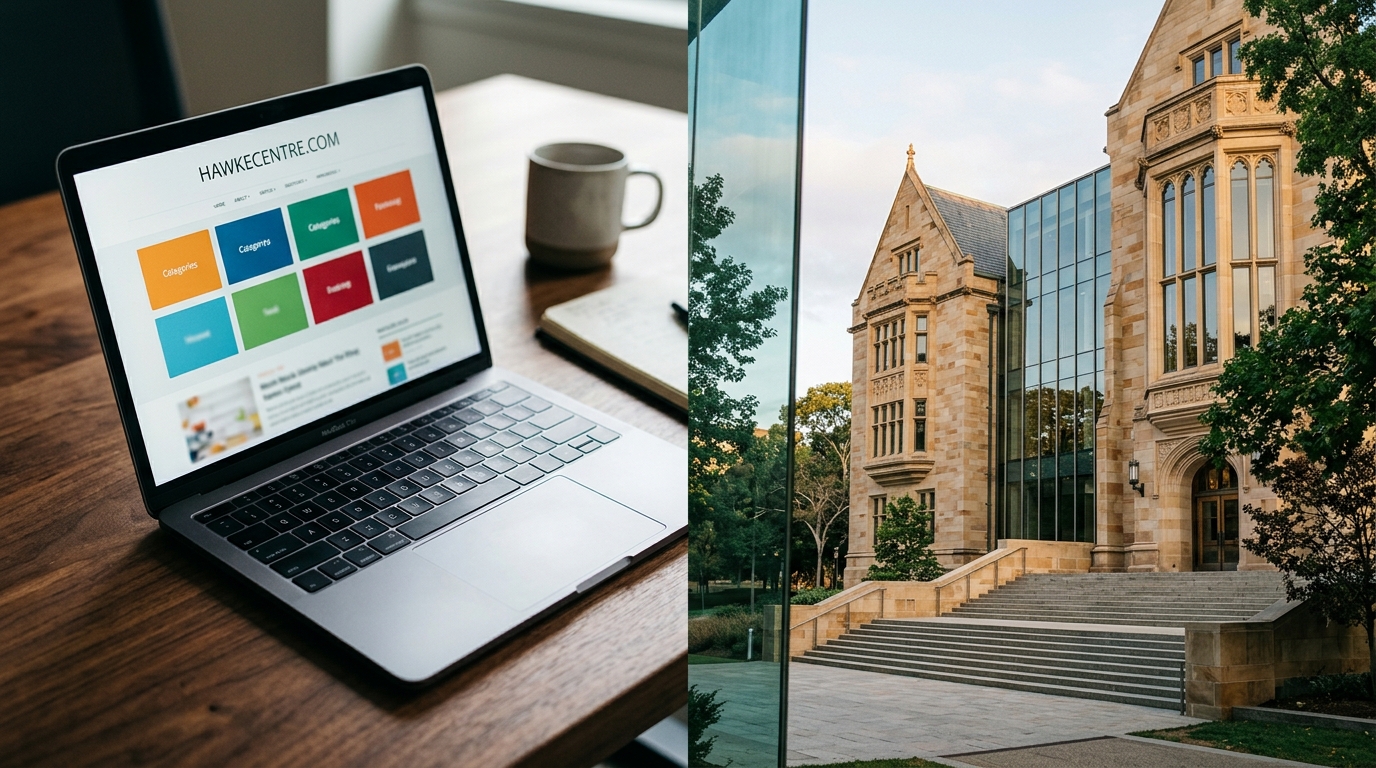
If you searched for hawkecentre .com expecting a university lecture venue, a civic think tank, or a well-known brand, the real answer is more ordinary. It is a general-interest WordPress blog that publishes articles on many unrelated subjects and openly invites outside writers to submit posts. It is not the Hawke Centre in Adelaide, and the mix-up between the two names is the main reason the search results for this keyword contradict each other so badly.
Everything below reflects what was publicly visible on 9 November 2026. Websites change, so treat the details as a snapshot, and note that this article describes a site rather than judging anyone’s intentions.
What you find when you open the site
The homepage carries the tagline “We Love Food, Tech and Travel”, and its menu lists Business, Technology (with AI, reviews and hardware sub-sections), Travel, Games, Fashion, Home Improvement, and an Articles area that includes Advice and Education. The newest posts at the time of writing covered vacation rental management companies in Calgary, warning signs that call for a liver specialist, party wall surveyors in Essex, dental implants abroad, and how teeth and bite affect facial aging. The pagination at the bottom of the homepage runs to 127 pages, so the archive is large.
The topics tell you more than the tagline does. Food and travel barely appear in the recent posts, while local services in several different countries appear constantly. That is the pattern you would expect from a site that takes submissions from outside contributors, and the site says as much on its own pages.
Technically it is a standard WordPress installation using a ready-made news theme from AF Themes. The logo files were uploaded in December 2022 and the About page was first published in January 2023, which fits the roughly three-and-a-half-year domain age that one security checker reported in late 2025.
Three different descriptions of the same site
The site does not describe itself consistently. The About page says it is a source for “all things tech-related”, offering articles, reviews and news updates. The footer on every page instead calls it Australia’s premier destination for SEO and guest posting. The meta description that search engines display says it offers expert SEO and guest posting services in Australia. A reader could reasonably walk away thinking it is a tech blog, a food and travel magazine, or a marketing agency.
The Write for Us page settles most of the question. It asks contributors for original articles of at least 500 words, tells them to pitch an idea first, and says accepted posts are published on the site. It states no price and does not say whether links in submitted posts are marked as sponsored. The disclaimer page adds that content is general information on SEO and digital marketing rather than professional advice, and that the owners accept no responsibility for external sites they link to.
One more detail is worth knowing before you rely on the site for anything. The pages I reviewed give no company name, business registration number or street address. The listed contact points are a Gmail-style address, an admin address at the domain, and a WhatsApp number with a UK country code, even though the site markets itself to Australian businesses. None of that proves a problem, but it does mean you cannot easily tell who stands behind the content.
Why some pages call it a civic and leadership platform
Several third-party articles describe the site as an educational and civic engagement hub that hosts public lectures, exhibitions, leadership forums and policy discussion. Others describe it simply as a publishing platform where businesses and writers post articles. Both cannot be right, and the live site supports the second description.
The .com.au address makes the gap easy to see. Its search snippet calls it a public leadership and civic dialogue platform, yet the homepage itself describes a multi-niche site covering food, technology, travel, health and real estate, with categories such as celebrity biographies, crypto and digital marketing. Among its recent technology posts is a review of online casinos for Australian players. The civic wording sits in the metadata and in articles that echo it, while the pages a visitor actually reads say something else.
The vocabulary also overlaps with how the real Hawke Centre in Adelaide talks about democracy and public debate. Whether that is deliberate or accidental is not something public evidence can answer, but it explains why the descriptions spread and why they are unreliable.
The .com and .com.au pair
Two websites use this name. One lives at the .com address, which redirects to the www version, and the other at hawkecentre.com.au. Both use the Hawke Centre name, both lean on the same food, technology and travel framing, and the .com.au site lists the .com domain’s admin email as its contact address. That strongly suggests a shared operator, although neither site states a relationship.
An author biography on one .com.au article names Muhammad Yaqoub as founder and lead author, with a background in digital marketing and local SEO. That appears on a single page of the .com.au site, and I could not confirm whether the same person runs the .com site, so treat it as an unverified lead rather than an established fact.
How it differs from the Hawke Centre in Adelaide
The real Hawke Centre is formally the Bob Hawke Prime Ministerial Centre. It describes itself as a community-focused centre working toward cohesive, sustainable societies, and it runs a year-round program of free events and exhibitions under the themes of strengthening democracy, valuing diversity and building the future. Its best-known fixtures are the Annual Hawke Lecture and the Nelson Mandela Lecture, and it is home to the Kerry Packer Civic Gallery. It is affiliated with the Bob Hawke Prime Ministerial Library and sits in the Hawke Building at 55 North Terrace, Adelaide.
Its website is hawkecentre.adelaide.edu.au. The centre long belonged to the University of South Australia, and after that university merged with the University of Adelaide, the combined Adelaide University opened in January 2026 and was officially opened on 29 January 2026, according to the South Australian government. The centre’s site now carries Adelaide University branding, although some older UniSA references remain on its pages.
Nothing on the blog’s pages I reviewed mentions the university, the library, the lectures or the gallery. If you want event dates, lecture recordings or gallery details, the university address is the only one to use. If you landed on the blog while looking for those things, you are on the wrong site.
Is the site safe to visit?

Automated reputation tools disagree, which is typical for small, anonymous content sites. Gridinsoft gave it a trust score of 39 out of 100 as of 24 September 2025 and classed it as suspicious. A MalwareTips scan rated it moderate risk with a score of 62, said it was not flagged on the major browser threat feeds, and pointed to unclear ownership and gambling-related affiliate content. Another checker listed Google Safe Browsing as clean and confirmed the site uses HTTPS.
These are automated opinions, partly driven by how little the site reveals about itself, and they may have changed since they were published. I found no confirmed reports of malware or fraud tied to the site. Reading articles with ordinary browser protection carries the same low risk as most blogs. The sensible limits are practical ones: do not enter payment details or personal documents on any page, and treat the health, legal and insurance-claim articles as general reading from contributors, which is exactly what the site’s disclaimer says they are.
Thinking about buying or submitting a guest post there?
Some freelance marketplace listings, according to the MalwareTips write-up, offer paid guest posts on this site, and the site itself invites submissions. If you are weighing that, Google’s published spam policies are the reference point. They treat buying or selling links for ranking purposes as link spam, including exchanging money for posts that contain links, while accepting that sponsored links are a normal part of advertising when they are properly labeled with a sponsored or nofollow attribute. Google has also said that sites publishing or acquiring excessive guest and sponsored posts without proper link tags can face algorithmic or manual action.
In practice, that suggests a few checks before paying anyone. Ask for live addresses of recent placements and confirm they remain online weeks later. Find out who the contracting party is and where they are based, since the site does not say. Agree in writing whether the link will be tagged as sponsored. Avoid anyone who promises specific ranking results, because no publisher controls those.
Explore More
wisestudyspot .com: What the Site Really Publishes and How to Judge It in 2026

I’m Muhammad Ubaid, founder of YBR Magazine. I research and write detailed guides on America’s National Parks — covering entry fees, permits, best times to visit, and planning tips — using official NPS sources and up-to-date information.

