


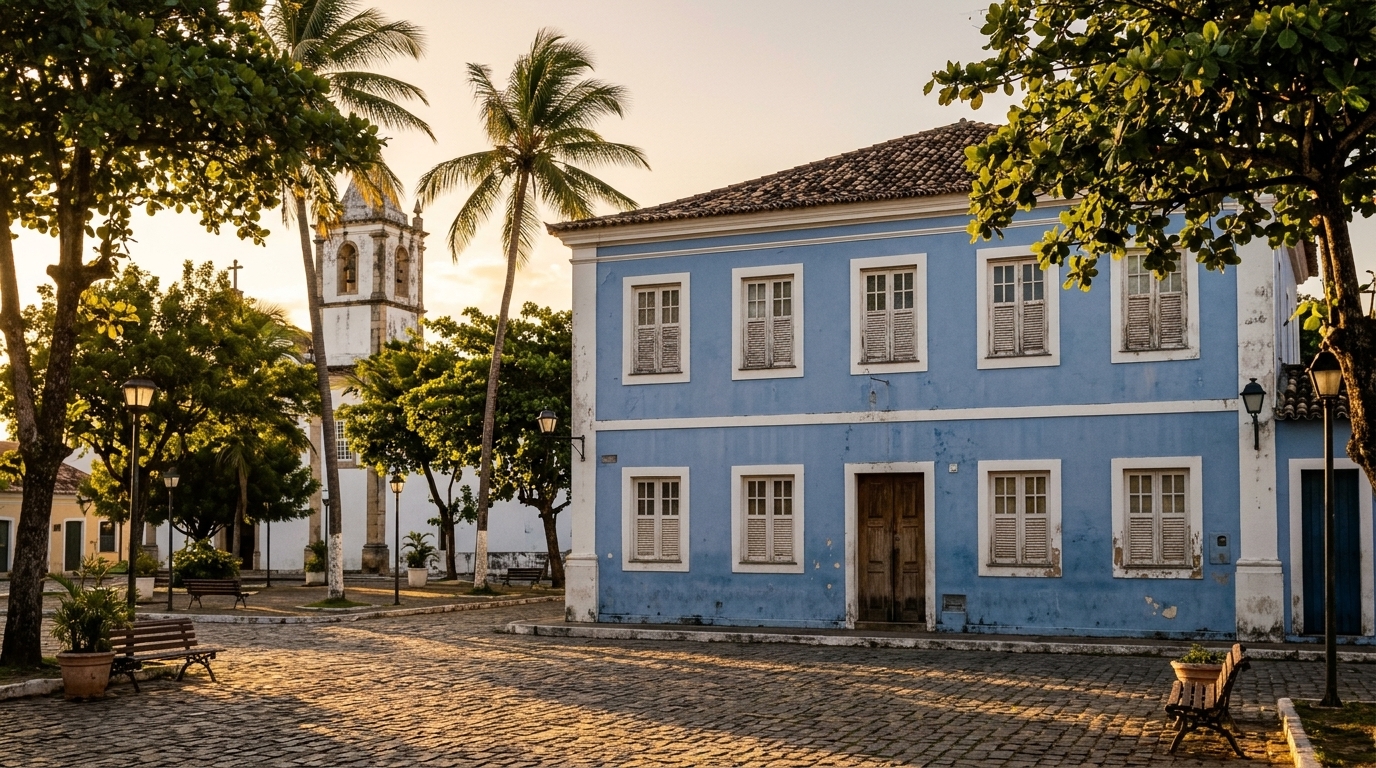
The casarao azul that readers are looking up right now is most likely the historic blue house on Praça São Miguel, in the center of Itacaré, a beach town on the south coast of Bahia, Brazil. It reached national news after a collective mural painted on its walls on 30 October 2026 ended in a confrontation between pro-Palestine activists and a group of Israeli tourists. Reports about that night, and about the weeks around it, differ on several important points, so this article separates what the main sources agree on from what only one side claims. Everything here reflects press coverage and public statements available up to 9 November 2026, and the story is still developing.
A note on sensitivity: the dispute touches a charged political conflict and involves private people. Most details come from parties to the dispute, no court ruling on the episode was found, and allegations below are attributed to whoever made them rather than stated as fact.
What the blue house is, and what nobody has confirmed about it
The building stands on Praça São Miguel, in the central district of Itacaré, and its owner says it has belonged to his family for more than a century. The square carries the name of the saint who gave the town its first name: according to the Brazilian statistics institute IBGE, the place began as an indigenous village where a Jesuit priest raised a chapel to São Miguel, grew into the settlement of São Miguel da Barra do Rio das Contas, and became a vila and municipality in 1732.
Reports describe the house’s earlier uses in different ways. Activists say it once held a music school, while the owner says it was historically used to give temporary shelter to people going through financial hardship. Its construction date, its architect, and any official heritage listing could not be confirmed in public sources, so none of them is stated here.
Shortly before the dispute, the house had been rented to a group of Israelis. According to the activist who organized the mural, they left in the last week of October after the owner asked for the property back. A municipal communications official described the house as a kind of religious base for that group, a description the reports do not independently verify.
How the events unfolded, step by step
The table follows the most detailed reports. The right-hand column shows whose account each step rests on, because several steps come from only one person.
| Date (2026) | What was reported | Whose account |
|---|---|---|
| Last week of October | Israeli tenants leave after the owner asks for the house back | Mural organizer |
| 25 October | The organizer says the owner gave verbal permission for a large mural, including a watermelon, which many Palestine supporters use as a symbol of resistance | Mural organizer; the owner says what was painted went beyond the agreement |
| Friday, 30 October | The mural is painted during Flicaré, the town’s literary festival, held in the same square. At night, Israeli tourists are accused of trying to remove or damage it, and people in the square confront them on video | Mural organizer; videos reported by the press |
| 31 October | The owner asks for the messages to be erased, then for the whole mural to be removed | Mural organizer |
| Monday, 2 November | A painter hired by the organizer covers the mural. The owner posts a video saying the paintings were not authorized, announces security cameras, and bans new interventions | Press reports of the owner’s video |
| Thursday, 5 November | City hall publishes a public statement | City hall |
| Friday, 6 November | The Brazilian Israelite Confederation (Conib) issues a statement, reported the same day | Conib, via Bahia Notícias |
| Saturday, 7 November | The Bahia state human rights secretariat announces prevention measures | State government |
What each side says
The Frente Palestina do Sul da Bahia, coordinated by Itacaré resident and teacher Mariá Veiga, describes the mural as a peaceful community work. It says the phrases included messages about defending local culture and about freedom for all, that nothing in it targeted Israelis, and that about seven visitors tried to erase part of it. In the group’s version, fishermen and residents playing football in the square ran over and protected the wall. The group also alleges that during the tenancy the occupants painted over the face of a Black woman shown on one wall and replaced the Farol da Concha lighthouse symbol with a flag associated with Zionism. Those allegations come only from the Frente: no former tenant could be reached by the press, and the owner did not address them in the coverage reviewed.
One of the painted phrases was “from the river to the sea,” which is where the two camps part ways most sharply. The activists present it as a call for equality and human rights. Conib reads it as a call for the destruction of Israel. Conib also condemned damage to property and any hostility toward people because of nationality or religion, while stating that defending Palestinian rights is compatible with respecting Israelis and Jews.
The owner says the paintings went beyond what he had agreed to, denies any link to political or religious movements, and has told the press he considers the matter closed. The Israeli group that rented the house had not been located by reporters at the time of the most detailed coverage, which means its version is missing from most reports.
City hall says it was not a party to the rental contract and that disputes between private parties should be settled by them or by the authorities. It rejects violence, intolerance and discrimination, declines to take an institutional position on the Israel-Palestine conflict, and denies that students or residents of the town were involved in the mural. Its communications secretary also said that tourism supplies nearly 95% of Itacaré’s economic output, which he gave as a reason the town cannot take sides.
Where the accounts conflict
The date is the first inconsistency. Most detailed reports place the mural and the confrontation on 30 October, but at least two secondary reports say it happened on Thursday, 5 November. That was the day city hall issued its statement, so the later date likely reflects when the story spread rather than when it happened.
The permission is the second. The organizer says she got verbal approval and asked participants to avoid racist or xenophobic symbols. The municipal communications secretary, relaying what the owner told him, says the approval covered only themes about Itacaré’s nature, tourism and local character. No written agreement has been published.
The third is who stepped in that night. The Frente says residents protected the mural on their own, while city hall says the argument was between activists and did not involve residents. Police involvement is also unclear: the Civil Police reportedly said it was not called that night, yet the state human rights secretariat later said that episodes in the region are being investigated by the Civil Police. That announcement also covered other complaints in Itacaré and Morro de São Paulo that are separate from the mural.
A March 2026 clash at another square in town adds a final wrinkle. One outlet says three men were arrested for contempt of authority and taken to Ilhéus, while another says three visitors were taken to a police station and later released, so the accounts disagree on who was detained and what happened next.
Is there an Israeli military operation in Bahia?
Some viral posts link the tension to Israeli soldiers operating in Brazil. One outlet that examined the claim reported that no evidence has been presented of any organized operation by the Israeli government in Itacaré. Many young Israelis travel abroad after finishing mandatory military service, and that fact alone does not turn a trip into a mission. The same report adds that accusations against specific individuals should be checked one by one and cannot be stretched to every Israeli visitor. A municipal official said Israelis are a visible group among foreign visitors but that most foreigners in town are Europeans.
What officials have done so far
The Bahia secretariat of justice and human rights said it is following the episodes and plans to gather state agencies, civil society groups and local communities the following week to discuss prevention. Its plan includes training for tourism workers on the rights of migrants and foreigners, to be led by the consumer protection body Procon-BA together with the state tourism secretariat, along with guidance against racism, sexism and xenophobia. The secretariat is also in contact with the federal foreign affairs, justice and human rights ministries. Its head, Felipe Freitas, framed tourism as something that should rest on coexistence and respect for human rights, and the agency said it wants to balance the protection of residents and traditional communities with the safety of visitors of every nationality and with the right to political expression.
Can you see the casarao azul today?

The mural is gone. The owner has said the house was repainted in its original color, that cameras now cover both the building and the square, and that no new interventions are allowed. Because it sits on a public square, the outside of the house can be seen by anyone walking through the center of Itacaré. Whether the interior is open to visitors, or whether the house currently hosts any business, is not publicly confirmed.
Other buildings with a similar name
The nickname is easy to confuse with other places. Casa Azul in Guarujá, São Paulo, is a modern house by the architecture firm Studio MK27 set in protected Atlantic Forest near Iporanga Beach, and it has no connection to Itacaré. The Casarão dos Azulejos in João Pessoa, Paraíba, is a two-floor, 480-square-meter building covered in tiles that has been protected as heritage since 1980, and today the state government uses it for exhibitions and cultural events.
What to watch next
For anyone following the casarao azul story, three things will show where it goes: the meeting the state said it would hold in the week after its announcement, any findings the Civil Police release about the night of 30 October, and the start of the tourist season that the municipal official placed between December and May, when Israeli visitors return in larger numbers. Until those developments arrive, viral posts about the episode deserve caution, since the strongest claims on every side still rest on accounts that nobody has verified.
Disclaimer
This article is based on press coverage and public statements available up to 9 November 2026. The situation is still developing, and some details may change. Several accounts conflict, and allegations are attributed to the people who made them, not stated as fact. No court ruling has been found. This article does not take a side in the Israel-Palestine conflict. Images are illustrative only and do not show real people or events from the incident.
Explore More
wisestudyspot .com: What the Site Really Publishes and How to Judge It in 2026

I’m Muhammad Ubaid, founder of YBR Magazine. I research and write detailed guides on America’s National Parks — covering entry fees, permits, best times to visit, and planning tips — using official NPS sources and up-to-date information.

