If you searched for “pappedeckel”, you probably ran into a German word and want to know what it means. The short answer is that pappedeckel is a common variant spelling of the German word Pappendeckel, which means cardboard or stiff paperboard. It can also mean a single piece of that material, such as a flat sheet you put under something. Dictionaries list both senses, and their example sentences include scenery made of cardboard and a piece of cardboard placed underneath an object.
The standard spelling is Pappendeckel, with an extra “n” in the middle. A shorter form, Pappdeckel, is also common, and the everyday word is simply Pappe. Pappedeckel is not the form you will find in dictionaries, but people type it often, so it shows up in search results. All of these spellings point to the same family of materials.
Some websites describe pappedeckel as a cardboard lid for cups and food containers. That reading is understandable, because Deckel does mean lid in German. In standard German, however, Pappendeckel refers to the board itself and not to a finished lid. If you want to talk about a lid for a cup, German speakers usually say Becherdeckel. Keeping this difference in mind will save you confusion when you read German product pages or translate texts.
Where the Word Comes From

The word is a good example of how everyday language can hide a long history. Pappe goes back to a Middle High German word meaning porridge or mush, and related words with the same meaning exist in English (pap) and Dutch. The idea fits the material well, because paperboard begins as a wet, mushy mix of fibers. Etymology sources date the use of Pappe for a paper-based material to the 18th century. The meaning of a sheet of thick paper is a shortened form of Pappendeckel, which was originally a term for the bookbinder’s material.
The second half of the word, Deckel, means cover or lid, and it comes from the verb decken, to cover. This word has an interesting connection to English. Papermakers in English-speaking countries use the term deckle for the wooden frame that holds pulp on the mould when making handmade paper, and the word was borrowed from German. The ragged “deckle edge” you see on some high-quality paper and old books is named after that frame. It is a small reminder that German has shaped the vocabulary of papermaking in several languages.
How Pappendeckel Was Made in the Past
Old German sources show that this material was once made by hand through gluing. A printed handbook on fireworks from 1864 describes Pappendeckel as usually being made from sheets of grey paper pasted together and then covered with two sheets of white paper. The book mentions it being used for the casings of large rockets, which shows how strong and useful the material was even then. Bookbinding was another early use, since the covers of books needed a stiff but light material.
Modern production is more efficient, but the basic idea has not changed. Fibers from wood pulp or recycled paper are mixed with water, formed into layers, pressed and dried. The result is a material that is thicker and stiffer than ordinary paper because it contains many bonded layers of fibers.
Paper, Cardboard and Pappe: Where Is the Line?
In everyday speech people use the words paper, cardboard and board almost interchangeably, but German industry standards separate them by weight per area, measured in grams per square meter (g/m², also written gsm). A sheet of 100 g/m² paper means that one square meter of it weighs 100 grams. Under the German standard DIN 6730, material up to about 150 g/m² counts as paper, material between roughly 150 and 600 g/m² is called Karton, and heavier material is Pappe.
These limits are not exact. Different sources set the starting point of Pappe at 220, 225, 500 or 600 g/m², and one frequently cited rule of thumb links 225 g/m² with a thickness of about 1.5 mm. The boundaries are blurred because modern production methods keep changing what is possible. For that reason the weight should be seen as a rough guide and not as a strict rule. Also, an important practical difference is that Karton is made as a continuous web, while Pappe is the broader umbrella term that covers both solid board and corrugated board.
The Main Types of Pappe

Understanding the types will help you choose the right material, whether you are buying packaging or working on a craft project. Pappe is the general term for two big groups: Vollpappe (solid board) and Wellpappe (corrugated board).
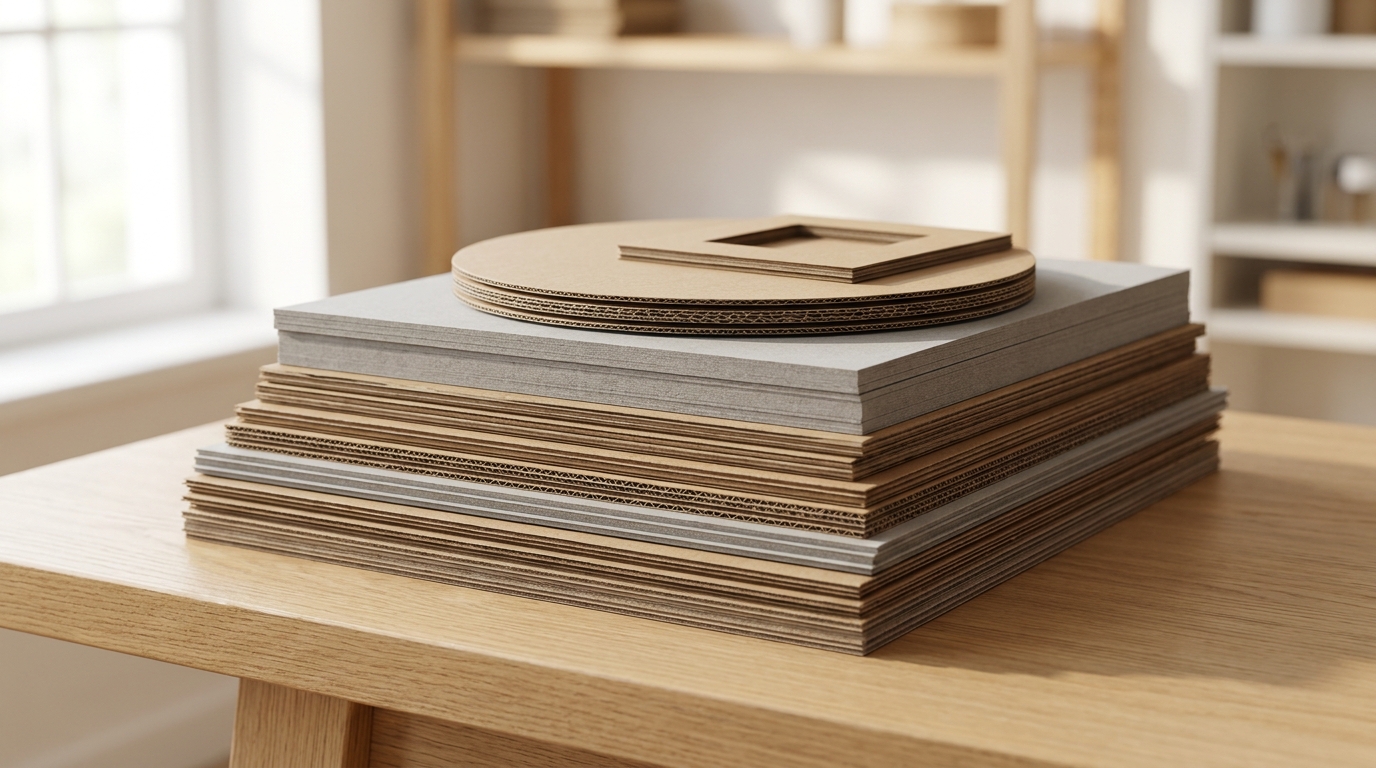
Solid board (Vollpappe) is made from layers of paper pressed or glued into a dense, even sheet. A well-known example is Graupappe (grey board), a low-cost solid board that lies flat and is used as a base for mounted posters and displays, for model building, in architecture studios and in bookbinding. Supplier data sheets show that grey board made from 100% recycled paper comes in many thicknesses, from under one millimeter to several millimeters. Buchbinderpappe is a higher-quality grey board that is smooth on both sides and made from recycled fibers, and it is valued for its stability and flexibility. Holzpappe is a very smooth board made entirely from wood pulp.
Corrugated board (Wellpappe) is built from one or more layers of waved paper glued to flat paper or board. The wave pattern creates small air channels that give the board strength while keeping it light. Single-sided corrugated board has one wavy layer attached to one flat layer, and multi-wall versions stack several layers. This is the material used for most shipping boxes.
Common Uses of Pappendeckel and Related Boards
The most obvious use is packaging, since paper, board and cardboard are among the most widely used packaging materials. Corrugated boxes protect goods during transport, while thinner board is used for folding cartons. Beyond packaging, thick board appears in bookbinding, where it forms the stiff cover of hardback books, and in stage and display work, where it is cut into scenery, signs and backdrops.
Craft and education are other big areas. Students and hobbyists use grey board for architectural models, portfolio covers and boxes, and teachers use cardboard to show how a light material can still carry weight. The same material that holds a shoebox together can be turned into a sturdy desk organizer, a picture mount or a protective underlay for a work surface. Even the beer coaster, which Germans call a Bierdeckel, is a small piece of this kind of board.
Is Pappe Eco-Friendly?
Cardboard has a good environmental reputation, and this is partly deserved. It is made from cellulose fibers, which come from wood, so the material can break down naturally and can be recycled. In Europe, recycled paper has become the most important raw material source for the paper industry, and recycled fibers are used mainly for corrugated board and other board grades. German waste authorities encourage separate collection of paper, board and cardboard because recycling saves resources and protects the climate.
At the same time, it helps to stay realistic. Board that is coated, laminated with plastic or heavily soiled with food may not be accepted in the paper recycling stream, and the rules differ between towns and countries. If you are unsure, check the guidance from your local waste service. Choosing board that is clean, uncoated and made from recycled fibers is usually the simplest way to get the environmental benefits.
A Useful German Expression
Pappe also appears in a popular German saying. If someone says that something is nicht von Pappe, they mean that it is strong, serious or not to be underestimated, which is the opposite of what the flimsy material might suggest. The phrase is informal, and Duden lists it as a colloquial expression. It is a nice detail to know if you are learning German, because it shows how a simple material found its way into everyday speech.
Tips for Choosing and Using the Right Board
Start with the job. For protection during shipping, corrugated board is usually the best choice because its wave structure absorbs shocks. For flat, stiff surfaces such as picture backs, folders or models, solid grey board gives a smoother and more even result. For anything that will touch food, look for products that are clearly labeled as suitable for food contact, because not every board is made for that purpose.
Next, think about thickness. Heavier board is stiffer but harder to cut and fold, so craft projects often go better with medium weights. A sharp knife, a metal ruler and a cutting mat give cleaner edges than scissors on thick board. Finally, store board flat and dry, because moisture is its main enemy and can make it warp or soften.
Frequently Asked Questions
Is pappedeckel a real German word?
The standard dictionary form is Pappendeckel, and Pappedeckel is a variant spelling that is mostly seen online. Both refer to cardboard or a piece of it.
Is Pappendeckel the same as cardboard?
Mostly yes in everyday use, although technical standards separate Karton from Pappe by weight per area.
Can I put it in the paper recycling bin?
Clean and dry board generally can be recycled, but coated or heavily soiled board may not be accepted, so check your local rules.
Conclusion
Pappedeckel may look like a confusing keyword at first, but it leads to a simple and useful subject. It is a spelling variant of Pappendeckel, the German word for cardboard, a material with a long history in bookbinding, craftsmanship and packaging. Knowing the difference between paper, Karton and Pappe, and between solid and corrugated board, makes it easier to read German texts and to pick the right material for your own needs. Whether you are shipping a parcel or building a model, this humble material is, as the German saying goes, certainly not to be underestimated.
Disclaimer: This article is for general information only. Standards, weight limits and recycling rules differ between countries, manufacturers and local authorities, so always check product labels and local guidance before making decisions about packaging, food contact or waste disposal.
Explore More
ext:asp intitle:cart Explained: What This Google Search Does and Why It Matters

I’m Muhammad Ubaid, founder of YBR Magazine. I research and write detailed guides on America’s National Parks — covering entry fees, permits, best times to visit, and planning tips — using official NPS sources and up-to-date information.