


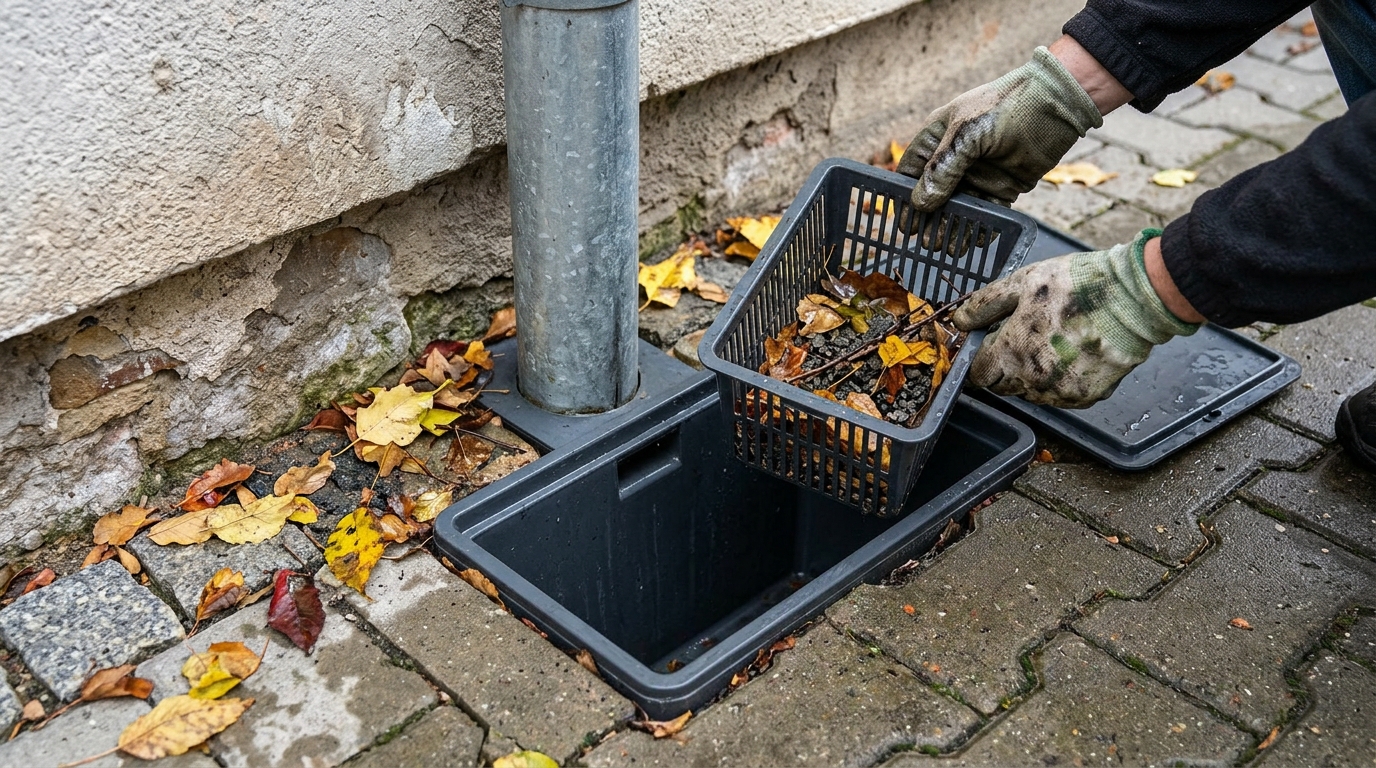
Gajgry is a Czech builder’s word for the small plastic or cast-iron boxes that sit at the bottom of an outdoor rainwater downpipe, where roof water leaves the pipe and enters the drain. Their job is to catch leaves, grit and other roof debris before it reaches the sewer or a rainwater tank, and to stop sewer smell from creeping back up the pipe. The singular is gajgr, and the same part has a formal name, lapač střešních splavenin, which means roughly “roof debris trap”. If you landed here because yours smells, overflows, or you are not sure what to buy, the sections below take those questions one at a time.
Is a gajgr the same thing as a geiger?
In practice, yes. Czech technical portals describe the roof debris trap as something people colloquially call a “geiger”, and public tenders and building survey documents in the Czech Republic use gajgr in brackets next to the formal name. One survey report on a damp basement, for example, lists water seeping in when the debris trap (gajgr) became blocked. The spelling looks like a phonetic way of writing the same word, but I did not find a dictionary that confirms where it comes from, so treat that as a sensible reading rather than an established fact.
The slang is also old. The building portal ESTAV, in a write-up of a talk by Ing. Jakub Vrána, notes that these devices were once called sand traps or roofing-material traps, and that two historic designs are known in Czech lands, the Prague type and the Plzeň type, linked to regulations from 1908. The talk’s title argues that “geiger” is actually the wrong name, which is worth knowing if you ever read a technical document that avoids the slang entirely. Whichever word you use, a shop or an installer will understand you if you also say lapač střešních splavenin.
What is inside a modern gajgr
Manufacturer data sheets from Czech and Austrian suppliers describe a very similar design. The body is usually moulded polypropylene, in some models UV-stabilised for outdoor use and in others reinforced with glass fibre or ribbing so it does not deform when buried. A lid closes the top, and several makers add a lock so the lid cannot pop open and spill water during a heavy downpour. Under the lid sits a removable grating or basket that filters out leaves and small twigs, which is the part you actually clean.
The downpipe slides in from above, and many models include a stop so the pipe cannot slip down into the throat of the trap. Spacer inserts let one body take downpipes from 80 up to 125 mm, while the outlet toward the sewer is typically 110 mm, either at the side or at the bottom. Cast-iron visible parts are also made for listed buildings and historic town centres. Flow ratings vary by model: publicly listed examples range from about 360 to about 528 litres per minute, so compare the figure on the data sheet of the exact product with the roof area it must drain rather than assuming all models behave alike.
Dry flap or wet siphon: which type do you have?
The main difference between products is how they keep sewer air out. A dry type uses a hinged flap that opens under flowing water and closes again afterward. A wet type uses a baffle that holds a small pool of water, which acts as a seal in the same way a sink trap does. Both are sold in Czech catalogues, and the choice matters more than most buyers realise.
| Dry flap | Wet siphon | |
|---|---|---|
| How it blocks smell | Hinged flap closes after flow | Standing water behind a baffle |
| What makers say | Described as frost-resistant and “dry” | Described as stopping odours returning |
| Known drawback | A home-owner forum warns a simple mechanical flap may not seal fully | The same forum warns the water can freeze in winter |
The drawbacks in the last row come from a discussion among home-owners, so treat them as practical experience rather than tested fact. They do match a warning on ESTAV that careless changes to these traps can lead to frost-cracked pipes, which is a reason to keep the type that was designed for your climate and exposure.
Where a gajgr can and cannot be used

These traps belong on outdoor downpipes only. According to the ESTAV talk summary, the lid is not watertight, so if one were fitted on an interior downpipe and became blocked, water would flood the building. Sealed versions for interior downpipes were used in the past, but they did not prove themselves because they demanded constant cleaning, and where they still exist they need regular maintenance. In some cities the traps were once compulsory, while Brno at one time discouraged venting the sewer network through downpipes, so older houses may follow different logic from newer ones.
Why gajgry smell, and what usually causes it
The smell blocker is the flap or water seal, together with a tight joint where the downpipe enters the trap. Manufacturers of side-outlet models stress that a snug downpipe connection also keeps moisture from creeping into insulated façades. If you can smell the drain near a gajgr, the usual suspects are a flap that is stuck, missing or not seating properly, a lid or collar that does not close around the pipe, or a loose joint at the downpipe.
A discussion thread on the Czech advice site Poraďte shows how these problems appear in real houses. One owner with all downpipes connected to a septic tank noticed a bad smell, and replies pointed to a leaky connection to the downpipe, a grating fitted instead of a closed cover, and the lack of a proper odour flap. Those replies are anonymous opinions and should not be treated as a diagnosis, but they illustrate why removing the flap to “let the smell escape upward” is a poor fix. The same thread’s author reported that sewer fumes with ammonia had damaged a copper downpipe. Commenters also questioned whether rainwater should be connected to a septic tank at all; rules on that vary and are something to confirm with a local installer or the authority responsible for drainage in your area.
What a blocked gajgr does to a building
A clogged trap does more harm than a bad smell. ESTAV’s summary explains that when maintenance is neglected the flow through the trap becomes small, and in bigger rains the pipe fills with water to a greater height than designed. A survey report from a Czech public contract on a damp building lists a blocked debris trap as one of the possible faults on the rainwater drainage that caused water to seep in, alongside limited ventilation in the basement. So a few handfuls of leaves at the base of a downpipe can be the difference between a dry cellar and a damp one.
A simple care routine
I could not find an official inspection interval from a standards body or manufacturer, so what follows is common-sense practice and not a rule. The trap is most likely to clog after autumn leaf fall, after storms, and in houses surrounded by trees or with moss-covered roofs. Lift the lid, take out the basket or grating, and remove leaves, grit and roofing granules. Check that the flap swings freely and settles back down, that the lid lock engages, and that the downpipe still sits snugly in the inlet with no gap. A wet type should show standing water behind the baffle, and in frost-prone spots it deserves an extra look after a cold spell.
Choosing and fitting a replacement
Start with the downpipe diameter, because the insert has to match it, then the direction of the outlet. Side-outlet models suit downpipes running through insulated facades or around columns, while bottom-outlet models fit a straight run. Some bodies include a locating sleeve that stops them shifting when set in soil or concrete. After that, check the flow rating against your roof area, the lid lock, and whether the grating is easy to lift out with gloves on. Colour and visible parts matter only for appearance, with the notable exception of historic buildings where cast-iron tops are made to match the setting.
Where a gajgr fits in a rainwater system
A gajgr catches coarse material and does not make rainwater clean. Czech sources describe it as a trap for rough debris that could threaten the sewer pipe. Anyone planning to send roof water into a buried tank should therefore treat the gajgr as the first and simplest stage, and ask the tank supplier what finer filtration they require.
Conclusion
Gajgry are small, easily overlooked parts, yet they decide whether roof water reaches the drain cleanly and whether odours stay out of the downpipe. Knowing the formal name, the dry and wet designs, and the outdoor-only rule makes it much easier to diagnose a smell or a blockage, and to buy the right replacement.
This article gives general information based on Czech trade portals, manufacturer data sheets and public documents available as of November 2026. Drainage rules differ by municipality and property, so confirm details such as septic connections with a qualified installer or your local authority.
Explore More
Windstrebe: What This Diagonal Roof Brace Does and Why Nobody Should Cut It Out Casually

I’m Muhammad Ubaid, founder of YBR Magazine. I research and write detailed guides on America’s National Parks — covering entry fees, permits, best times to visit, and planning tips — using official NPS sources and up-to-date information.

