


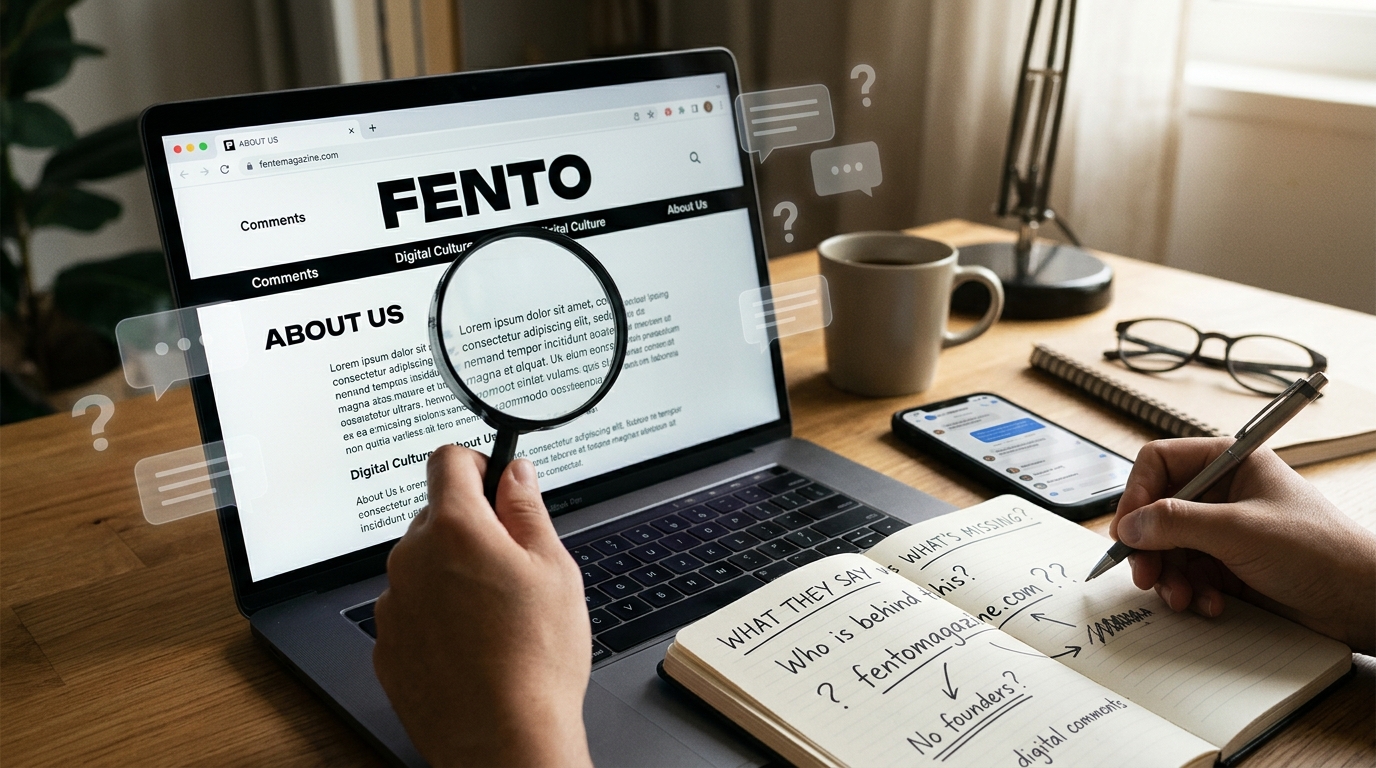
The fentomagazine com about us page is short on company detail but very clear about attitude. It presents Fento Magazine as a publication built on one idea: the comments, opinions and reactions people leave online are not throwaway noise, and they shape how audiences understand news, entertainment, culture and public figures. If you arrived wondering whether the site is a news outlet, a caption library or something else, the honest answer sits somewhere in between. This guide explains what the page says, what it does not say, and how that should affect the weight you give the site. Descriptions of the page here reflect how it and the site’s other public pages were reported by several independent reviews as of November 2026.
What the About Us page says Fento Magazine is for
According to the About Us page, Fento Magazine exists to explore how comments, feedback and digital discussions influence people, culture and society. The page frames online comments as a window into public opinion, something closer to evidence of how audiences react than to clutter under a post. That is an unusual starting point for a magazine, because most publications treat reader comments as an afterthought, while this one treats them as the subject.
The page also describes a method. Rather than simply repeating what people said online, the publication says it wants to give context and explain why a particular conversation matters. In practice that means the stated editorial voice is closer to commentary on internet culture than to original reporting. The topics the page names include social-media reactions, celebrity and influencer commentary, opinions about news, entertainment, pop culture, memes and wider internet trends.
It helps to read this as a statement of intent. An About page tells you what a site wants to be, and it does not prove the site delivers it article by article. For a reader deciding whether to trust a particular post, the page is a useful clue about tone and purpose, and it is not a guarantee of editorial rigor.
What the page confirms and what it leaves open

Most searchers want to know who is behind a site, and this is where the page is thin. Reviews that read it closely report that it does not clearly name a founder, parent company, editor-in-chief or ownership structure, and it refers to the “Fento Magazine team” in general terms. The table below separates what is stated from what is not publicly confirmed.
| Question | What can be said today |
|---|---|
| What is the stated mission? | Examining comments, opinions and online conversations, and the influence they have on people and culture |
| How does it say it works? | By adding context and explaining why conversations matter, not just repeating them |
| Who owns or edits it? | Not clearly named on the pages reviewed, so not publicly confirmed |
| When was it founded? | No reliable source reviewed gives a founding date, so it is left out here |
An anonymous team is not proof of anything bad. Plenty of small online publications are run without public bylines. It does mean you cannot check an author’s background, which is worth remembering when the topic is health or money.
How the content has widened beyond comments
The mission on the About page is about comments and conversation, but the site you see today is wider. The navigation highlights a Comments section, and the site is also known for Instagram captions, Instagram bio ideas and caption-generator style resources. Those tools suit people who post regularly and want wording ideas for different moods, occasions, interests and professions.
Alongside that, reviewers describe a steady mix of general-interest articles covering business, technology, health, lifestyle, fashion, home improvement and marketing. Some of these posts, such as ones on artificial intelligence or business communication tools, have little to do with the original comments theme. The result is a site with two sides: a niche built around online wording and reactions, and a broader multi-topic magazine that reads more like a typical informational blog.
That split explains why visitors describe such different experiences. Someone looking for a caption finds a useful quick resource, while someone expecting investigative journalism finds something else entirely. The more accurate label, used by several reviewers, is a digital magazine or multi-topic online publication, and not a conventional breaking-news organization.
Is there a separate USA edition of the site?

A lot of people reach this topic through the related phrase “fentomagazine com usa”, so it is worth clearing up. The reviews that checked the site’s main navigation found no separately branded American edition. There is one main website, and the “USA” part appears to be a search habit among readers who want to know whether the publication is relevant to them.
The only clear American link reported is legal. The Privacy Policy and Terms of Service are described as naming New York, United States, as the governing jurisdiction. That tells you which law the site’s own terms refer to, and it does not show that the editorial team is based in the United States or that the content is written for an American audience. Treat location as unconfirmed beyond that legal wording.
Who can write for it and how to get in touch
One area where the site is unusually open is contributions. The Contact page is described as inviting feedback, article pitches, guest posts, collaboration requests, and ideas for trends or captions, and it provides an email address for these messages. If you want to propose a piece, that page is the starting point, and the standard pages around it (Privacy Policy, Terms of Service, Disclaimer and Site Map) explain the ground rules.
The disclaimer deserves a quick look before you submit anything or rely on a submitted piece. Reviews note that the site says user-generated material, such as comments or contributed articles, may carry views that do not necessarily represent Fento Magazine itself. In other words, a guest post is the guest’s opinion, and the magazine is not vouching for it line by line.
How to read Fento Magazine sensibly
Because the site’s central subject is opinion, the most useful habit is to keep opinion and fact apart. A comment, however popular, shows what some people felt, and social comments do not necessarily represent wider public opinion. The About page itself leans toward analysis of reactions, so a post about how people responded to a celebrity or a viral moment tells you about the response, not about whether the underlying claim was true.
For practical topics, check the post rather than the brand. Look for a named author, a visible publication or update date, and references to primary sources such as official statements, government pages or original studies. Posts on health, finance or legal matters should be confirmed with a qualified professional or an authoritative organization before you act on them, which the site’s own disclaimer also points toward. Caption and bio ideas carry almost no such risk, since they are creative suggestions and not claims.
Finally, notice what a reader can and cannot verify. You can read the mission, see the categories and send a message through the Contact page. You cannot, from the public pages reviewed, trace ownership, editorial standards or a founding story. That is a reasonable reason to enjoy the content for what it is while staying cautious with anything that carries real-world consequences.
What the fentomagazine com about us page tells you in the end
The fentomagazine com about us page gives you a clear purpose and a limited paper trail. Fento Magazine wants to treat online comments and conversations as meaningful, to add context to them, and to stay open to feedback and contributors, while the site around that mission has grown into a mixed-topic magazine with social-media resources at its center. What the page does not give you is a named owner, a founding date or a statement of editorial standards, so judge each article on its own evidence and use the site as a starting point for ideas and discussion, not as a final authority.
Explore More
Barbeglue: What This Barbecue Adhesive Is, How to Use It, and What Not to Substitute

I’m Muhammad Ubaid, founder of YBR Magazine. I research and write detailed guides on America’s National Parks — covering entry fees, permits, best times to visit, and planning tips — using official NPS sources and up-to-date information.

