


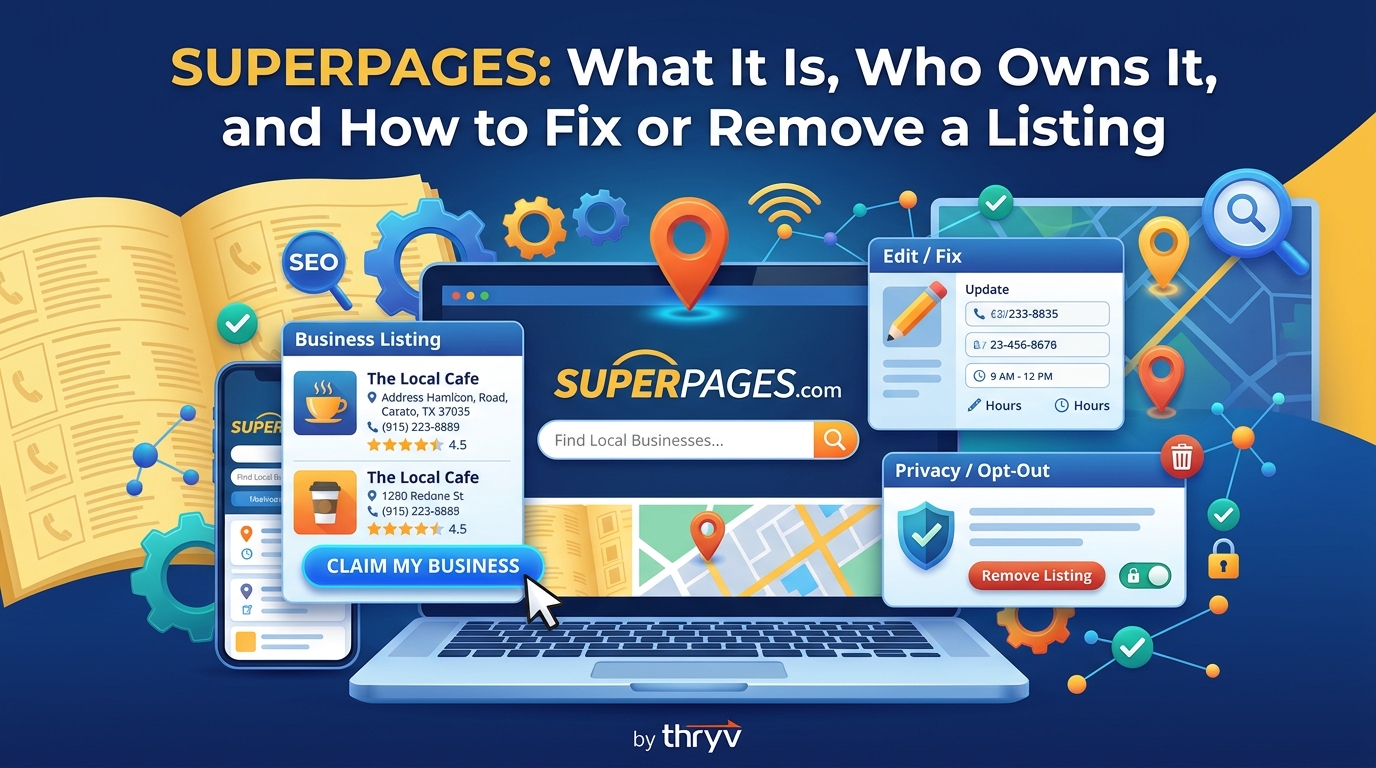
Superpages is an online directory of US businesses that lets people search by name, location or category, and it is owned today by Thryv, the Texas-based company that also runs Yellow Pages. Most visitors arrive for one of two reasons: they want a company’s phone number or opening hours, or they are a business owner who found a listing they never created and want it corrected or gone. This guide covers both situations, explains how the site passed from GTE to its current owner, and sorts out two unrelated technical uses of the same word that often get mixed into the search results.
What a listing shows and where the information comes from
According to DeleteMe, a privacy company whose directory guide was updated in September 2026, a typical entry includes a phone number, address, website link, price range, opening hours, a map, photos and customer ratings or reviews. None of that has to be typed in by the business. The same guide says the site compiles its data from public sources such as phone directories and business registrations, plus third-party data providers, which is why a company can be listed without ever signing up. It also means the reverse can happen: if none of those sources holds your details, you probably will not be in the directory at all.
How a GTE phone-book brand ended up with Thryv

The name is older than most people assume. GTE Directories filed the SUPERPAGES trademark on March 8, 1996, and every later owner of that directory business inherited the brand. The table lists the main hand-offs.
| Year | What happened |
|---|---|
| 2000 | Bell Atlantic and GTE merge to form Verizon, and the directory units become Verizon Information Services |
| 2006 | Verizon spins its directory business off as Idearc |
| 2009 | Idearc goes through bankruptcy and re-emerges as SuperMedia |
| 2013 | SuperMedia and Dex One complete their merger (April 30) and become Dex Media |
| 2016 | Dex Media restructures its debt through a prepackaged Chapter 11 and emerges in August |
| 2017 | Dex Media buys YP Holdings, the publisher of the Real Yellow Pages |
| 2019 | Dex Media renames itself Thryv Holdings; it lists on Nasdaq directly in October 2020 |
Two details are worth separating from the table. First, Thryv’s own announcement of the 2017 YP Holdings deal named Superpages.com and DexKnows.com among the consumer search portals being combined, so the site has been kept as a separate brand rather than folded into Yellow Pages. Second, the long chain of owners explains why old articles, trademark records and help pages still mention Verizon, SuperMedia or Dex Media. If a guide names one of those companies as the current owner, it is out of date.
Is it legitimate, and does a listing still help?
DeleteMe describes the site as legitimate in the sense that it does what it says, which is publish business information across the US. That is a fair description, but it is not evidence of influence. No independently verified traffic or ranking figures for the site turned up in my research, so any statistic claiming a precise share of local searches should be treated with caution.
What can be said with confidence is how a directory entry relates to Google. A listing here is not a Google Business Profile. Thryv’s own support pages state that using its online listing management does not automatically make you the owner of your Google profile, and that ownership has to be claimed through Google’s process, which is typically free apart from possible verification costs such as a postcard. Think of the directory as one more place where your name, address and phone number should be right, not as a replacement for the profile people see on Google Maps.
How to claim or correct your Superpages listing
Synup’s walkthrough describes a form-based route. Scroll to the bottom of the homepage, click the blue “Claim My Business” button, open the contact form it points to, and check that the reason for contact reads “Add, Edit or Remove a Listing”, which is already selected by default. The form has three parts: the reason for contact, your contact and business details, and a free-text message where you say what you want changed. A short, specific request works best, such as asking to claim the entry and fix a wrong phone number.
Older guides, including one from Local SEO Guide, describe a different flow in which you type your phone number into a “Find My Business” box and then confirm by email. That guide also warns that call-tracking numbers sold by the directory’s former parent companies could have generated duplicate entries, which is a common reason a business appears twice. Because those instructions are dated, follow whichever process the site shows today, and give the form the same name, address and phone number you use everywhere else so a duplicate can be matched and merged.
Free listing or paid sales pitch? What owners report
Thryv states that listing your company on Yellow Pages is free and that you can claim a listing in a few clicks. Some owners say their experience was different. A thread on the Local Search Forum describes a claim form that led to a sales call from Thryv instead of a simple update, and several complaints on the Better Business Bureau’s Thryv page come from customers who say they believed they had agreed to a free one-line listing but were later billed for a paid product. These are individual accounts rather than proven findings, and the company does reply to complaints, but the pattern is a useful warning.
The practical lesson is to keep two things apart. Claiming or correcting a basic entry is one request; buying advertising or Thryv’s software, which among other things syncs business details across more than 30 listing sites, is another. If anyone phones about your listing, ask for the offer in writing, check what is being billed and how often, and do not agree to charges you cannot see in a document.
How to remove a listing or opt out
There are two routes, and they are not obviously the same thing. DeleteMe’s guide starts at the “Privacy Policy” link in the site footer, continues to a “Directory Opt-Out” link on Thryv’s privacy page, and then walks through entering a zip code, registering with an email address, confirming it, and choosing “Opt-Out of All” before confirming twice. The button labels in that flow refer to opting out of or ordering directories, which suggests it may be aimed at printed books, and the guide says your information will be removed afterwards without separating print from online. Data-broker tracker Optery lists a different address for privacy requests, the site’s CCPA page, as the company’s primary opt-out URL.
Given that mismatch, the safest approach is to submit the request through the privacy page and then search the directory yourself a few weeks later to confirm the entry is actually gone. DeleteMe also cautions that directories sometimes relist information when they find it again elsewhere, so a repeat check every so often is sensible. Removal matters most for sole traders and home-based businesses, whose business phone number or address may also be personal.
The other things “superpages” can mean
The word is also used in two technical fields that have nothing to do with business listings. In operating systems, a superpage is a block of memory larger than the standard page, which is 4 KB on x86-64. Processors on that architecture commonly support 2 MiB pages and, on CPUs with the right flag, 1 GiB pages; Linux usually calls them huge pages. The appeal is speed. A translation buffer with 64 entries covers only 256 KB with 4 KB pages, but 128 MB with 2 MB pages, which cuts the number of costly address lookups for memory-hungry software such as databases.
The catch is that large pages need physically contiguous, aligned memory with consistent attributes, and a mostly empty large page wastes space. Linux offers both pre-reserved pages and transparent huge pages, where the kernel promotes memory automatically; Oracle’s documentation notes that on x86_64 the transparent option only assigns 2 MB pages. Research on making this work without changing applications goes back to a well-known 2002 OSDI paper on operating system support for superpages.
The third meaning is smaller still. The climate group 350.org built a custom WordPress content type it calls superpages, which gives editors full control over a page’s layout. Its own documentation admits the trade-off: these pages take longer to create, are harder to edit and break more easily than normal pages. It appears to be a tool for that organization’s own sites rather than a public plugin.
Explore More
Gajgry Explained: What They Are, How They Work, and What To Do When They Smell or Clog

I’m Muhammad Ubaid, founder of YBR Magazine. I research and write detailed guides on America’s National Parks — covering entry fees, permits, best times to visit, and planning tips — using official NPS sources and up-to-date information.

