


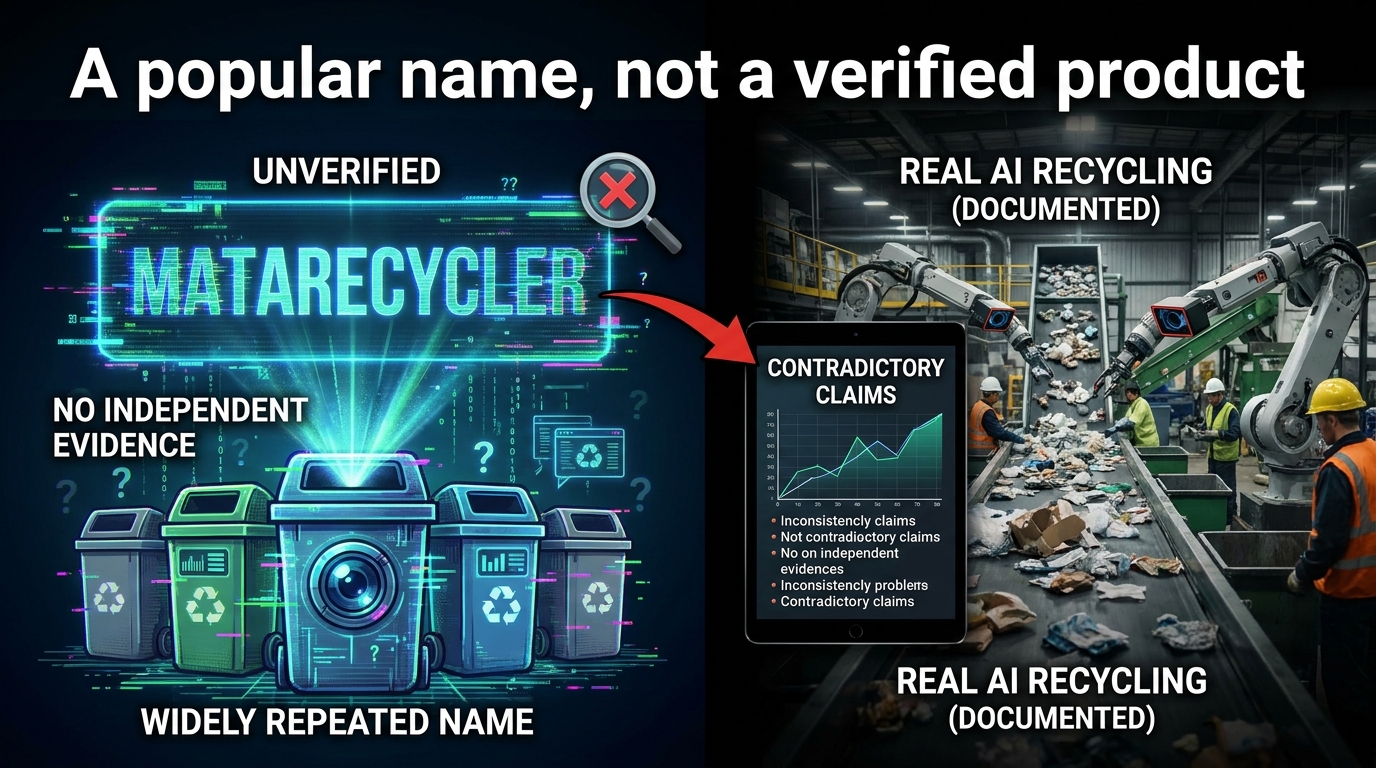
Search for matarecycler and you will find dozens of pages describing a smart recycling system with AI cameras, sensor-equipped bins, and impressive accuracy numbers. What you will not find, once you look past those pages, is a named company, a product page you can verify, or a city that publicly says it uses one. As of mid-November 2026, the honest answer is that this is a widely repeated name with very little independent evidence behind it. This article explains what is confirmed, what is contradictory, and how the real technology these pages borrow from actually works.
The short answer: a popular name, not a verified product
Most of the pages that describe the system sit on newly created blog networks, free hosting subdomains such as vercel.app, pages.dev and netlify.app, or general news-style sites whose menus cover fashion, gaming and finance as well as recycling. A handful of fact-check style reviews published in 2026 reached cautious conclusions. One found no independently documented pilot city or facility, no published pricing, and no independently audited performance results. Another reported that public domain records place the creation of the matarecycler.com website in November 2025 and that no founder or executive could be established from reliable sources. A third went further and called the name a fabricated search keyword.
Those reviews come from small publications, so they are best read as support for a pattern rather than as final proof. The stronger evidence is what is missing: my own searches also turned up no company registration, press release, municipal contract, or statement from a waste authority that mentions the name. Unverified is the accurate label. It is not the same as proven false, and it would change if a named operator published details that others could check.
Where the pages contradict each other
If one real product were being described, the descriptions would agree on the basics. They do not, which is one of the clearest signs that the pages are copying a name rather than documenting a thing.
| Question | What different pages claim | Why it does not hold together |
|---|---|---|
| What is it? | An AI sorting line; smart bins with an app and leaderboards; a chemical process for recycling polyester; a general idea of reusing data and workflows | These are four different kinds of product, and no page links them to one maker |
| When did it start? | Pilot projects “in the early 2000s” on one page; a website domain created in November 2025 according to one review | A 2000s origin is hard to square with a name that only seems to appear online from late 2025 |
| Who runs it? | One page names a founder; other reviews found no named founder or executive in reliable sources | A single unsupported mention is not confirmation |
| Does it work? | A pilot in “a mid-sized U.S. city” with a 30% rise in recycling rates; a pilot in “a mid-sized European city” with a 45% drop in landfill contributions | Neither names a city, dates, or a source document, and the figures differ |
| How accurate is it? | Sorting accuracy of 95–98% versus 85–90% for human sorters | No test method, sample, or independent audit is given |
Nothing here is a reliable data point. Where a claim appears in only one place, or appears in several places with the wording slightly changed, it tells you about the content network and not about recycling.
Why so many near-identical articles exist

This part is my interpretation, not a confirmed fact. A new, unusual word has almost no competition in search results, so publishers can reach page one quickly by producing a standard article around it. The typical result is a page with the same skeleton: a friendly definition, a list of key features, a comparison with traditional recycling, a case study with round numbers, and a short FAQ. When the pages are written from each other instead of from a source, errors and invented details spread, and the repetition starts to look like confirmation.
How to check any recycling-technology claim yourself
The same checks work for any product that claims to improve recycling, whether or not it is the one discussed here.
- Look for a named operator you can find elsewhere, such as a registered company, a contact address, or a facility with a public address.
- Ask where the pilot happened. A real municipal or commercial deployment usually leaves traces, such as council minutes, tender documents, or a local news report.
- Find out what “accuracy” means. Sorting accuracy counted by items, by weight, or by purity of the final bale can give very different numbers for the same machine.
- Look for independent testing, not a figure the seller or an affiliated site publishes about itself.
- Check the date. Recycling rules and material markets change, so a result with no date and no location is hard to interpret.
What real AI recycling looks like, and where it struggles
The ideas these pages describe do exist, and they are worth understanding on their own terms. Reporting from the Columbia Climate School describes modern facilities using robots with AI vision, high-resolution cameras, hyperspectral imaging and near-infrared sensors. It notes that a human sorter typically handles 50 to 80 items an hour, while a robot with optical sensors can handle up to about 1,000. The National Institute of Standards and Technology is also reported to be using infrared spectroscopy with AI robots to identify specific plastics.
The picture is less tidy than the marketing-style pages suggest. Trade coverage in Recycling Today explains that optical sorters read the chemical makeup of a material but can struggle with distinctions such as food-grade versus non-food-grade HDPE, which is where AI can add value. The same article quotes a sorting-equipment manager saying that if a facility is already happy with its optical sorter and it is not overloaded, adding AI will not improve sorting results. A 2025 research paper on arXiv tested optical recognition on plastics and concluded that its success on real-world material at recovery facilities was limited, mainly because the methods lean on color and shape. A separate student research study found that contamination lowers the accuracy of image-recognition models, which means dirty input hurts the very systems meant to cope with it.
That last point matters for any claimed accuracy figure. According to figures cited in that study from the National Solid Wastes Management Association (the name the study uses), contamination runs from roughly 10% to 25% of recycling streams across the United States depending on local habits and rules. The EPA is quoted in industry coverage as estimating that about a quarter of recycling truck hauls are too contaminated to go to a recycling facility. A system that performs at 95% on clean test images may do noticeably worse on a wet, mixed load, which is why a number without conditions tells you little.
What this means depending on why you searched
If you came looking for a product to buy, fund, or install, treat it as unverified until a named provider and independent evidence appear. If you are a student or writer, cite the underlying sources on AI sorting and contamination instead of pages that describe a system nobody has documented. If you simply want to recycle better at home, your local program’s list of accepted materials is the authoritative guide, and the sources above point to contamination as the common problem.
Note: this article is for information only and is not purchasing, investment or legal advice.
Questions people ask
Is it an app?
One review found no clearly verified consumer app. Some third-party pages mention scanning, rewards and tracking, but none identifies an official developer or a confirmed app-store listing.
Is it a person or a celebrity?
Nothing reliable suggests so. The reviews that looked into it found the name used for a recycling-themed website, not a profile of an individual.
Does the name have a meaning beyond waste?
One blog uses it as a loose idea for reusing digital files and workflows as well as physical materials. I found that usage in a single article, so it is not an established term.
Could this change?
Yes. A named organization could publish verifiable details at any time, and any assessment would need updating then.
Bottom line
Based on what could be checked as of November 2026, matarecycler is best understood as a name that spread through repetitive web content, not a documented company or system. The recycling technology described in its name is real, but it is documented by research and trade reporting elsewhere, with limits that the glossy pages rarely mention.
Explore More
mamaisguitars.com: What the Website Shows Today and How to Stay Safe

I’m Muhammad Ubaid, founder of YBR Magazine. I research and write detailed guides on America’s National Parks — covering entry fees, permits, best times to visit, and planning tips — using official NPS sources and up-to-date information.

