


Power outages can interrupt everyday activities, affect essential household appliances, and create unexpected challenges for families. From keeping refrigerators running to maintaining internet connectivity, lighting, and essential equipment, having a dependable backup power solution can make a significant difference.
Traditional fuel-powered generators have been a common choice for emergency electricity. However, many homeowners are now considering battery-powered alternatives that offer quieter operation, flexible charging options, and less routine maintenance.
One technology attracting attention in residential backup systems is lithium iron phosphate, commonly known as LiFePO4.
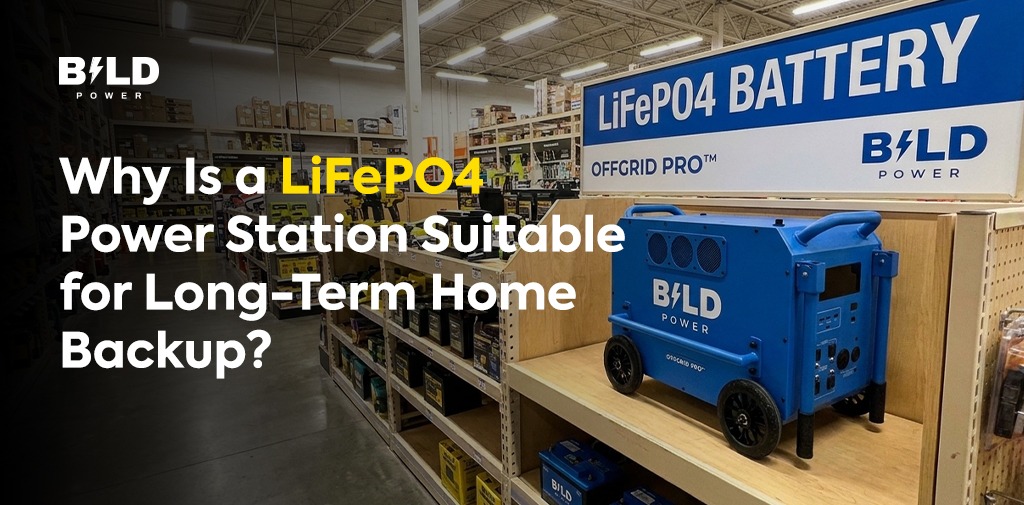
A LiFePO4 power station combines rechargeable battery storage with an inverter and electrical output connections to provide backup electricity when grid power is unavailable. Its long cycle-life potential, thermal stability, and suitability for repeated charging make it an attractive option for homeowners who need dependable energy storage.
But what makes a LiFePO4 power station suitable for long-term home backup? How long can it last, what appliances can it support, and what should homeowners consider before purchasing one?
Let’s explore the technology, its advantages, and how a high-capacity solution such as the BILD Power OffGrid Pro can support household backup needs.
1. What Is a LiFePO4 Power Station?
A LiFePO4 power station is a rechargeable energy storage system that uses lithium iron phosphate battery chemistry.
Unlike a traditional generator, which produces electricity by burning fuel, a battery power station stores electrical energy and releases it when needed. An integrated inverter converts the battery’s stored DC electricity into AC electricity for compatible household appliances.
A typical portable LiFePO4 power station includes:
- LiFePO4 battery cells: Store electrical energy for later use.
- Battery management system (BMS): Monitors battery conditions and provides protective functions.
- Inverter: Converts DC battery power into AC electricity.
- AC outlets: Supply power to compatible household appliances.
- USB and DC connections: Support smaller electronics and compatible devices.
- Charging inputs: Allow the battery to recharge through compatible AC or solar sources.
These components work together to provide a convenient source of backup electricity.
For homeowners, this means a battery power station can supply selected appliances and essential equipment during an outage without requiring a running combustion engine.
2. Why Is LiFePO4 Battery Technology Suitable for Long-Term Backup?
One of the biggest advantages of LiFePO4 technology is its potential for extended cycle life.
A battery experiences gradual chemical and physical changes as it repeatedly charges and discharges. Over time, these changes reduce its ability to store and deliver energy.
LiFePO4 batteries are designed to handle repeated charging and discharging, making them suitable for applications where regular use is expected.
Here are some of the main characteristics that make this battery chemistry attractive for home backup.
Longer Cycle-Life Potential
Battery cycle life describes how many charge and discharge cycles a battery can complete before its capacity falls to a specified level.
Many LiFePO4 energy storage products advertise thousands of cycles under defined testing conditions.
This is particularly useful for homeowners who expect to recharge and use their backup system regularly rather than keeping it exclusively for emergencies.
For example, a system rated for 6,000 cycles may offer substantial long-term use potential. However, this rating should always be evaluated alongside the manufacturer’s testing conditions, depth of discharge, temperature, and remaining-capacity threshold.
A cycle-life rating does not mean the battery will retain its original capacity indefinitely.
Good Thermal Stability
LiFePO4 chemistry is known for its comparatively good thermal stability among lithium-ion battery chemistries.
This characteristic makes it attractive for residential energy storage, where dependable battery operation and appropriate protective controls are important.
However, thermal stability does not mean a battery is immune to overheating, electrical faults, or damage.
A properly designed battery management system, suitable installation environment, and compliance with manufacturer operating instructions remain essential.
Consistent Energy Storage Performance
LiFePO4 batteries are widely used in rechargeable energy storage applications because they can support repeated charging and discharging.
For home backup, this means homeowners can recharge their power stations after an outage and prepare them for future electricity interruptions.
The actual performance depends on the battery design, inverter, operating conditions, and charging practices.
Reduced Routine Maintenance Compared With Fuel Generators
A battery power station does not require engine oil changes, fuel refilling, or spark plug replacement.
This can make day-to-day ownership simpler compared with conventional fuel-powered generators.
However, battery systems still require attention. Homeowners should follow recommended storage conditions, inspect cables and connections, maintain appropriate charging levels, and observe the manufacturer’s maintenance guidance.
3. How Does a LiFePO4 Power Station Support Household Appliances During an Outage?
The usefulness of a home backup system depends on which appliances it can operate and for how long.
A high-capacity power station can support multiple household devices, provided their combined power requirements remain within the system’s rated output.
Common household backup priorities include:
Refrigerators and Freezers
Refrigerators and freezers are among the most important appliances to consider during an extended power outage.
They help preserve food and reduce the risk of spoilage when grid electricity becomes unavailable.
A compatible battery power station can operate a refrigerator, but homeowners should check its running wattage, compressor startup demand, and expected operating pattern.
Internet Routers and Communication Equipment
Internet access is important for remote work, communication, business operations, and access to emergency information.
A battery backup system can support compatible routers, modems, networking equipment, and charging devices.
These relatively low-power loads may be practical priorities when planning how to use stored battery energy.
Lighting and Essential Electronics
Portable power stations can provide electricity for compatible LED lighting, televisions, laptops, mobile phones, and other electronics.
Keeping these devices operational can help households maintain normal routines during an interruption.
Water Pumps and Other Essential Equipment
Some households rely on electric pumps and other equipment for everyday operations.
A suitable backup power system may support these devices, but their voltage, running wattage, starting requirements, and electrical connections must be checked carefully.
The appliance’s requirements should always be compared with the power station’s specifications before connecting it.
4. How Does Battery Capacity Affect Long-Term Home Backup?
Battery capacity determines how much energy a power station can store.
It is generally measured in watt-hours (Wh) or kilowatt-hours (kWh).
One kilowatt-hour equals 1,000 watt-hours.
For example, a battery with a nominal capacity of 9,792Wh stores approximately 9.8kWh of energy.
However, a larger battery does not automatically guarantee longer backup time for every household. Runtime depends on how much electricity your appliances consume and how much of the stored energy is available for use.
How to Estimate Backup Runtime
You can estimate battery runtime using this formula:
Estimated Runtime (Hours) = Usable Battery Capacity (Wh) ÷ Average Appliance Load (W)
For example, suppose a home backup system has an estimated usable energy capacity of 8,000Wh and the household’s selected appliances consume an average of 800W.
8,000Wh ÷ 800W = 10 hours
This is a simplified estimate. Actual runtime will vary because of inverter conversion losses, appliance cycling, temperature, standby consumption, and battery operating limits.
Example of Household Energy Consumption
Consider this illustrative backup plan:
| Household Equipment | Estimated Average Power | Daily Operating Time | Daily Energy |
| Refrigerator | 150W | 10 hours | 1,500Wh |
| LED lighting | 60W | 6 hours | 360Wh |
| Wi-Fi router | 15W | 24 hours | 360Wh |
| Television | 100W | 4 hours | 400Wh |
| Laptop | 65W | 5 hours | 325Wh |
| Total | 2,945Wh |
These figures are examples, not universal appliance ratings. A refrigerator’s compressor cycles on and off, so its actual daily consumption should ideally be measured or taken from its energy label.
The example demonstrates why homeowners should calculate their energy requirements before choosing a backup battery.
A household that prioritizes refrigeration, lighting, and internet equipment may need considerably less stored energy than one that also wants to operate air conditioning, electric heating, or other high-demand appliances.
5. Why Is a LiFePO4 Power Station a Practical Alternative to Traditional Generators?
Fuel-powered generators can provide substantial electricity during outages, but they come with operating requirements that some homeowners would prefer to avoid.
A LiFePO4 power station offers a different approach to backup electricity.
Quiet Operation
Battery power stations operate without a running combustion engine.
This makes them quieter than conventional fuel generators and can be beneficial in residential environments where engine noise may disturb family members or neighbors.
Fans or cooling components may still produce some operating noise, depending on the model and load.
No On-Site Fuel Storage for Battery Operation
A battery power station stores electricity rather than relying on gasoline or diesel.
Homeowners do not need to store fuel specifically to operate the battery system.
This can simplify emergency preparation and reduce concerns associated with keeping combustible generator fuel on-site.
No Combustion Exhaust During Battery Operation
A battery power station does not burn fuel while supplying electricity.
Therefore, it does not produce combustion exhaust during normal battery-powered operation.
This is an important difference from fuel generators, which produce carbon monoxide and other exhaust gases. Fuel-powered generators must always be operated outdoors, away from doors, windows, and ventilation openings, according to safety guidance.
Flexible Charging Options
Many modern LiFePO4 power stations support multiple charging methods.
Depending on the model, these may include:
- Standard AC wall charging.
- Compatible solar panel charging.
- Other manufacturer-approved charging inputs.
Solar compatibility can be particularly useful during extended outages when grid electricity is unavailable but sufficient sunlight is available.
Less Engine-Related Maintenance
Without an internal combustion engine, battery power stations avoid many maintenance requirements associated with fuel generators.
There is no engine oil to replace or fuel system to maintain.
However, homeowners should still inspect the system and follow battery storage, charging, and operating recommendations.
6. Can Solar Charging Make a LiFePO4 Power Station More Useful for Extended Outages?
One challenge with any battery-based backup system is that its stored energy is finite.
Once the battery reaches its operating limit, it must be recharged before it can supply more electricity.
Solar charging can help address this limitation.
A compatible solar power setup allows homeowners to recharge a battery station using energy from sunlight.
This can be particularly valuable during extended outages caused by storms, infrastructure problems, or other disruptions.
Benefits of Solar-Compatible Battery Backup
Additional Charging Flexibility
Solar panels provide another way to recharge the battery when grid electricity is unavailable.
Reduced Dependence on Grid Charging
A suitable solar configuration can help homeowners replenish stored energy without relying entirely on conventional electrical outlets.
Support for Essential Equipment
During an extended outage, solar charging may help maintain energy for refrigeration, lighting, communication devices, and other priority loads.
Useful for Off-Grid Applications
The same battery system can also support cabins, RVs, workshops, and other locations where conventional electricity may be limited.
What Should You Check Before Connecting Solar Panels?
Solar compatibility involves more than choosing panels with a high advertised wattage.
Check the following:
- Maximum supported solar input wattage.
- Solar input voltage range.
- Maximum input current.
- Connector type and polarity.
- Series and parallel connection requirements.
- Panel compatibility and environmental operating limits.
The total solar input must remain within the power station’s published electrical specifications.
Actual charging performance also depends on sunlight intensity, panel angle, shading, weather, and temperature.
7. What Should Homeowners Look for in a Long-Term LiFePO4 Backup System?
Not every portable power station is designed to support the same household requirements.
Before purchasing a system, consider its overall design rather than focusing on battery chemistry alone.
Battery Capacity
Look for a battery capacity that matches your expected energy consumption.
A small system may be enough for communication equipment and lighting, while a larger system may be necessary for refrigeration, pumps, and other essential appliances.
Continuous Power Output
Continuous output determines how much electricity the system can supply while operating within its rated limits.
Add the running wattage of the appliances you plan to use simultaneously and compare the total with the power station’s continuous output rating.
Surge Capacity
Some appliances, especially compressors and motors, draw additional electricity when starting.
Check the power station’s surge rating and its specified duration to determine whether it can handle those temporary demands.
Voltage Compatibility
Many household devices use 120V electricity in the United States, while some larger appliances require 240V.
If your home backup plan includes 240V equipment, look for a system with the appropriate split-phase output and compatible electrical connections.
Battery Management System
A battery management system monitors important battery operating conditions.
Depending on its design, protective functions may include:
- Overvoltage protection.
- Undervoltage protection.
- Overcurrent protection.
- Temperature monitoring.
- Short-circuit protection.
- Cell balancing.
Review the manufacturer’s documentation to understand the specific protections included.
Charging Speed and Solar Input
A large battery is more useful when it can be recharged within a practical timeframe.
Compare the AC charging rate, maximum solar input, and supported charging configurations with your expected energy requirements.
Warranty and Manufacturer Support
Long-term ownership involves more than battery cycle life.
Review the warranty period, coverage limitations, service availability, replacement policies, and technical support arrangements.
A clear warranty helps you understand what protection is available if a system develops a problem.
8. How Does BILD Power OffGrid Pro Support Long-Term Home Backup?
For homeowners looking for a high-capacity portable energy solution, the BILD Power OffGrid Pro combines LiFePO4 battery technology with substantial electrical output and solar charging capability.
It is designed for applications that extend beyond small electronics, including household backup, RV use, professional equipment, and off-grid power needs.
Here are some of its published specifications:
9,792Wh Battery Capacity
OffGrid Pro provides approximately 9.8kWh of nominal stored energy. This capacity can support selected household appliances and essential equipment, depending on their energy consumption and the usable battery capacity.
LiFePO4 Battery Technology
The system uses lithium iron phosphate battery chemistry, which is valued for its cycle-life potential and thermal stability.
6,000+ Cycle-Life Rating
BILD Power advertises a cycle life of more than 6,000 cycles. As with any battery specification, actual performance depends on operating conditions and the testing criteria used to establish the rating.
120V/240V Split-Phase Output
The system supports both 120V and 240V output configurations for compatible appliances and equipment.
7,200W Rated Output at 240V
Its published product specifications list 7,200W rated output at 240V and 3,600W at 120V. This provides flexibility for a range of compatible household and professional electrical loads.
Solar Charging Capability
OffGrid Pro lists up to 3,700W of high-voltage solar input, providing an additional charging option when used with compatible solar panels.
Which Household Applications Can It Support?
Depending on appliance requirements and system configuration, OffGrid Pro may be suitable for:
- Refrigerators and freezers.
- Internet routers and networking equipment.
- Essential household lighting.
- Televisions, laptops, and charging devices.
- Compatible water pumps.
- Selected air-conditioning equipment.
- Other household appliances within its electrical limits.
Homeowners should calculate the combined running wattage and startup requirements before connecting appliances.
A power station’s battery capacity determines its available energy, while its inverter output determines which loads it can operate. Both specifications matter when planning household backup.
Explore the BILD Power OffGrid Pro Portable Power Station to review its technical specifications and see whether it matches your home’s backup requirements.
9. How Can You Extend the Useful Life of a LiFePO4 Power Station?
Although LiFePO4 batteries are designed for repeated use, proper operating practices can help maintain their performance over time.
Here are several ways to care for a home backup battery system.
Follow the Recommended Charging Range
Use the charging limits recommended by the manufacturer.
Avoid assuming that every battery should remain at 100% charge continuously or that it is safe to discharge completely.
Some manufacturers provide specific storage-charge recommendations for periods when the system will not be used.
Avoid Excessive Heat
High temperatures can accelerate battery aging.
Keep the power station in a suitable environment and avoid exposing it to direct sunlight or other unnecessary heat sources.
Always observe the manufacturer’s operating and storage temperature ranges.
Use Compatible Charging Equipment
Only use approved charging equipment and compatible solar panels.
Incorrect voltage, current, or connection arrangements can affect performance and create electrical risks.
Avoid Repeated Overloading
Do not exceed the power station’s continuous output or surge limits.
Running appliances beyond the system’s rated capabilities can trigger protective shutdowns and may damage connected equipment.
Inspect Connections and Cables
Periodically inspect power cables, plugs, and connections for visible damage.
Do not use damaged electrical components, and seek qualified assistance if you notice unusual heating, odors, swelling, or other signs of a potential fault.
Follow Long-Term Storage Instructions
If the system will remain unused for an extended period, follow the manufacturer’s recommended battery charge level, inspection schedule, and storage environment.
Proper storage is an important part of maintaining rechargeable battery performance.
10. Is a LiFePO4 Power Station Worth Considering for Long-Term Home Backup?
For many households, a LiFePO4 power station can be a practical alternative to traditional fuel generators, especially when quiet operation, flexible charging, and repeated use are priorities.
Its suitability depends on the home’s energy requirements and the system’s electrical capabilities.
A smaller battery station may be sufficient for lighting, internet equipment, and mobile devices. A high-capacity model may be more appropriate for households that want to support refrigeration, pumps, and other demanding appliances.
Before making a purchase, consider:
- Which appliances must remain operational during an outage?
- How much energy do those appliances consume?
- How many hours or days of backup power do you need?
- Does the system provide the correct voltage and continuous output?
- Can it handle appliance startup demand?
- Can solar panels or another supported charging method replenish its battery?
- Does the manufacturer provide clear warranty and technical support information?
Answering these questions will help you choose a backup system based on practical household requirements rather than advertised specifications alone.
Frequently Asked Questions
1. How long does a LiFePO4 power station last?
The useful life of a LiFePO4 power station depends on its battery cycle-life rating, usage patterns, temperature, charging practices, and overall system design. Some products advertise several thousand charge and discharge cycles. The battery’s capacity gradually decreases as it ages, even when properly maintained.
2. Is LiFePO4 better than lithium-ion for home backup?
LiFePO4 is a type of lithium-ion battery chemistry. It is often selected for energy storage because of its cycle-life potential and comparatively good thermal stability. The best choice depends on the system’s design, energy capacity, power output, warranty, and intended application.
3. Can a LiFePO4 power station run a refrigerator during a power outage?
Yes, a compatible LiFePO4 power station can run a refrigerator if it provides sufficient continuous output, startup power, voltage, and battery capacity. Check the refrigerator’s electrical specifications before connecting it.
4. Can a LiFePO4 battery power an entire house?
Some high-capacity battery systems can support substantial household loads, but whether they can power an entire home depends on the home’s electrical demand, inverter output, battery capacity, and connection arrangement. High-demand appliances may need to be excluded or operated selectively.
5. Can a LiFePO4 power station stay connected to solar panels?
Many models support solar charging, but the panels must meet the manufacturer’s input voltage, current, connector, and wattage requirements. Follow the approved connection instructions for safe operation.
6. Does a LiFePO4 power station require regular maintenance?
LiFePO4 power stations generally require less routine maintenance than fuel-powered generators because they do not have combustion engines. However, owners should inspect cables, maintain appropriate storage conditions, and follow the manufacturer’s charging and maintenance guidance.
7. Is a LiFePO4 power station safe to use indoors?
A battery power station does not produce combustion exhaust during normal operation, unlike a fuel-powered generator. However, indoor use must still follow the manufacturer’s instructions, ventilation requirements, placement guidance, and electrical safety precautions. Never operate a fuel generator indoors or in an enclosed space.
8. How much battery capacity do I need for home backup?
The required capacity depends on your daily energy consumption and how long you need backup electricity. Calculate the watt-hours required by your priority appliances and account for conversion losses and usable battery limits before selecting a system.
9. Can a LiFePO4 power station operate a 240V appliance?
Some models support 240V output, including compatible split-phase systems. Check the appliance’s voltage, current, plug, and power requirements against the power station’s published specifications.
10. Is a 6,000-cycle LiFePO4 battery guaranteed to last 6,000 days?
No. A battery cycle represents a defined amount of charging and discharging, not one calendar day. The actual number of years a battery lasts depends on how frequently it is cycled, operating conditions, and the manufacturer’s cycle-life testing criteria.
Final Thoughts: Reliable Home Backup Starts With the Right Battery Technology
Choosing a home backup system is about more than having electricity available during an outage. It is about selecting an energy solution that matches your household’s essential needs, offers practical charging flexibility, and can support repeated use over time.
LiFePO4 technology stands out because of its cycle-life potential, thermal stability, and suitability for rechargeable energy storage. When combined with adequate battery capacity, appropriate inverter output, and compatible solar charging, it can provide a useful foundation for a modern home backup strategy.
For homeowners seeking substantial portable energy storage, the BILD Power OffGrid Pro brings together a 9,792Wh LiFePO4 battery, 120V/240V split-phase output, and solar charging capability in one system.
Whether you want to keep essential household equipment operating, prepare for extended outages, or create a more flexible off-grid power setup, take time to evaluate your energy requirements and compare them with the system’s specifications.
Explore BILD Power and discover a high-capacity portable power solution designed for home backup, work, and life beyond the grid.

I’m Muhammad Ubaid, founder of YBR Magazine. I research and write detailed guides on America’s National Parks — covering entry fees, permits, best times to visit, and planning tips — using official NPS sources and up-to-date information.

