


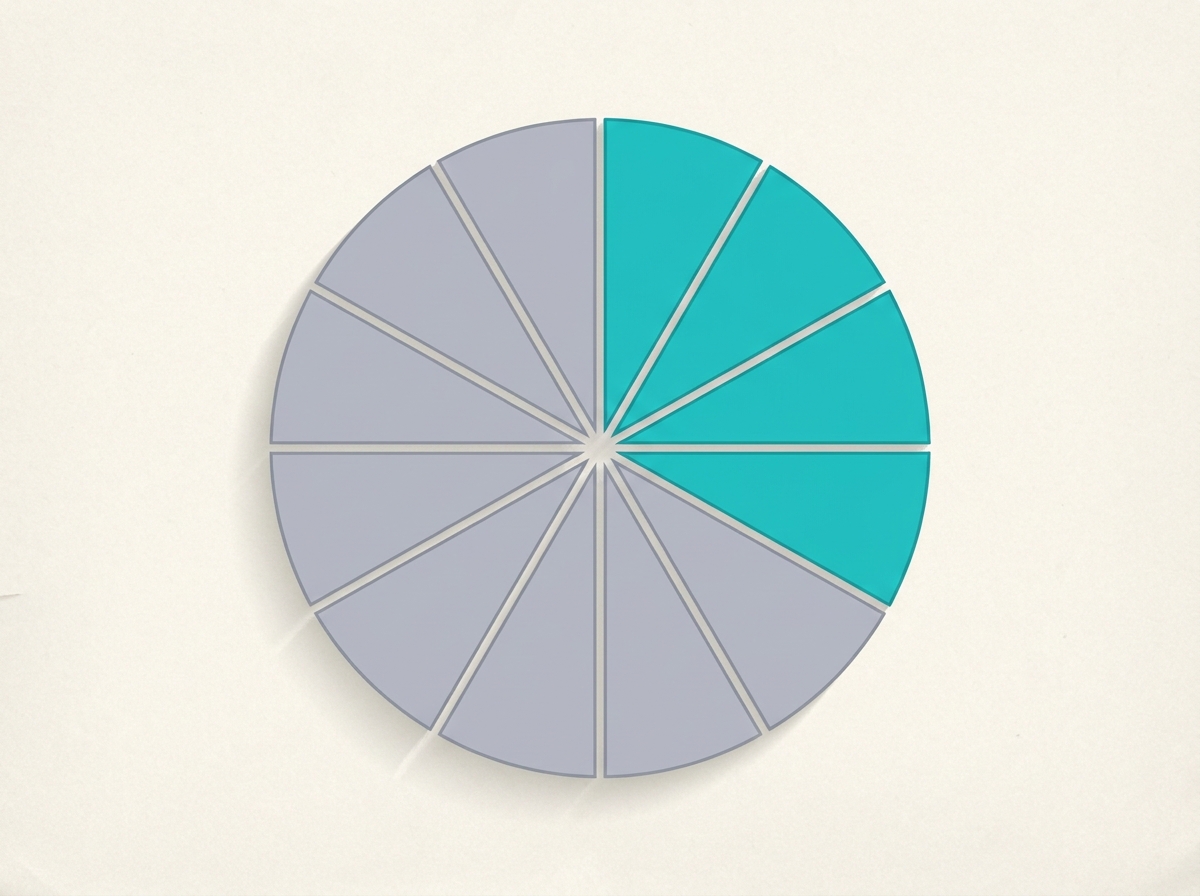
The decimal .3125 as a fraction is 5/16, and that is already the simplest form, so there is nothing left to reduce. If the answer was all you needed, you can stop here. If you want to see where 5/16 comes from, or you ran into a different answer on another site and want to know who is right, the sections below show the conversion, give you a fast way to verify it, and explain the mistakes that cause wrong answers to circulate.
That last point matters more than it might seem. Most of the calculator-style pages that appear for this search agree on 5/16, but at least one page states that the value is 1/4, which is simply incorrect because 1/4 equals 0.25. Several other pages mix the number up with 3.125, a different value that converts to 25/8. Knowing why those errors happen is the best protection against repeating them.
How to turn .3125 into a fraction, step by step
This method works for any decimal that ends after a few digits, and it relies only on place value. Take .3125 as the example:
- Count the digits after the decimal point. There are four (3, 1, 2, and 5), which means the last digit sits in the ten-thousandths place.
- Write the digits as the numerator and put 1 followed by four zeros underneath: 3125/10000. The zero some people place before the decimal point changes nothing.
- Find the greatest common divisor of 3125 and 10000. It is 625.
- Divide the top and bottom by 625. That gives 3125 ÷ 625 = 5 and 10000 ÷ 625 = 16, so the result is 5/16.
If you do not spot 625 right away, you can reduce in smaller bites instead. Both numbers can be divided by 5 again and again: 3125/10000 becomes 625/2000, then 125/400, then 25/80, and finally 5/16. Four rounds of dividing by 5 is the same as dividing once by 625, and you stop when the top and bottom no longer share a factor.

Why the reduction stops at 5/16
The prime factors explain the whole thing. The number 3125 is 5 multiplied by itself five times, while 10000 is 2 multiplied by itself four times and then multiplied by 5 four times. They share four factors of 5, which is where 625 comes from. After those cancel, the numerator keeps a single 5 and the denominator keeps four 2s, which multiply to 16. Since 5 contains no factor of 2, nothing else can cancel, and the fraction is fully reduced.
This also tells you why the decimal ends cleanly instead of running forever like 1/3 does. A fraction in lowest terms produces a finite decimal only when its denominator is built from 2s and 5s alone, and 16 is made entirely of 2s.
A shortcut using fractions you already know
You can also reach the answer without any division by splitting the decimal into familiar pieces. The number .3125 is the same as 0.25 plus 0.0625, and those are 1/4 and 1/16. Rewrite 1/4 as 4/16, add 1/16, and you get 5/16.
This approach is useful when you work with measurements in sixteenths, because each step of 1/16 is worth 0.0625. It also gives you a sense check for any answer you find online. Since .3125 falls between 0.25 and 0.375, a correct fraction must land between 1/4 and 3/8, and a claim of 1/4 fails that test immediately.
How to check the result in ten seconds
Divide the top of the fraction by the bottom: 5 ÷ 16 comes out to exactly 0.3125 with nothing left over. You can also go the other direction by multiplying 0.3125 by 16, which should give a whole number, and here it gives 5. When the multiplication lands on a clean integer equal to your numerator, the pair is confirmed.
Look-alike numbers that cause wrong answers
Most errors come from a small change in the digits or the position of the decimal point. The table shows how close values lead to very different fractions.
| Decimal | Fraction in lowest terms | Common slip |
|---|---|---|
| 0.3125 | 5/16 | Stopping at 3125/10000 without reducing |
| 3.125 | 25/8 | Using this answer for the number without the 3 in front |
| 0.03125 | 1/32 | Dropping the extra zero and giving 5/16 |
| 1.3125 | 1 5/16 (or 21/16) | Forgetting the whole number part |
| 0.325 | 13/40 | Treating a missing digit as a typo |
The pair 3.125 and 0.3125 deserves the most care. The first has three decimal places, so it starts as 3125/1000 and reduces by 125 to 25/8, while the second has four decimal places and reduces by 625. The digits are identical, but the place values are not, so the answers are not interchangeable.
Where 5/16 sits among the sixteenths
Because 16 is the denominator, it helps to see the whole run of sixteenths side by side. This is the list most people reach for when matching a decimal on a ruler, a spec sheet, or a drawing.
| Fraction | Decimal |
|---|---|
| 1/16 | 0.0625 |
| 1/8 (2/16) | 0.125 |
| 3/16 | 0.1875 |
| 1/4 (4/16) | 0.25 |
| 5/16 | 0.3125 |
| 3/8 (6/16) | 0.375 |
| 7/16 | 0.4375 |
| 1/2 (8/16) | 0.5 |
Notice that only the odd sixteenths stay as sixteenths. The even ones collapse into eighths, quarters, or a half, which is the same reduction process in action.

What 5/16 looks like as a percent, an inch, and a millimeter value
Multiplying the decimal by 100 gives 31.25%, so a pie cut into 16 equal slices has about 31 percent of its area in five of them. The same ratio shows up in everyday measurements, and the easiest example is length. Since an inch is defined as exactly 25.4 millimeters, five sixteenths of an inch comes to 7.9375 millimeters. Sizes such as 5/16-inch bolts and sockets are common in hardware stores in the United States, so people searching for this conversion are often working from a tool or parts list rather than a math worksheet.
Getting the fraction from a calculator or spreadsheet
A scientific calculator with a fraction or decimal-toggle key will usually show 5/16 once you enter 0.3125 and press that key. In a spreadsheet such as Excel, you can type 0.3125 into a cell, open Format Cells, choose the Fraction category, and pick either “Up to two digits” or “As sixteenths” to display 5/16.
Be careful with the broader fraction presets. If you pick “As quarters,” Excel can only show quarters, so it rounds the value to the nearest quarter and displays 1/4 even though the cell still holds 0.3125. That is a display limit, not a real conversion, and it is a good reminder to check any rounded fraction against the original decimal.

Questions readers often ask next
Is 5/16 bigger or smaller than one third?
It is slightly smaller. One third is about 0.3333, so 5/16 sits roughly 0.0208 below it, which is a gap you would notice in precise work.
What if there is a whole number in front, such as 2.3125?
Keep the whole number and attach the fraction, giving 2 5/16, or convert it to an improper fraction by multiplying 2 by 16, adding 5, and writing 37/16.
Does it matter that the number starts with a dot instead of a zero?
No. The form .3125 is a shorthand you often see in machining, engineering, and older reference tables, and it has exactly the same value as 0.3125.
The takeaway
Whenever you meet .3125 as a fraction, remember that four decimal places mean a denominator of 10000, and that 625 is the number that shrinks it to 5/16. From there, a quick division of 5 by 16 confirms the answer, and a glance at the nearby sixteenths tells you whether it makes sense in context.
EXPLORE MORE: Mother and Daughter Spa Day: How to Plan One That Works for Both of You

I’m Muhammad Ubaid, founder of YBR Magazine. I research and write detailed guides on America’s National Parks — covering entry fees, permits, best times to visit, and planning tips — using official NPS sources and up-to-date information.

