


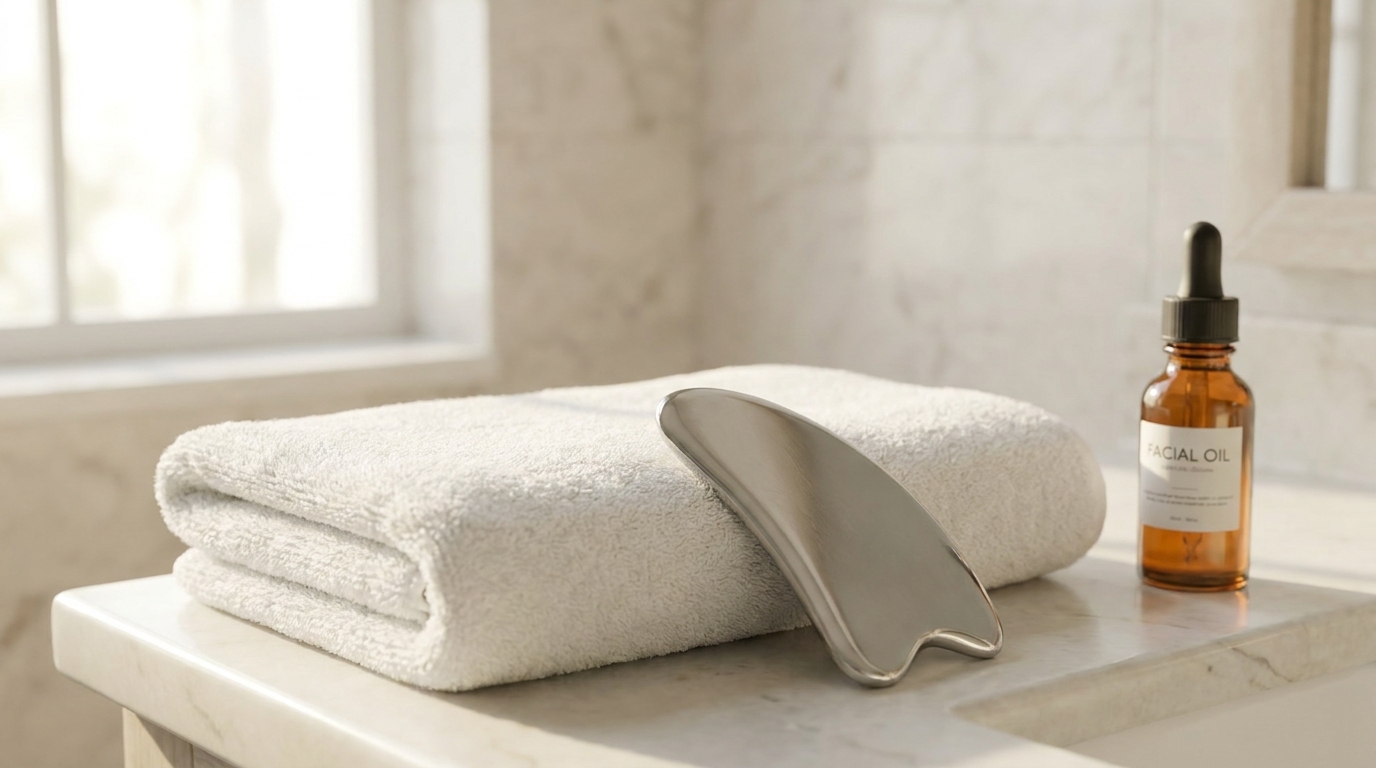
A stainless steel gua sha is a small, flat, smooth tool that you glide over your face with a little oil, and it has become one of the most popular skin care tools of the last few years. The big promises are a sharper jawline, fewer wrinkles, and a glow that lasts all day. The honest answer from skin doctors and research is smaller than that. A gentle routine can reduce puffiness for a short time and feel relaxing, but it does not change your bones or remove lines for good. This guide explains what the studies really show, why some people pick steel over jade, what to know if you have a nickel allergy, and how to use the tool without hurting your skin. Shop details in this article come from listings checked in November 2026, and prices change often.
What Can a Stainless Steel Gua Sha Really Do for Your Face?
The short answer is that it can help with morning puffiness, and not much more has been proven. Cleveland Clinic says there is not enough high-quality research to declare the benefits of gua sha for sure, but it explains that the gentle downward motion may help move lymph fluid, which could lessen facial puffiness and leave you feeling fresh. A 2026 report in Dermatology Times, written for skin doctors, reaches a similar view. It calls the effect real but modest, describing a short-term drop in facial swelling and a small boost to blood flow at the skin surface.

Where the “four times more blood flow” claim comes from
You may have seen a claim that gua sha increases blood flow by four times. It comes from a small 2007 study of 11 healthy people. The researchers found about four times more blood flow at the skin surface, and it lasted around 25 minutes. The catch, as Dermatology Times points out, is that this study used firm pressure on the back to raise red dots on purpose, with no comparison group. It did not test the light, gentle stroking people do on their faces at home, so it cannot prove that a face routine does the same thing.
What the best face study found
The best face-focused study so far is a 2025 randomized trial that compared a facial roller with gua sha over eight weeks. According to Dermatology Times, the gua sha group showed reductions of about 2.2 to 2.4 millimeters in some distances measured on the face, along with a change in a measure of muscle tone. That is a real result from a proper trial, but it is small, and the reviewers believe it comes mostly from fluid and relaxed muscles. The same report says the data do not support permanent wrinkle removal, lasting collagen growth, or changes to fat or bone. A dermatologist quoted in a lifestyle report said the lifted look often fades within 24 hours, which fits this picture. A 2023 review in the Journal of Cosmetic Dermatology also found the evidence too weak to back strong anti-aging claims.
Is Stainless Steel Better Than Jade or Rose Quartz?
For results, there is no proof that steel beats stone, and a consultant dermatologist quoted by RTE in 2026 said the benefits come from the massage technique rather than the stone itself. Cleveland Clinic’s acupuncturist goes even further and says a small wooden spoon works just as well as a gemstone tool. So the real question is which material is more practical for you. A Gulf News buying guide notes that stainless steel stays cool naturally and is less likely to chip when dropped, which is why it suggests steel for beginners. That matters because Cleveland Clinic says you should stop using any tool that chips or breaks. Makers also say steel is non-porous, so it does not trap germs the way a rough stone might, and some say you can chill it in the fridge for extra de-puffing. These are brand claims, not tested results, but they match how the material behaves in daily life. Some buyers do say steel feels heavier than stone, which you may like or dislike.
It also helps to know that the story behind the tool is less clear than shop pages suggest. Dermatology Times says traditional gua sha was done with firm pressure on the back and body, and a Guardian article quotes a dermatologist who calls the face version a modern commercial idea. One lifestyle report, on the other hand, says wealthy families in 17th-century China began using jade tools for beauty. Sources disagree on this point, and stainless steel itself is a modern material, so a steel tool is not an ancient tradition.

Is a Stainless Steel Gua Sha Safe If You Have a Nickel Allergy?
This is the question most buying guides skip, and it matters because nickel allergy is common. A 2018 paper in Contact Dermatitis says up to 17 percent of women and 3 percent of men in the general population are allergic to nickel. Many stainless steels contain nickel, including the popular 304 and 316 types, so people reasonably worry. The research is more comforting than you might expect. A French lab study published in 1997 tested several steels in artificial sweat and on patients who were already allergic to nickel. Low-sulfur grades such as 304, 316L, and 430 released very little nickel, less than 0.03 micrograms per square centimeter per week, and caused no reactions. A nickel-plated sample released about 100 micrograms, and a high-sulfur grade called 303 caused reactions in 14 percent of patients.
The lesson is that the exact grade and the finish matter more than the words “stainless steel” on the box. The problem is that many cheap tools do not tell you the grade. A shopper on one large retailer’s page reported that the brand’s support team said it does not specify the grade, and another buyer doubted that the tool was real stainless steel. If you have a nickel allergy, look for a tool that names its grade, such as 304 or 316, avoid anything described as plated or coated, and test it on a small area first. Stop right away if you see redness or itching, and ask a dermatologist if you are unsure. A gua sha only touches your skin for a few minutes, which lowers the exposure, but the choice is still worth making with care.
How to Choose a Good Stainless Steel Gua Sha
Start with the material details, because they are the part that you cannot see in photos. A clear grade on the product page is a good sign, and so are one solid piece of metal and a smooth finish with no sharp seams. Run a clean fingertip along every edge before you use it on your face, since a tiny burr can scratch your skin. Shape comes next. A dermatologist quoted in a lifestyle report on AOL says smooth, rounded edges suit unidirectional massage, while more angular edges work better for focused areas like the jawline. If you want one tool for the whole face, pick a curved side for the cheeks and a straighter side for the jaw.
Price is a weak guide to quality. The listings I checked in November 2026 ran from about 20 to 45 US dollars, with some tools on sale for much less than their usual price, and the cheaper ones are not always worse. Read the product page for the grade, the return policy, and the care instructions instead. Some brands also sell larger steel tools made for the body. These are a different product from a small face tool, so do not mix them up.
How to Use a Stainless Steel Gua Sha Gently at Home
A good routine is simple, and it follows the advice from Cleveland Clinic and the dermatologist in the RTE report. First wash the tool and your face. Then spread a generous layer of facial oil, serum, or moisturizer so the steel glides instead of drags, because dragging can cause tiny injuries to the skin. Hold the tool nearly flat and use light pressure. Cleveland Clinic says a little pinkness is fine, but it should never hurt, and the dermatologist added that facial gua sha should not leave marks, since bruising is not the goal on the face.
Work from the center of your face outward, for example from the nose toward the ear, and move in one smooth direction rather than rubbing back and forth. Repeat each move about five to ten times on each side, which is the amount that dermatologist described as enough. Skip any area that is swollen, because pressing there can break tiny blood vessels. Experts do not agree on how often to do this. One retailer suggests three times a week, while one practitioner quoted in a lifestyle report suggests daily use for stress relief. Because no schedule has been proven, a gentle few times a week, with a look at how your skin reacts, is a sensible place to begin.

Who Should Skip It or Ask a Doctor First?
Never use the tool on irritated or inflamed skin, such as rashes, open wounds, or sunburn, according to Cleveland Clinic. The clinic also says gua sha may not suit people with circulation problems, diabetes, skin conditions like eczema or psoriasis, or people who take blood thinners, are having chemotherapy, or are pregnant, so it is wise to talk with a health professional first. Dermatology Times adds a few more cautions that matter for the face. People with rosacea, visible tiny blood vessels, or a tendency to bruise or develop dark marks may do better with gentler options such as an ice roller. Anyone who has recently had filler or neuromodulator injections should check with their provider, because pressure on the area could move the product before it settles.
How to Clean and Store Your Stainless Steel Gua Sha
Clean the tool before and after each use, because oils and serums build up on it. Care advice varies by maker, which is a good reason to read your own instructions. One brand’s care card says to wash its steel tool with water, and another maker says its steel tool can be sanitized with alcohol. Dry it well and keep it in a pouch or a clean drawer so it does not rub against hard objects. If you chill the tool in the fridge, as some makers suggest, wipe it clean first and keep it away from open food.
The Bottom Line on a Stainless Steel Gua Sha
A stainless steel gua sha is a sensible tool if you want something that will not chip, is easy to clean, and feels cool on the skin. It is not a way to reshape your face. The proven effects are small and short, the technique matters more than the material, and your grade of steel matters most if you have a nickel allergy. Choose a tool that names its grade, use plenty of oil and light pressure, move in one direction, and stop if your skin tells you to. Used that way, it is a calm, low-cost ritual that can help you start the day with a less puffy face.
This article is general information and not medical advice. If you have a skin condition, an allergy, or a health problem, speak with a doctor or dermatologist before starting.
EXPLORE MORE: How do I choose a durable window frame material for different climate zones?

I’m Muhammad Ubaid, founder of YBR Magazine. I research and write detailed guides on America’s National Parks — covering entry fees, permits, best times to visit, and planning tips — using official NPS sources and up-to-date information.

