


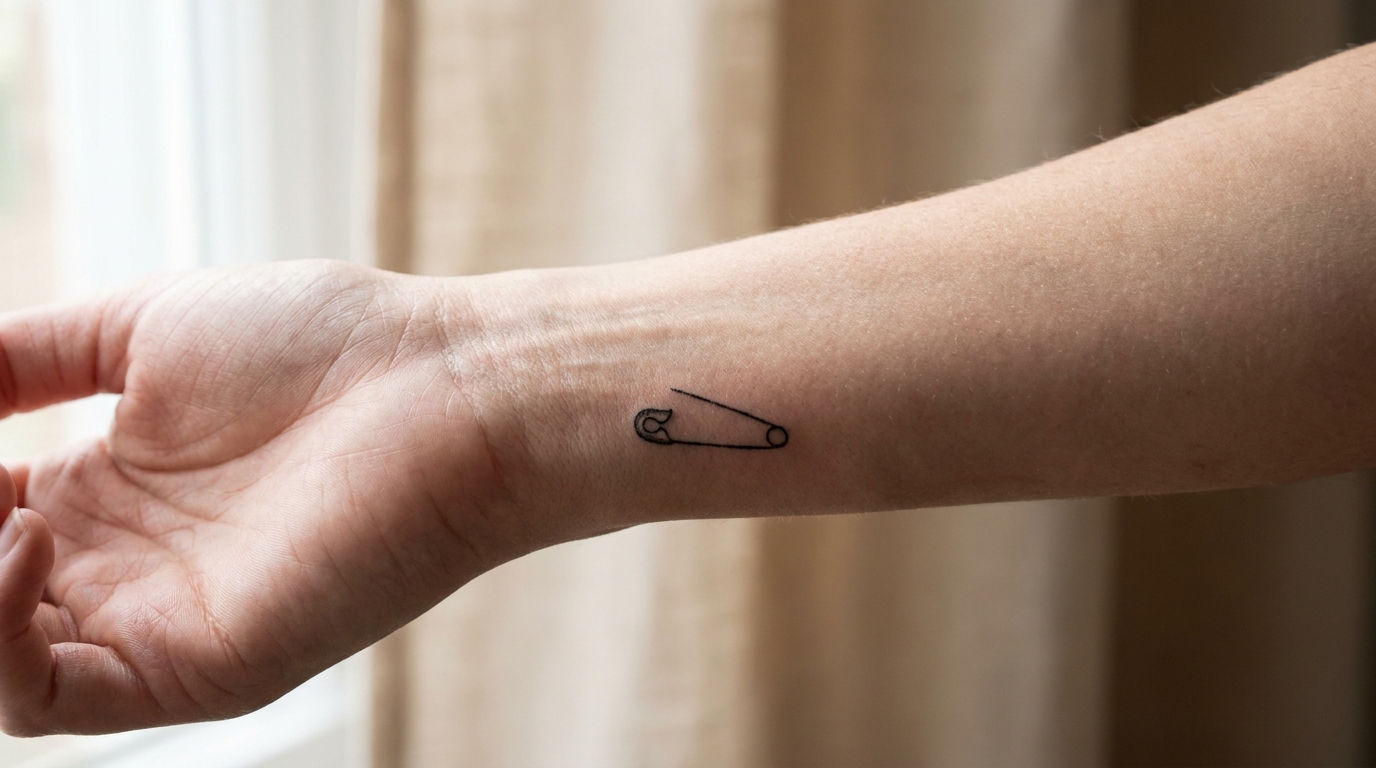
If you have seen a small safety pin inked on someone’s wrist or collarbone and wondered what it says about them, you are not alone. The safety pin tattoo meaning that most people give today is simple: I am a safe person, and you can come to me if you feel threatened. That idea is only about ten years old, though, and the pin carried a very different message for decades before it. This guide explains what the tattoo can mean, where each meaning came from, which popular online stories are not backed by evidence, and what to think about before you sit in a tattoo chair. Everything here was checked against news reports, museum and patent records, and health agencies as of November 2026.
What does a safety pin tattoo mean today?
The meaning most people know today began on social media in late June 2016. After Britain voted to leave the European Union, police reports and news stories described a rise in racist abuse, and an American woman living in London, who goes by Allison online, asked people to pin an empty safety pin to their coats as a sign that they stand with immigrants and anyone else who felt unsafe. She said she took the idea from the #IllRideWithYou campaign in Sydney, which followed the Lindt Cafe siege in 2014. The pin cost almost nothing, needed no slogan, and could be made by anyone, which is a big reason it spread so fast. Allison also warned that a person who wears the pin must be ready to step in if someone is being abused, so it was meant as a promise and not only a badge. In November 2016, after the United States presidential election, many Americans began to wear the pin for the same reason, and the Boston Globe reported that the American Civil Liberties Union urged people to use a safety pin as their social media profile picture. A safety pin tattoo is the permanent version of that promise, and for most people who choose it, it says that they will not look away.

Where did the safety pin come from before it became a symbol?
Before it meant anything political, the safety pin was just a clever tool. The American inventor Walter Hunt received US patent number 6,281 for it on April 10, 1849, and he sold the rights for only $400. Smithsonian magazine repeats the well-known story that he designed it in about three hours to settle a $15 debt to a draftsman who had prepared his patent drawings. His patent describes one piece of wire that combines a spring with a clasp that holds the sharp point. This plain job of holding things together is why many wearers describe the tattoo as a sign of resilience, meaning a person who keeps going when life pulls at the seams. That reading is personal and not an official one, but it fits the object well, and it is the main meaning for people who chose the design for reasons that have nothing to do with politics.
Is a safety pin tattoo also a punk tattoo?
Yes, and this is the older meaning. In the 1970s the pin became part of punk style, and the exact start is still debated. One fashion expert told Rolling Stone that the look was possibly imported from New York, where the musician Richard Hell ripped his shirts and closed the holes with pins, and where the manager Malcolm McLaren saw him. McLaren later returned to London, where he and the designer Vivienne Westwood sold punk clothes from their shop at 430 King’s Road and dressed the Sex Pistols. In 1977 the artist Jamie Reid made the artwork for the band’s single “God Save the Queen” with a safety pin on the Queen’s face, and that image helped fix the pin in public memory as a sign of rebellion. For someone who loves punk music, a pin tattoo can be a simple nod to that world with no message about politics at all. Because many people now read a lone pin as solidarity, a punk-minded wearer who wants a different message may want to add other details that point to the music.

Did the Dutch really wear safety pins against the Nazis?
Many websites say that Dutch people wore safety pins under their collars during the Nazi occupation to recognize one another, and some tattoo pages treat this as the real beginning of the symbol. We could not confirm it. Snopes looked into the claim in November 2016, traced it to an internet post from 2011, and found no older record of Dutch people using safety pins in this way. One article that repeated the story was later corrected to say that the idea was made popular by a 1941 British film called One of Our Aircraft Is Missing. Dutch people did wear small symbols as a silent protest during the war, though. The Rijksmuseum describes small pieces of jewellery worn in the Netherlands for this reason, and the Textile Research Centre in Leiden notes that Dutch BBC radio asked listeners in 1941 to wear a pin with a V for victory. Those records point to V pins and coin badges and not to safety pins, so it is safer to treat the Dutch story as a legend that matches the spirit of the symbol and not as its history.
Safety pin tattoo meaning beyond politics: support, resilience, and private stories
Because no group owns this symbol, wearers are free to give it their own story. In one personal essay on Scary Mommy, a writer named Kiran explained that she got the tattoo to tell minorities they are safe with her, which matches the 2016 idea closely. Other people use the pin as a quiet sign of support for LGBTQ+ friends, which also fits the solidarity meaning. Some websites say that a few people wear safety pins to show that they have struggled with their mental health, but those same pages admit this is not a universal meaning, and no official group has confirmed it as a code. The honest answer is that the tattoo has no single rule book. If you meet someone with this tattoo and you are curious, the kindest way to learn what it means to them is to ask politely, because the real answer may be a personal story that no website can guess.
Is wearing a safety pin enough? What critics and supporters said
Not everyone liked the idea when it spread. On November 14, 2016, the Associated Press reported that critics on social media said the pin was no substitute for action. The Prindle Institute for Ethics noted that wearers usually mean well but that one small display of support is not enough, and it also mentioned a worry that such a quiet sign could let people with opposite views blend in without being noticed. Supporters answered that a visible sign can comfort people who see it. A Boston University sociologist told the Boston Globe that people often rely on symbols to build a sense of community, and a Globe columnist argued that explaining the pin to anyone who asks is already a meaningful act. A tattoo makes this old debate sharper, because ink cannot be unpinned at the end of the day. If your tattoo is about solidarity, the strongest version of it is the one you can back up with what you say and do when someone needs help.
What should you think about before getting a safety pin tattoo?
Since the meaning depends on the person wearing it, it helps to decide your message before you pick a design. A pin on its own will be read as solidarity by people who know the 2016 story and as a punk sign by others, so a date, a word, or another symbol can make your meaning clearer. It is also worth remembering that removal is not simple. The US Food and Drug Administration warns that some tattoo removal procedures may leave permanent scarring and may not remove the tattoo completely. Give yourself time with the design, ask the artist how it will look as the skin ages, and choose an artist whose clean, careful work you can see for yourself.
Why a real safety pin should never be your tattoo tool
There is one more reason this topic needs care, because safety pins themselves are sometimes used for home tattoos. UF Health notes that sewing needles, safety pins, and home kits are often used for stick-and-poke tattoos, and it warns that needles which do not come from a licensed studio can cause serious skin infections and diseases such as hepatitis B and C. The FDA says that unsterile tattoo equipment can spread infections including HIV, hepatitis, and staph, and that do-it-yourself inks and kits have been linked to infections and allergic reactions. A Cleveland Clinic doctor has also pointed out that no rules cover home tattooing, so nobody knows whether needles are shared or the area is cleaned properly. The FDA adds that in the United States a tattoo from an unregulated place or from unsterile equipment can keep you from giving blood or plasma for twelve months. Tattoo shops are usually regulated by local governments, so check the rules where you live, pick a licensed studio, and see a doctor if you notice strong pain, swelling, redness, or a weeping wound after any tattoo. This article is general information and not medical advice.

Final thoughts on safety pin tattoo meaning
The safety pin tattoo meaning has three layers that sit on top of each other: a simple tool that holds things together, a rebellious punk badge, and a modern promise to stand beside people who feel unsafe. None of them is official, and the Dutch wartime story is better left out of any explanation until someone finds real proof. The pin works best when the person wearing it knows which layer they mean and is ready to explain it. Before you book a session, ask yourself what you would actually do if a stranger needed help while you wore this symbol, and let that honest answer decide whether the design is right for you.
EXPLORE MORE: Stainless Steel Gua Sha: What It Really Does, How to Choose One, and How to Use It Safely

I’m Muhammad Ubaid, founder of YBR Magazine. I research and write detailed guides on America’s National Parks — covering entry fees, permits, best times to visit, and planning tips — using official NPS sources and up-to-date information.

