


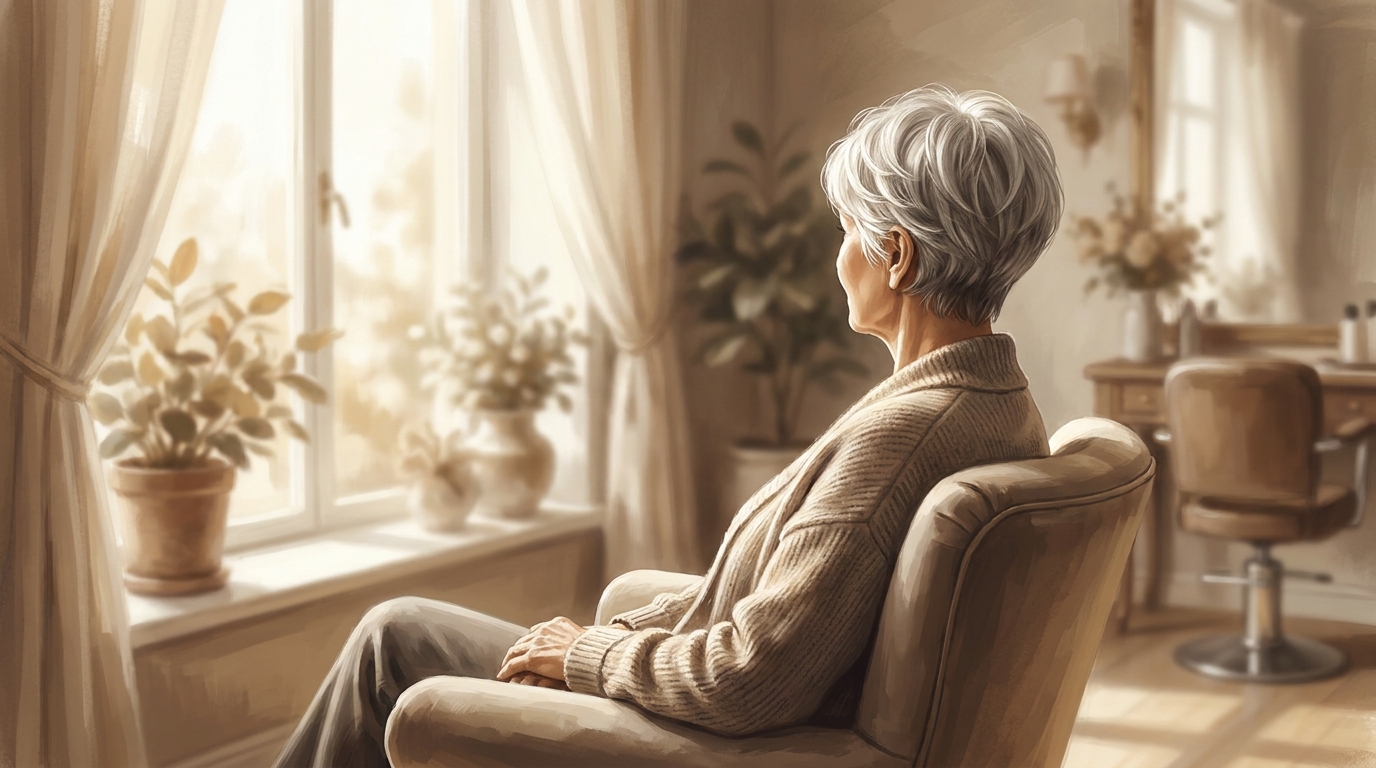
There is no single best cut among short haircuts for women over 70, and the stylists behind the popular roundups mostly agree on that. What they do agree on is a short list of shapes that keep working at this age: the soft pixie, the layered or chin-length bob, the textured crop, and the short curly cut. Which one suits you depends far less on your birth year than on what your hair is doing right now, whether that means fine and flat, frizzy and gray, wavy, or thinning at the part.
This guide starts with that question, then matches each hair situation to a cut and to the words you can use when you ask for it. The advice comes from named hairstylists and dermatologists, with the stylist features dated 2025 and 2026, and it avoids crowning one “number one” cut for everyone, because the pages that do rarely explain why it would work for your head.
What changes in your hair by 70, and why it affects the cut
Dermatology sources describe a steady shift rather than a sudden one. According to a review in Dermatology Times, the diameter of each hair fiber shrinks after about age 40 in women, and the lipid coating on the hair declines with menopause, which is why aging hair tends to feel drier and needs more conditioning. UCLA Health notes that women’s hair is typically thickest around 40, and that 38% of women over 50 have significant thinning. Dermatologist Neelam Vashi, speaking to Consumer Reports, explains that in older adults more hairs sit in the resting or shedding stage at any moment and fewer are actively growing.
Texture moves too. Less scalp oil can make hair coarser and more brittle, and Consumer Reports adds that gray strands sometimes grow in coarser, which reads as frizz. Healthline’s experts point out that straight hair can turn slightly curlier with age, and that hair often looks duller. None of this is a flaw to fix. It simply changes what a cut has to do: hold shape with less density, look polished when the strands are finer, and stay easy to handle when the texture has become less predictable.
That is the real reason short lengths come up so often for this age group. Shorter hair carries less weight, so it can lift at the roots, and layers can make a thinner head of hair look fuller. The trick is choosing the version that matches your particular changes.
Which short cut for which hair
The table below pairs the most common hair situations with cuts stylists recommend for them. Treat the “ask for” column as a starting conversation with your stylist, not a prescription.
| If your hair is… | Cuts worth asking for | Worth avoiding | Everyday effort |
|---|---|---|---|
| Fine and flat | Layered bob, volumized pixie, short feathered cut | One-length blunt shapes that can fall flat | Light mousse and a round brush give the lift |
| Thinning at the crown or part | Soft pixie with lift at the front or crown, layered crop | Heavy, thick bangs | Small amounts of texturizing cream |
| Coarse or frizzy gray | Chin-length bob, soft pixie with even layers | Ends left untrimmed | Smoothing balm or serum |
| Wavy or curly | Curly bob, curly shag, short layered curls | Sleek, blunt shapes that fight the curl | Leave-in conditioner, then scrunch or diffuse |
| Thick and strong | Bob with internal layers, short asymmetrical cut | Dramatic stacking that adds bulk at the back | Round brush to turn the ends in |
Two patterns stand out when you read across the rows. Anything with soft, textured edges is forgiving on almost every hair type, while the cuts that depend on blunt lines or heavy fringe only suit hair that already has body. If you are unsure which row you belong in, describe how your hair behaves on a day with no styling, because that tells a stylist more than your age does.

Where the experts disagree, and how to settle it
Reading several stylist roundups side by side turns up a few real contradictions, and sorting them out is the fastest way to a better decision.
The first is about edges. Celebrity stylist Kazu Katahira told Glam that a chin-length bob cut at one length can look very stylish and does not need to resemble the puffy bobs of youth. Leo Izquierdo, co-founder of IGK Hair Care, told Parade that blunt edges can emphasize wrinkles and sagging, and that soft, textured ends are more forgiving. Both can hold true at once. A chin-length bob with its ends lightly broken up gives you the clean shape Katahira likes and the softness Izquierdo wants.
The second is about bangs. Glam’s feature lists thick, heavy bangs among the weaker choices for older women, yet Parade’s stylists suggest wispy or side-swept fringes to reduce the weight on the forehead and draw attention to the eyes. These are different haircuts. The problem is thickness and bluntness, so a sheer fringe that sweeps to the side is a safe version to test.
The third is about how short to go. Stylist Kim Kimble cautions that a cut can be so short it accentuates fine lines unless the areas around them are styled softly. Other sources push the pixie as a near-universal answer. A better reading is that a pixie is excellent when it has soft layers and some height on top, and a crop worn too close and left severe can do the opposite of flattering. Katahira also notes that a volumized pixie asks for more daily effort than a soft one, so the “easiest” short cut depends on which version you choose.
If you wear glasses, plan the cut around the frames
Eyewear changes the brief more than most guides admit. Celebrity stylist Marcos Diaz told Parade that soft layers falling around the temples can offset angular frames, and that cuts exposing the forehead or cheekbones help open the face and bring out the eyes. He also recommends keeping hair cropped or neatly shaped around the ears so strands do not tangle with the arms of the glasses. When you choose a fringe, ask the stylist to place it so it sits above the top edge of your frames rather than colliding with them. Bring your glasses to the appointment, since a stylist can judge the balance far better with the frames on your face.

How to explain what you want to your stylist
Photos help, but front views alone are misleading, so bring pictures that show the side and back of a cut on someone whose hair texture resembles yours. A cut that looks airy on thick wavy hair will behave differently on fine straight hair, and the picture cannot tell you that.
Then describe your real routine. If you have limited grip strength or shoulder movement, say so, and ask for a shape that dries well with a towel, a little product, and one tool at most. It also helps to ask what the cut will look like in four weeks, because short styles change shape quickly as they grow. If you are nervous, ask for a slightly longer first cut. Katahira’s reassurance to Glam readers is that hair grows back, and it is much easier to take off another half inch next time than to put it back.
Keeping a short cut looking good
Short hair trades long hair’s forgiveness for precision, so upkeep matters. Katahira recommends a trim every four to six weeks to keep the shape sharp and the frizz in check, a figure echoed by a hairstyle gallery site that lists the extra salon visits as the main downside of short styles. If that frequency is too much, tell your stylist at the start so the cut can be designed to grow out gracefully.
At home, the dermatology advice is mostly about gentleness. The Dermatology Times review recommends limiting chemical procedures on aging hair and conditioning generously, because weaker fibers break more easily when processed. A Baylor College of Medicine health article adds that sun exposure, heat tools and chemical treatments all wear the hair shaft down over time, and suggests hats or UV-protective sprays for hair and scalp. With less hair covering your head after a short cut, that sun advice is worth taking seriously.

Going short while your gray grows in or your color grows out
A short cut has one quiet advantage for anyone changing color. Because the dyed lengths are trimmed away every few weeks, a transition to natural gray happens much faster than it would with long hair. The Cleveland Clinic notes that age-related gray is unlikely to regain its pigment, so planning around gray rather than waiting for it to reverse is the realistic approach.
If you want a softer transition, Consumer Reports describes gray blending, where a colorist weaves lighter and darker shades through the hair so the gray strands blend in. It works best when you are already at least 25 percent gray. Pairing blending with a soft, textured cut keeps the grow-out from looking like a harsh line.
When thinning is a medical question, not a styling one
A flattering cut can disguise thinning, but it cannot treat it. The American Academy of Dermatology identifies female pattern hair loss as the most common cause of hair loss in women, typically showing up as a widening part or receding hair near the temples. It advises seeing a dermatologist for a diagnosis, because other causes can look similar and each needs different treatment, and it says treatment works best when it begins at the first sign. The same source notes that treatments such as minoxidil need roughly six to twelve months before you can judge results, and that hair loss shampoos cannot regrow hair or stop loss from worsening.
AARP’s reporting adds an important warning: some loss is typical with age, but sudden or excessive shedding, or hair loss together with a rash or itchy scalp, can point to something more serious. This article offers general information, not medical advice, so bring those symptoms to a doctor rather than waiting to see whether a new haircut hides them.
Questions women ask before the first cut
Do I have to cut my hair short after 70?
No. Glam’s list of stylist suggestions includes wavy or curly lobs that fall just above the shoulders, which give some of the same ease without going as short. The point is a shape you can manage comfortably, not a length you feel obliged to reach.
Will washing less, or stopping coloring, slow down thinning?
A dermatologist, Dr. Mercurio, told an American Academy of Dermatology annual meeting (reported in 2010, so the point is long established rather than new) that washing, coloring or perming does not change the course of female pattern hair loss, so there is no need to give up your routine out of fear.
Does short hair make a woman look younger?
Izquierdo’s view is that a good cut does not try to hide age but brings lightness and movement to the hair. In practice that means looking for lift at the crown and soft ends rather than chasing a particular look.
The short version of choosing well
Short haircuts for women over 70 succeed when the shape answers a specific need: lift for fine hair, softness for frizz, movement for curls, or frames-friendly edges for glasses. Pick the texture and edge first, then the length, bring honest information about your daily routine, and treat any change in thinning as a question for a dermatologist. A cut chosen that way will look right for your hair, and for you, long after the trend of the season has moved on.
EXPLORE MORE: Body to Body Tantric Massage: What the Term Really Means and How to Avoid Getting Misled

I’m Muhammad Ubaid, founder of YBR Magazine. I research and write detailed guides on America’s National Parks — covering entry fees, permits, best times to visit, and planning tips — using official NPS sources and up-to-date information.

