
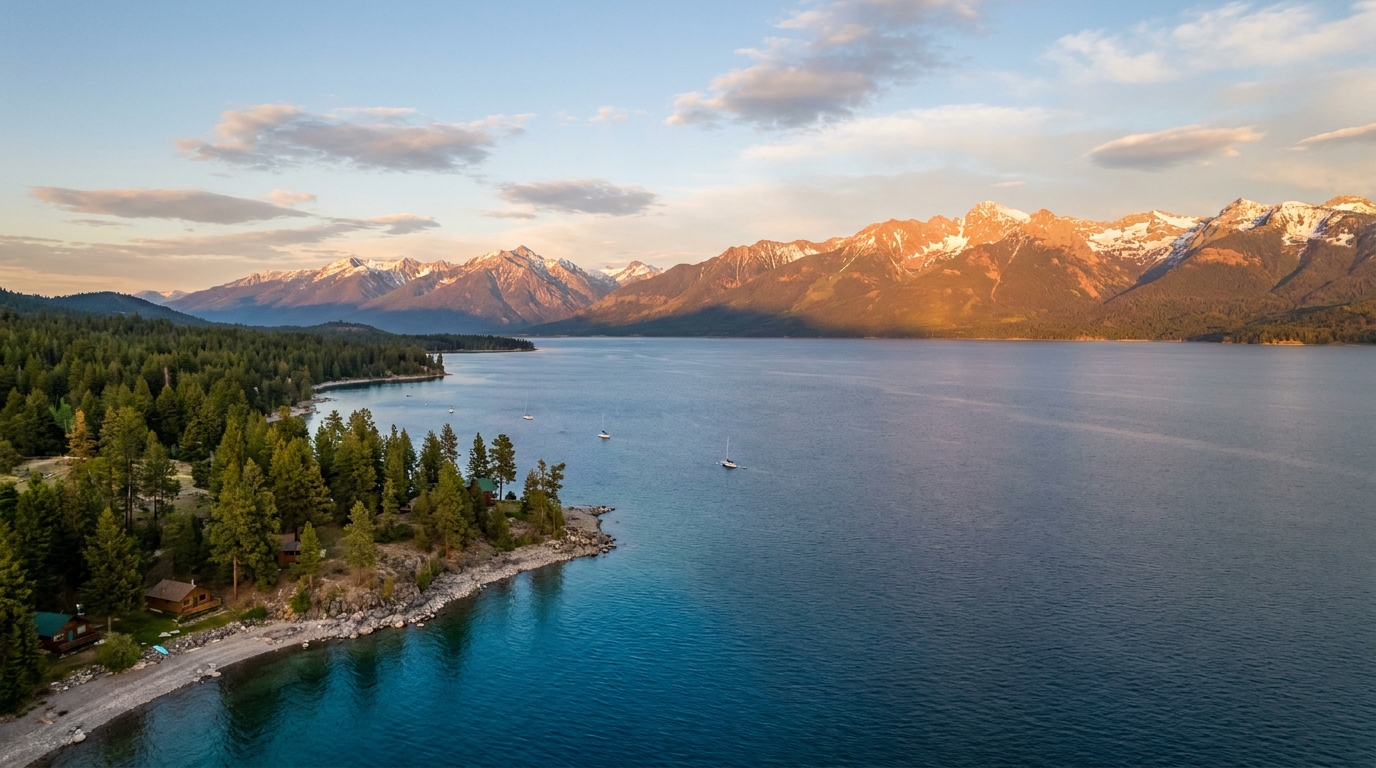
Flathead Lake in northwestern Montana is one of those places that surprises people the moment they see it. The water is a deep, clear blue, the Mission Mountains rise sharply along the eastern shore, and the lake stretches so far that it can feel more like an inland sea than a mountain lake. It is the largest natural freshwater lake by surface area in the western United States outside of Alaska, and it is widely regarded as one of the cleanest lakes of its size anywhere in the populated world. Whether you are planning a family vacation, a fishing trip, or a scenic stop on the way to Glacier National Park, this guide explains what makes Flathead Lake special and how to enjoy it well.
Where Is Flathead Lake Located?
Flathead Lake sits in the Flathead Valley of northwest Montana, about seven miles south of Kalispell, and it spreads across Lake and Flathead counties. The towns of Bigfork, Lakeside, Somers and Dayton are found along its northern and western edges, while Polson, the largest community on the lake, sits at the southern end where the water flows out into the Flathead River. The Mission Mountains rise along the eastern side, and the lower, forested Salish Mountains run along the west. Because the lake marks the southern end of a long valley known as the Rocky Mountain Trench, the surrounding scenery feels open and dramatic from almost every angle.
The southern half of the lake lies within the Flathead Indian Reservation, which is the homeland of the Confederated Salish and Kootenai Tribes. This detail matters for visitors, because it affects fishing licenses, some local rules, and the way the lake is managed. It also means that the story of the lake cannot be told without the story of the people who have lived beside it for thousands of years.
How Big and How Deep Is Flathead Lake?
The lake is roughly 30 miles long and up to about 16 miles wide, and its surface area is usually given as somewhere between about 191 and 197 square miles, depending on the water level and the measurement method. The shoreline stretches for around 185 miles, which is why a drive around the lake along Highways 93 and 35 can easily fill a full day when you stop for views, snacks and swimming.
In terms of depth, the deepest point is about 370.7 feet, while the average depth is about 164.7 feet. The lake is slightly larger than Lake Tahoe in surface area, but it holds far less water because Tahoe is much deeper. Flathead Lake is also considered the 79th largest natural freshwater lake in the world, which gives a helpful sense of how impressive it is on a global scale.
| Quick Fact | Detail |
|---|---|
| Location | Northwest Montana, near Kalispell, Polson and Bigfork |
| Length | About 30 miles |
| Width | Up to about 16 miles |
| Surface area | Roughly 191 to 197 square miles |
| Maximum depth | About 370.7 feet (113 meters) |
| Average depth | About 164.7 feet (50.2 meters) |
| Shoreline | About 185 miles |
| Largest island | Wild Horse Island, about 2,160 acres |
| Main inflows | Flathead River and Swan River |
| Outflow | Flathead River at Polson |
How Was Flathead Lake Formed?
The lake is a leftover piece of the Ice Age. It is considered a remnant of the enormous glacial lake known as Glacial Lake Missoula, which covered much of western Montana until roughly 15,000 years ago. A massive glacier pushed down the valley and stalled near what is now Polson, leaving behind a large pile of rock and gravel called a moraine. That natural dam is a big reason the lake exists today.
Geologists have also found that the lake level was once about 500 feet higher than it is now. At that time the water drained westward through the valley near Elmo, at the end of Big Arm Bay, before the lake settled into its modern shape and began draining south through Polson. Even Wild Horse Island is a product of this glacial history, as the island was shaped by the same powerful forces that carved out the surrounding valley more than 17,000 years ago.
A Short History of the Lake and Its People
Long before maps and highways, the Salish and Kootenai peoples lived, hunted and traveled around this lake, and the lake was originally known by the name of the Salish people. Early explorer David Thompson later described it as “a fine sheet of water,” a phrase that still feels accurate today. The modern name comes from the Flathead people, another name used for the Salish, whose reservation borders the lake on the south.
The twentieth century changed the lake in two important ways. Seli’š Ksanka Qlispe’ Dam, formerly known as Kerr Dam, was completed near Polson in 1938 and raised the natural lake level by about 10 feet. It generates around 194 megawatts of electricity and is now operated cooperatively by the Confederated Salish and Kootenai Tribes and PPL Montana. Around the same time, scientific interest in the lake was growing, and the University of Montana’s Flathead Lake Biological Station on the eastern shore has now studied the lake and its watershed for well over a century, making it one of the oldest active freshwater research stations in the country.
Why Is the Water So Clean and Clear?
Visitors often ask why Flathead Lake looks so pure, and the answer comes from a mix of geography and careful monitoring. The lake is fed mostly by the Flathead and Swan Rivers, which carry cold, clean mountain water from protected wild country, including parts of Glacier National Park and the Bob Marshall Wilderness region. Its large size and good depth also help dilute and absorb pollution that might harm a smaller body of water.
Scientists at the Flathead Lake Biological Station have tracked water quality here for decades, and that long record is one reason the lake is described as unusually healthy for its size. Local residents, tribal agencies and state officials continue to watch for threats, especially runoff from development and the arrival of invasive species, which is why boat inspections have become such an important part of life on the lake.
Best Things to Do at Flathead Lake
Visit Wild Horse Island State Park
Wild Horse Island is the largest island on the lake and one of the most memorable places to visit in the entire region. It covers about 2,160 acres and rises roughly 1,200 feet above the water, with open grassland, ponderosa pine forest, and one of the last remnants of Palouse prairie in Montana. Wildlife is the main attraction here, and hikers regularly see bighorn sheep, mule deer, bald eagles and a small number of wild horses that give the island its name. According to local history, the Salish and Kootenai once used the island to pasture horses safely away from raiders.
The island can only be reached by boat, whether that is your own, a rental, a kayak, or a guided tour from towns such as Bigfork, Lakeside, Polson or Big Arm. It is a day-use park with no visitor services, so you need to bring your own water, food and layers, and you should follow Leave No Trace principles carefully. A hiking trail of roughly three miles loops around the southwestern part of the island and offers sweeping views back across the lake.
Explore Flathead Lake State Park
Flathead Lake State Park is made up of six separate units spread around the shoreline, and each one has its own character. Wayfarers State Park near Bigfork is a favorite for photographers, with a rocky shoreline, a river rock swimming beach, picnic areas, a boat launch and some of the best sunset views in the valley. Other units, including West Shore, Big Arm, Finley Point and Yellow Bay, provide boat ramps, swimming areas and camping, although facilities and seasons vary, so it is smart to check the current details before you travel.
Go Fishing and Join a Mack Days Tournament
Fishing is a major reason people travel to the lake. Anglers target lake trout, which locals call “mackinaw,” along with yellow perch, whitefish and native species such as westslope cutthroat trout and bull trout. Lake trout were introduced in 1905, and their numbers grew explosively after tiny shrimp-like creatures called Mysis arrived in the lake in 1981 and gave young lake trout a rich food source. As a result, native fish like bull trout and cutthroat trout were pushed down, which is why management agencies now encourage anglers to harvest lake trout.
The best-known effort is the Mack Days fishing derby, run in spring and fall by the Confederated Salish and Kootenai Tribes. Anglers compete for cash prizes and tagged fish, and all bull trout and westslope cutthroat caught during the event must be released. A fishing license is required, and the type depends on which part of the lake you fish, because the southern half falls within the reservation and requires a tribal license, while other areas fall under state rules. Always check the latest regulations before you cast a line.
Boat, Sail, Kayak and Paddleboard
The lake is large enough that motorboats, sailboats, kayaks and paddleboards can all share it comfortably. Dayton Bay is known for favorable winds that sailors enjoy, while sheltered bays near Somers and Wayfarers are popular with paddlers who want calmer water. Rentals and guided trips are widely available in the main lakeside towns during summer. One safety note applies to every visitor: weather on a lake this size can change quickly, and strong winds can produce real waves, so check the forecast and stay close to shore if you are in a small craft.
Taste Flathead Cherries
The lake creates a milder local climate that allows fruit trees to grow, and the eastern shore is famous for its cherry orchards. White blossoms appear in spring, and the sweet cherries are ready for picking and buying at roadside stands from around late July into August. Polson also hosts a Flathead Cherry Festival each July, which makes mid to late summer an especially tasty time to visit. Some vineyards also exist on the western side, which shows how different this lake climate is from the rest of Montana.
Walk the Streets of Bigfork and Polson
Bigfork, on the northeast corner, is known for its galleries, shops, restaurants and a well-respected summer theater tradition. Polson, at the southern end, feels more relaxed and offers a marina, the Polson-Flathead Historical Museum and the quirky Miracle of America Museum. A short drive from Polson, the dam itself is worth a quick visit, and nearby wildlife areas such as Ninepipe National Wildlife Refuge and the CSKT Bison Range near Moiese provide excellent chances to see birds, bison, elk and other animals.
Is There Really a Flathead Lake Monster?
Like many large, deep lakes, Flathead Lake has its own legend. Stories of a long, serpent-like creature have been told for generations, and it is often compared to the Loch Ness monster. No scientific evidence has ever confirmed such a creature, and the lake’s clarity has not produced any proof, but the tale remains a fun part of local folklore that adds a bit of mystery to a sunset boat ride.
Boating Rules and Invasive Species Inspections
Protecting the lake from aquatic invasive species is a serious concern in Montana. Zebra and quagga mussels are especially feared, because once they are established they are almost impossible to remove, and they can damage native ecosystems, clog water systems and harm fishing. For this reason, every boat entering Montana from out of state must be inspected before launching, and boats arriving in the Flathead Basin from waters outside the basin must also be inspected before launch. Paddleboards, kayaks and canoes are included, not only motorboats.
Inspections are generally free, and many stations are open during the boating season, including a Montana Fish, Wildlife and Parks office in Kalispell. If you pass an open inspection station while towing a boat, you are expected to stop. Because rules, hours and station locations can change from year to year, you should confirm the current requirements through the Montana “Clean, Drain, Dry” program before you travel.
Best Time to Visit Flathead Lake
Summer, from late June through August, is the most popular season because the days are long, the weather is warm, and every kind of water activity is available. The lake stays cold even in summer, so swimmers should expect a refreshing, and sometimes shocking, dip. September is a wonderful choice for people who prefer smaller crowds, golden fall light and quieter beaches, and it overlaps with fall fishing events. Spring brings blooming cherry orchards, early fishing and wildflowers, although the water is still very cold. Winter is peaceful and scenic, and nearby Blacktail Mountain offers skiing for those who want to combine lake views with snow.
How to Get to Flathead Lake
Most visitors arrive through Glacier Park International Airport near Kalispell, which is only a short drive from the northern end of the lake. Others fly into Missoula and drive north, which takes roughly an hour and a half to reach Polson. Driving around the lake is easy and scenic, and it makes a natural add-on to a trip to Glacier National Park, which lies to the north. Because the lake is so large, many travelers choose to base themselves in either Bigfork or Polson, depending on whether they prefer an art-filled village or a more laid-back lake town.
Practical Tips for Your Trip
Book lodging, campsites and boat rentals early for July and August, since the area is popular and summer weekends fill up quickly. Bring sun protection, because the sun reflects strongly off the water at this altitude, and pack layers because evenings cool down fast even after a hot afternoon. If you plan to visit Wild Horse Island, carry plenty of water and keep a respectful distance from wildlife, especially bighorn sheep and horses. Finally, if you plan to fish, make sure you understand which license is needed for the part of the lake where you will be, and follow all catch and release rules for native fish.
Frequently Asked Questions About Flathead Lake, Montana
Is Flathead Lake the biggest lake in Montana?
Yes. It is the largest natural freshwater lake in Montana and the largest natural freshwater lake by surface area in the western United States outside of Alaska.
How deep is Flathead Lake?
The maximum depth is about 370.7 feet, and the average depth is about 164.7 feet.
Can you swim in Flathead Lake?
Yes, swimming is popular at many beaches and state park units. The water stays cool through most of the year, so many visitors prefer the warmest days of mid to late summer.
Can you visit Wild Horse Island without a boat?
No. The island can only be reached by water, but guided boat tours and kayak trips are available from several lakeside towns.
What fish live in Flathead Lake?
Common fish include lake trout, yellow perch and whitefish, along with native bull trout and westslope cutthroat trout, which must be released when caught.
Do I need a boat inspection to launch on Flathead Lake?
Boats coming from out of state, or from waters outside the Flathead Basin, must be inspected before launching. Check the current rules before you go.
When are Flathead cherries ready?
They are usually available from about late July through August, although the exact timing depends on the weather each year.
Final Thoughts
Flathead Lake, Montana, combines natural beauty, rich history, wildlife, outdoor recreation and small-town charm in a way few destinations can match. It is large enough to feel wild, clean enough to be admired by scientists, and welcoming enough for families, anglers, hikers and boaters alike. With a little planning, such as checking boating rules, booking early in summer and respecting the land and its people, you can enjoy a trip that you will remember long after the cherries are gone.
Disclaimer: This article is provided for general information and travel planning only. Measurements such as surface area, shoreline length and lake level can vary slightly depending on the measuring method and the season. Fishing licenses, boat inspection requirements, park access, event dates, business hours and safety conditions can change, so please confirm current details with Montana Fish, Wildlife and Parks, the Confederated Salish and Kootenai Tribes, Montana State Parks and local visitor centers before your trip. Outdoor activities carry natural risks, and readers are responsible for their own safety and decisions.
Explore More
Glacier National Park: Complete Travel Guide to Montana’s Crown of the Continent
I’m Muhammad Ubaid, founder of YBR Magazine. I research and write detailed guides on America’s National Parks — covering entry fees, permits, best times to visit, and planning tips — using official NPS sources and up-to-date information.