


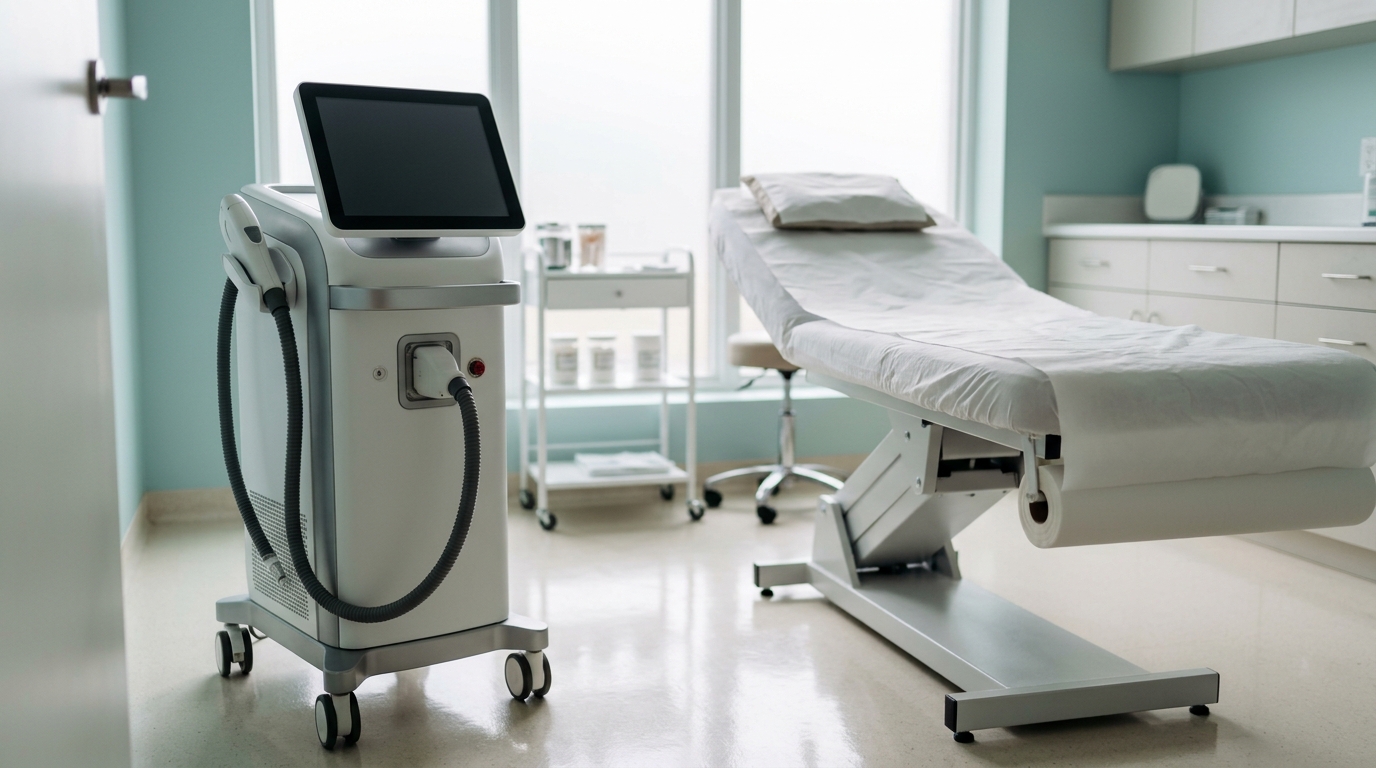
Buying time on a laser hair removal machine, or buying one outright, looks simple until you notice that the phrase covers very different tools. A clinic-grade diode or alexandrite system, a 1064 nm Nd:YAG unit and a flash-lamp gadget sold for the bathroom shelf are all described with the same words, yet they behave differently on different skin. This guide is written for two kinds of readers: people choosing a provider or a home device, and small clinic owners comparing equipment. The most useful thing to know up front is that the machine is only one of three things that decide the outcome. The other two are how well its wavelength suits your skin and hair, and how carefully the person holding it sets it up. Everything below reflects regulator statements, hospital guidance and manufacturer documentation available as of November 2026.
What the light is actually doing under your skin
These machines send a brief pulse of light that is absorbed by melanin, the pigment in hair. The light turns into heat, the heat damages the follicle, and future growth slows. Mayo Clinic describes the result as a large reduction in hair growth, with some hair removed permanently and some growing back over time.
Because the target is pigment, contrast is everything. Dark hair on light skin gives the machine a clear target and leaves the skin mostly untouched. Gray, red, blond and white hair absorb light poorly, which is why Mayo Clinic says treatment is less effective for those colors, even though research on light-colored hair continues. The same logic explains the main safety concern: skin also contains melanin, so deeper skin tones need a machine and settings that can pass through the surface without overheating it.
Alexandrite, diode, Nd:YAG and IPL: which one suits whom

Most professional systems fall into three laser families, and home devices usually belong to a fourth category that is not a laser at all. The table shows where manufacturers and clinical guides typically place each one. Treat the skin-type notes as positioning, not guarantees, because they come largely from the companies selling the equipment.
| Technology | Typical wavelength | How it is usually positioned | Worth knowing |
|---|---|---|---|
| Alexandrite | 755 nm | One leading maker positions its 755 nm unit for lighter skin, Fitzpatrick types I to III | Often paired with a second wavelength in dual systems |
| Diode | Around 800 to 810 nm, some systems add 940 nm | Described by makers as the most widely used and suitable across skin types | Cooling and pulse settings strongly affect comfort and safety |
| Nd:YAG | 1064 nm | The same maker positions its 1064 nm unit for deeper tones, types IV to VI | Passes more easily through skin pigment |
| IPL (intense pulsed light) | Broad-spectrum light | Common in home devices and large-area treatments | Not a true laser, even when sold as one |
Claims in this area contradict each other. Some diode makers say their systems safely treat every skin type, while others argue that a dual-wavelength alexandrite and Nd:YAG machine is the only serious choice for a varied clientele. Both are sales positions. A review of laser hair removal on Black skin put the point more usefully: what separates a good result from a burn is the wavelength of the device combined with the training of the operator. If you have a deeper skin tone, ask which wavelength will be used on you and how the provider has treated similar skin before, rather than asking which brand is on the cart.
What “FDA-cleared” does and does not promise
Advertising often says “FDA-approved,” but most hair removal lasers reach the US market through the 510(k) clearance route, which compares a new device with an existing one. That is a lower bar than proof of results. A recent public clearance summary for one 808 nm diode system states plainly that no clinical study was included, and that clearance rested on similarity to an earlier device.
The FDA has also been consistent about wording. Its definition of permanent hair reduction is a long-term, stable reduction in the number of hairs regrowing, measured at 6, 9 and 12 months after a treatment course, and a clearance letter dated August 2026 still uses that language. The agency has long said devices cleared for this claim reduce the number of hairs but do not remove all of them, and that makers may not call treatment painless or permanent without data. It also does not rank one laser above another. So a brochure promising smooth skin forever is going beyond what regulators allow, and “cleared” tells you a device met a safety and equivalence standard, not that it is the best performer.
Professional machine or home device: an honest comparison

Home laser and IPL devices exist because professional sessions add up, and some people can use them well. The first at-home diode laser from Tria received clearance in 2008, and the company says most users see a substantial reduction after at least eight treatments, while admitting that individual results range from complete reduction to little or none. That candor is worth noticing.
Independent voices are more cautious. Mayo Clinic notes that home lasers might cause modest hair reduction and that there are no large studies comparing them with office treatment. Dermatologists quoted by Cleveland Clinic say home units are less powerful and work only on a narrow range of hair and skin colors, and one skin-of-color specialist describes them as closer to hair-growth delay tools, best for small areas or for maintenance between professional courses.
| Clinic machine | Home device | |
|---|---|---|
| Power and speed | Higher energy, larger treatment areas | Lower energy, slow on big areas |
| Skin tones | Wider range with the right wavelength | Light to medium skin with dark hair; many block firing on darker tones |
| Settings | Adjusted by a trained operator | Fixed levels chosen by you |
| Evidence | Backed by decades of clinical use | Mayo Clinic notes no large comparison studies |
One warning deserves repeating. A New York dermatologist advised anyone with even a hint of tan or deeper skin to avoid home devices, even when the label claims they are safe for skin of color, because the target of every one of these devices is melanin. Never use any of them near the eyes.
Questions to ask before you buy or book
If you are equipping a clinic, the machine’s paperwork matters as much as its brochure. Ask for the exact model name and the clearance number, then check that the cleared intended use mentions permanent hair reduction and covers the skin types you plan to treat. Ask whether the system is cleared for professional use rather than only for consumer or spa-level settings, which one clinic-chain guide points out can differ. Compare cooling design, the range of spot sizes, handpiece replacement cost and what training and servicing the supplier includes. Be wary of any seller who describes a machine as painless or guaranteed permanent.
If you are a client booking treatment, the useful questions are simpler. Ask which laser or light source the clinic uses, whether it suits your skin tone and hair color, who will operate it, and what happens if you react badly. Mayo Clinic suggests choosing a board-certified doctor in a field such as dermatology or cosmetic surgery who has treated your skin type, and a consultation that covers your medical history, medicines and past hair removal is a good sign.
What a realistic treatment course looks like
Hair grows in cycles, and the laser mainly affects follicles that are actively growing, so each session catches only some of them. This is why single sessions disappoint. Published guidance on how many treatments you need varies: Mayo Clinic material gives ranges of roughly two to six sessions in some places and four to eight in others, spaced several weeks apart, with occasional follow-ups afterward. Your count will depend on the area, your hair, and the machine.
Preparation is straightforward. Mayo Clinic advises against plucking, waxing and electrolysis for at least four weeks before treatment because they disturb the follicle, and it suggests shaving the area the day before. Afterward, redness and swelling for a few hours are common. Rare effects include blistering, crusting, scarring, changes in skin texture, graying of treated hair and extra growth around treated areas, particularly on darker skin.
Laser treatment also does not fix the cause of excess hair. Mayo Clinic notes that people with hormone-related conditions such as polycystic ovary syndrome may keep growing new hair and need ongoing sessions. That is a reason to plan for maintenance rather than to treat it as a failure.
The short version
Choosing a laser hair removal machine comes down to three checks. Match the wavelength to the contrast between your skin and hair, confirm the device’s clearance covers what it is being used for, and put the settings in the hands of someone trained on your skin type. If your skin is light and your hair is dark, a home device may give you a slow, modest reduction. For anything else, or for large areas, a professional laser hair removal machine run by an experienced operator is the safer path.
This article is general information, not medical advice. Talk to a qualified dermatologist about your own skin, medicines and health before starting laser or light-based hair removal.
Explore More
What Is Barenia Leather and Why Is It Used for Watch Straps?

I’m Muhammad Ubaid, founder of YBR Magazine. I research and write detailed guides on America’s National Parks — covering entry fees, permits, best times to visit, and planning tips — using official NPS sources and up-to-date information.

