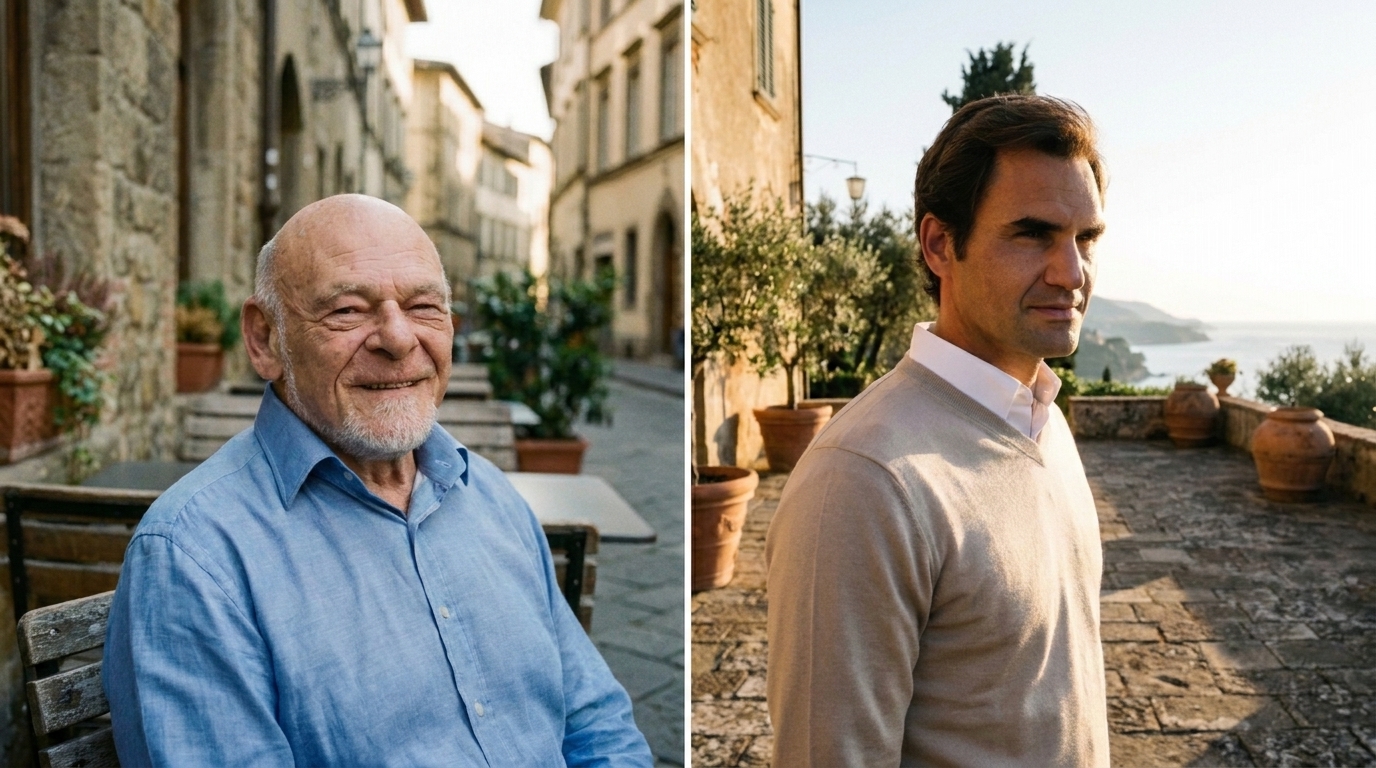
People who type “Roger Federer and Sam Zell” into a search bar are usually trying to answer one simple question: are these two famous men connected? One is a Swiss tennis champion who became one of the most admired athletes in history. The other was an American real estate investor from Chicago who built a reputation for buying troubled assets and turning them around. They come from different countries, different industries, and different generations of fame, so it is natural to wonder what brought their names together in a single search.
Here is the honest answer up front. After checking biographies, business profiles, and news coverage, there is no verified record of a personal friendship, a joint business deal, or a shared company between Roger Federer and Sam Zell. This article does not invent one. Instead, it explains who each man is, shows the real places where their stories brush against each other, compares how they built their wealth, and draws out the practical lessons that make the pairing interesting in the first place.
Who Was Sam Zell?

Samuel Zell was born on September 28, 1941, in Chicago, Illinois, and died on May 18, 2023, at the age of 81. His parents were Polish Jews who left Europe in 1939 as the war spread across the continent, and that immigrant background shaped his stubborn, independent outlook for the rest of his life. He studied at the University of Michigan, earning an undergraduate degree in 1963 and a law degree in 1966, and he started investing in apartment buildings while still a student. A fellow student named Robert Lurie became his business partner, and the two men worked together until Lurie died in 1990.
In 1968 Zell founded the company that grew into Equity Group Investments, often shortened to EGI. Over the following decades he created or controlled a long list of businesses, including Equity Residential, Equity LifeStyle Properties, Equity International, Covanta, and Anixter. He became widely known as the “Grave Dancer,” a nickname earned by buying distressed properties and companies that other investors considered too risky. After the recession of the mid-1970s, for example, he picked up struggling real estate at very low prices and helped lenders find workable ways to be repaid.
His biggest headline moment came in 2007. In February of that year he sold Equity Office, a huge office-building company, to the Blackstone Group for about 39 billion dollars, which was one of the largest deals of its kind at the time. Later that same year he took the Tribune Company private through a leveraged buyout that used an employee stock ownership plan, and he became its chairman and chief executive in December 2007. The Tribune Company owned newspapers such as the Chicago Tribune and the Los Angeles Times, along with the Chicago Cubs baseball team. The company filed for bankruptcy protection and emerged from it in 2012, after which Zell stepped away. In 2017 he published a memoir called Am I Being Too Subtle?, a blunt look back at his career.
Away from business, Zell was known for riding motorcycles and for speaking his mind, sometimes in colorful language. He was also a generous donor. His gifts supported the University of Michigan, Northwestern University’s Kellogg School of Management, and the Wharton School of the University of Pennsylvania, as well as Jewish and educational causes in Chicago and Israel. He had three children and nine grandchildren.
Who Is Roger Federer?

Roger Federer is a Swiss tennis player who is widely regarded as one of the greatest of all time. He won 20 Grand Slam singles titles, including eight at Wimbledon, and he held fans around the world with a smooth, graceful style of play that made hard shots look easy. He retired from professional tennis in 2022, ending his career at the Laver Cup in London, where he played alongside his longtime rival Rafael Nadal.
What makes Federer especially relevant to a comparison with a business figure like Zell is what he did off the court. In 2013 he co-founded the sports management company TEAM8 with his longtime agent, Tony Godsick. Four years later, in 2017, that company helped create the Laver Cup, a team event that pits six players from Europe against six from the rest of the world, in the spirit of golf’s Ryder Cup. TEAM8, Brazilian businessman Jorge Paulo Lemann, and Tennis Australia partnered to launch it, and since 2019 it has been an officially sanctioned ATP Tour event. Forbes has reported that the Laver Cup brings in more than 20 million dollars a year in sponsorship and ticketing revenue, and that its sponsor list has grown from six companies at the start to a record number in recent years.
Federer’s other major business move was becoming an investor in the Swiss sportswear brand On. He learned about the company when his wife began wearing its sneakers, and he took an equity stake in 2019. The company listed on the New York Stock Exchange in 2021, and Federer’s holding, estimated at roughly three percent, helped Forbes name him a billionaire in August 2025, with a net worth of about 1.1 billion dollars, making him the seventh athlete to reach that mark. More recent Forbes coverage notes that his billionaire status slipped when On’s share price fell, a good reminder that wealth tied to a stock moves up and down. He has also invested in the plant-based food company NotCo.
Where Their Stories Actually Touch: Chicago
If you are looking for a genuine point of overlap, it is the city of Chicago. Zell was a Chicago native whose company headquarters and public life were rooted there for decades, and through the Tribune Company deal he became closely tied to the city’s biggest media outlets and its baseball team. Federer’s connection is more brief but still real: the second Laver Cup took place in Chicago at the United Center from September 21 to 23, 2018, and Team Europe, with Federer and Alexander Zverev winning key matches, kept the title that it had won in Prague the year before.
This is an overlap of place, not of people. Nothing in the public record shows that the two men met at that event or collaborated on it, and it would be misleading to suggest otherwise. Still, it helps explain why a curious reader might connect a Chicago business legend with a tennis event that visited the city during the years Zell was still active.
How Each Man Built Wealth
The most useful way to compare Federer and Zell is by looking at how they turned success in one area into lasting value in others.
Zell built his fortune on a simple but demanding idea: find assets that others are afraid of, buy them at a low price, and fix them. His real estate and corporate investments often came after a downturn, when sellers were desperate and competition was thin. He was also quick to sell when prices looked too high, which is why the 2007 sale of Equity Office is still discussed as a famously well-timed move. His approach rewarded patience, nerve, and a willingness to disagree with the crowd. When the office-sharing company WeWork was valued at close to 50 billion dollars before its planned public offering, Zell publicly criticized the valuation and predicted trouble.
Federer, by contrast, built his fortune on a global reputation. His on-court dominance created trust, and that trust attracted long-term partners such as Rolex, NetJets, and UBS, among many others. Rather than staying only a paid face for brands, he later moved into ownership, first through TEAM8 and the Laver Cup and then through his equity stake in On. In effect, he moved from being paid for his name to owning a share of what his name helped build.
Both paths share a quiet logic. Neither man relied on a single source of income, and both used their credibility to open doors that were closed to most people. Zell’s credibility came from a long record of deals, while Federer’s came from years of public excellence and a famously respectful image.
Lessons Worth Taking From Both Men
Although the two never appear together in any verified story, their careers point to several ideas that readers can apply in their own work and finances.
The first lesson is to treat reputation as an asset. Federer’s calm, trustworthy image made sponsors and partners eager to work with him, and Zell’s reputation for straight talk made lenders, partners, and sellers take him seriously even when his deals were unusual. A good name takes years to build and can be used to create opportunities that money alone cannot buy.
The second lesson is to be careful with concentrated bets. Federer’s net worth rose sharply with On’s stock and then dropped when the shares fell, which shows how quickly paper wealth can change. Zell’s own career had both brilliant wins and painful losses, with the Tribune Company bankruptcy being the clearest example of a bold bet that did not work out. Taking risks can pay off, but it helps to understand how much of your future depends on a single outcome.
The third lesson is to build things that outlive you. Zell’s gifts to universities created programs and centers that still carry his name, while Federer’s Laver Cup was designed to honor tennis legends and has grown into a regular fixture on the calendar, now with plans to expand around the world. Both men put effort into institutions, not just personal gain.
Common Questions About Roger Federer and Sam Zell
Did Roger Federer ever meet or work with Sam Zell?
There is no verified public record of a meeting, partnership, or shared business. Any claim that they were close associates is not supported by reliable sources.
Why are the two names searched together?
Most likely because people are comparing famous figures from sport and business, or because of the Chicago link through the 2018 Laver Cup and Zell’s long presence in the city. Search interest of this kind often comes from curiosity rather than from a documented relationship.
How did Sam Zell make his money?
Mainly through real estate and distressed investments, including apartment buildings, office towers, manufactured-home communities, and the troubled companies he turned around, along with the large 2007 sale of Equity Office.
How did Roger Federer become a billionaire?
Through years of endorsements, his co-founding of TEAM8 and the Laver Cup, and an early stake in the shoe brand On, which went public in 2021. His billionaire status has changed with On’s share price.
Is Sam Zell still alive?
No. He died on May 18, 2023, at the age of 81.
Final Thoughts
Roger Federer and Sam Zell lived very different lives, one defined by grace on a tennis court and the other by sharp elbows in the deal room. What links them is not a handshake or a joint venture but a shared pattern: each turned a hard-earned reputation into ownership, and each tried to leave something lasting behind. If you came here hoping to find a secret partnership, the truthful answer is that none has been documented. If you came looking for ideas about building a career, a brand, and a legacy, their two stories offer plenty to think about.
Disclaimer
This article is provided for general information and educational purposes only. It is based on publicly available information at the time of writing and does not claim any personal or business relationship between Roger Federer and Sam Zell beyond what is stated. Financial figures such as net worth, valuations, and revenue are estimates that change over time and may differ between publications. Nothing here is financial, investment, or legal advice, and readers should do their own research or consult a qualified professional before making decisions. Names and trademarks mentioned belong to their respective owners.
Explore More

I’m Muhammad Ubaid, founder of YBR Magazine. I research and write detailed guides on America’s National Parks — covering entry fees, permits, best times to visit, and planning tips — using official NPS sources and up-to-date information.