

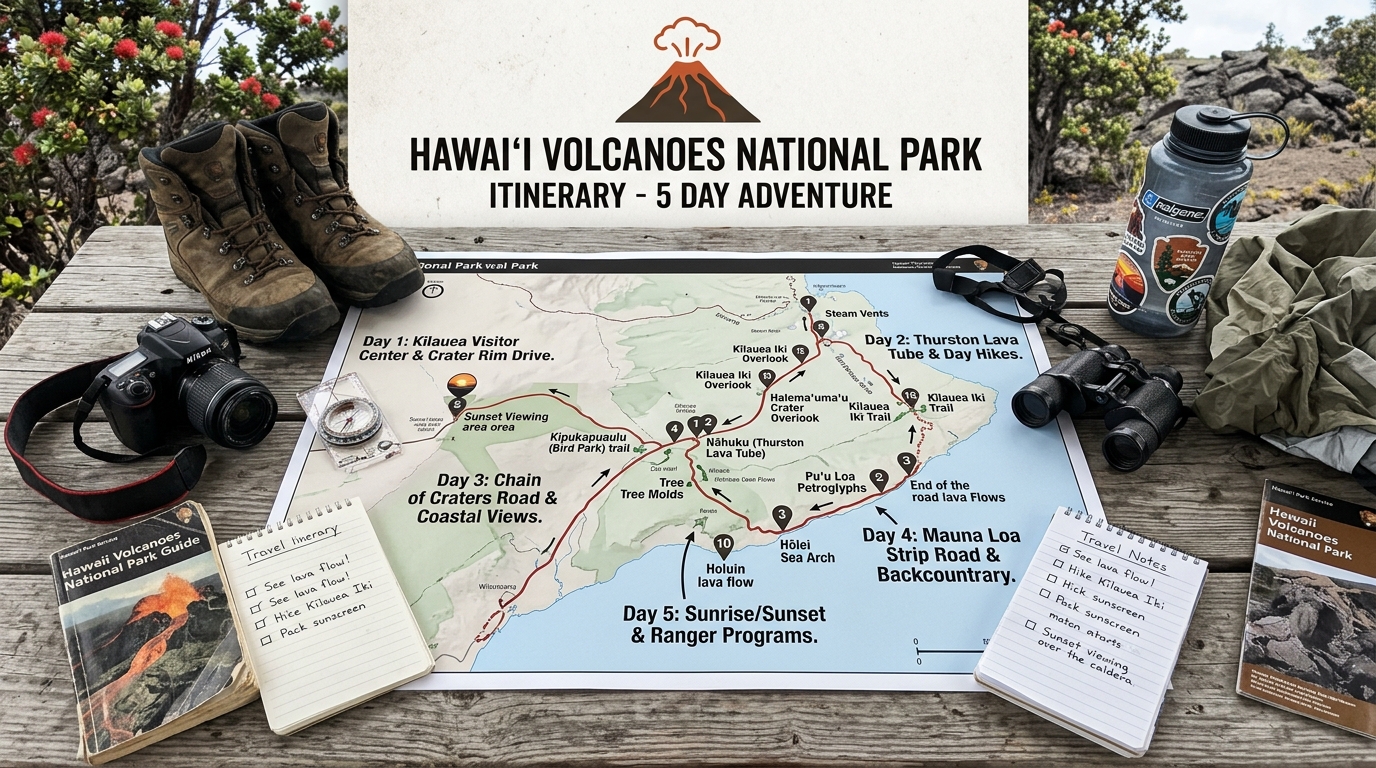
Balancing Summit Craters and Coastal Deserts on Hawaii Volcanoes National Park Itinerary
Planning a successful volcano national park itinerary means preparing for a lush tropical rainforest and a dry coastal desert in the exact same afternoon.
Hawaii Volcanoes National Park covers vastly different weather zones that require visitors to pack everything from waterproof jackets to sun protection before leaving their lodging. Unlike mountain parks that feature steady elevation gains, Hawaii Volcanoes presents active geological zones with shifting safety closures, sulfur gas hazards, and long driving stretches between the summit and the coastline. Travelers attempting to squeeze this destination into a single day often underestimate the massive distances between sights, making realistic time management the single most important factor for an enjoyable visit. For travelers interested in comparing diverse arid landscapes across the United States, reviewing a Saguaro National Park itinerary provides helpful perspective on managing desert-focused travel schedules.
Navigating the Summit Caldera and Steam Vents on Your Day Route
Focusing your first main block of time around the summit caldera ensures you see the park’s primary geological highlights without burning out the driver.
Begin your morning at the Kīlauea Visitor Center to check active eruption alerts, air quality advisories, and trail closures provided directly by the National Park Service. Step outside to the adjacent Kīlauea Overlook to take in the sheer scale of the massive summit crater before walking over to the nearby Steam Vents. Here, rainwater seeps deep into hot underground rocks and rises back to the surface as powerful plumes of white steam. Afterward, walk through the Nahuku Thurston Lava Tube to see a hollow underground passage carved by rushing molten rock hundreds of years ago. Conclude your summit loop by driving a portion of Crater Rim Drive to catch different angles of the caldera before moving toward other areas of the park.
Driving Down the Steep Slopes of Chain of Craters Road
Venturing down the winding Chain of Craters Road takes drivers from the chilly, misty summit all the way to sea level through miles of stark black lava.
This dramatic coastal highway descends thousands of feet past historical pit craters and older lava flows that tell the story of repeated volcanic eruptions over decades. Drivers should keep a close eye on their fuel gauge because there are zero gas stations, restaurants, or water refill stations anywhere along this remote coastal route. The road ends abruptly where a historic lava flow covered the asphalt entirely, leaving a turnaround point near the towering Holei Sea Arch. Make sure to allow plenty of daylight for the return drive uphill, as navigating these winding park roads in pitch-black darkness can be extremely tiring.
Exploring the Slick Trails of the Wet Rainforest Zone
Exploring the wet northeastern side of Hawaii Volcanoes National Park demands sturdy footwear and proper rain gear to handle sudden tropical downpours.
The higher elevations around the summit receive heavy annual rainfall, creating dense jungle environments where ferns and native ohia trees thrive in damp soil. Dirt paths and walking trails near the rainforest can turn into slick mud very quickly, so wearing hiking boots with aggressive tread helps prevent slips. Pack a light rain shell and use a waterproof bag for your electronics because showers can start instantly and stop just as fast. Always obey all safety barriers and posted warning signs managed by the National Park Service to stay away from unstable ground near thermal features.

Managing Official Park Rules and Volcanic Gas Hazards
Understanding official park guidelines, entrance fees, and volcanic gas risks keeps everyone in your travel party safe and prepared.
According to the National Park Service, vehicle entrance fees apply, and visitors can purchase passes at the entrance station or online before arrival. Staying on authorized trails is mandatory because the ground near steam vents and crater edges can be dangerously thin or prone to sudden collapse. Volcanic smog and sulfur dioxide emissions create serious health risks for visitors with asthma, heart conditions, or other respiratory sensitivities, so checking daily air quality reports is vital. Because there are no artificial streetlights anywhere within the park boundaries, driving after sunset requires extreme caution to avoid unlit park roads and unexpected obstacles.
Frequently Asked Questions About Visiting Hawaii Volcanoes
Finding quick answers to common scheduling and logistics questions helps travelers make the most of their time inside Hawaii Volcanoes National Park.
Is a day trip from Honolulu to Hawaii Volcanoes National Park realistic?
Attempting a day trip from Honolulu requires catching an early morning inter-island flight, renting a car, and driving across the island, making for an exhausting day with very little time to explore.
When is the best time to see glowing lava in the park?
Active eruptions and visible glow levels change unpredictably based on current geological activity, so visitors must check the official National Park Service website daily for real-time updates.
Are there restaurants inside Hawaii Volcanoes National Park?
Dining options within the park are very limited, with food service available mainly at the Volcano House hotel near the summit, meaning you should pack extra snacks and water.
How much does it cost to enter the park?
Vehicle entrance fees are set by the National Park Service, and standard passes cover entry for private vehicles for multiple consecutive days.
Can I visit the park if I have respiratory issues?
Volcanic emissions and sulfur dioxide gas can trigger severe breathing problems, so vulnerable visitors should monitor official air quality reports closely before exploring.
Do I need a reservation to enter Hawaii Volcanoes National Park?
Advanced reservations are generally not required for standard vehicle entry, though you should always check the official National Park Service website for any sudden capacity updates.

I’m Muhammad Ubaid, founder of YBR Magazine. I research and write detailed guides on America’s National Parks — covering entry fees, permits, best times to visit, and planning tips — using official NPS sources and up-to-date information.