


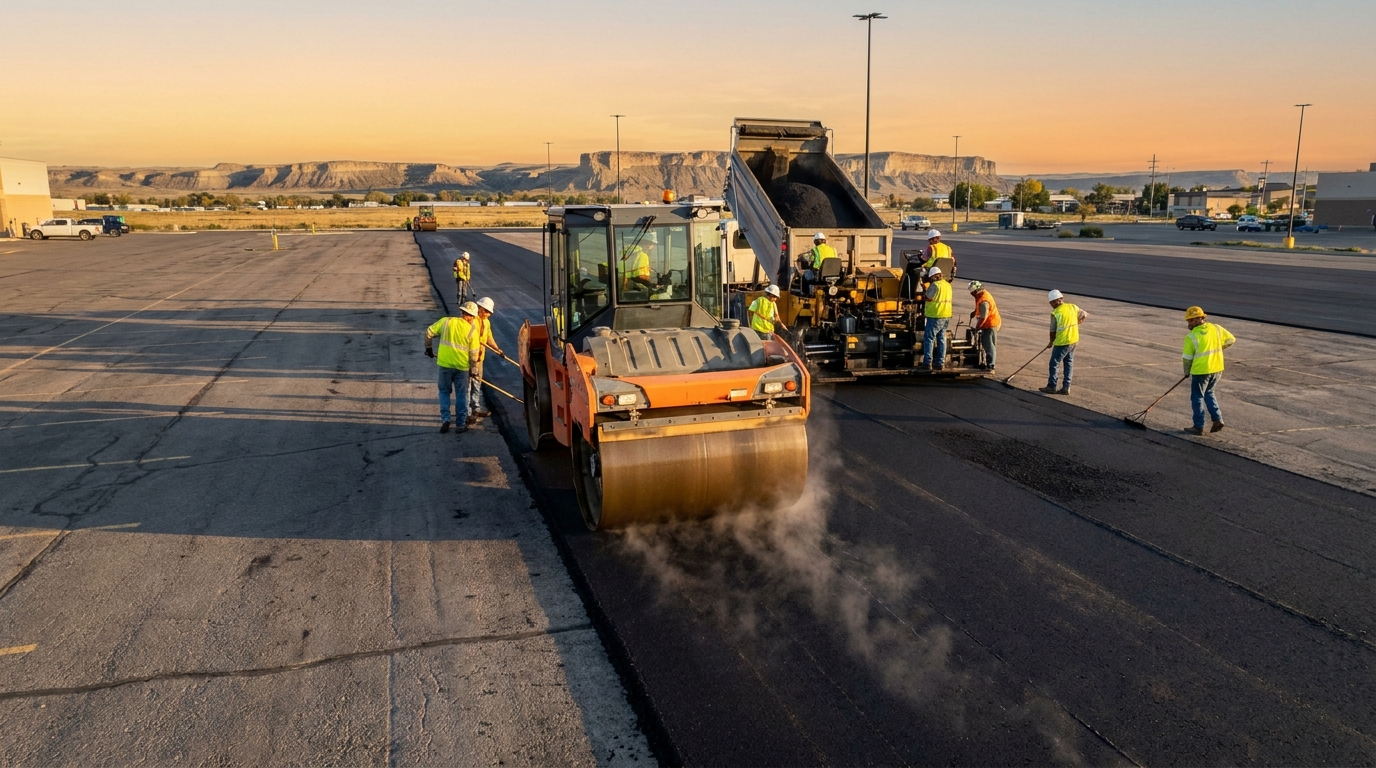
Anyone who looks after a shopping center, clinic, warehouse yard, or apartment complex knows how quickly a worn parking lot can become a safety problem and a poor first impression. Commercial asphalt paving Billings MT projects look simple from the outside, but the city’s freeze-and-thaw winters, its limited paving season, and the rules that apply to public bids shape almost every decision along the way. This guide explains what the work includes, when it can realistically be done, what moves the price, which rules matter, and how to choose a contractor without relying on thin directory listings.
Most pages that rank for this topic are contractor homepages and lead-generation directories. They list services but rarely explain how Billings weather, local timing, or compliance affect a project, and some cost pages borrow figures from other regions. The sections below fill those gaps and point out where public information is limited.
Quick Facts
| Topic | What is publicly known |
|---|---|
| Typical paving window in northern states | Mid-spring to mid-fall, according to Pavement Interactive |
| Freezing nights in Billings | About 147 per year, based on long-term averages published by climate-zone.com |
| Annual precipitation | Roughly 14 to 15 inches |
| Annual snowfall | About 54 to 59 inches, depending on the source |
| Life of a well-maintained asphalt lot | Around 20 years, according to HomeAdvisor’s local guidance |
| Billings-specific price per square foot | Not publicly confirmed |
| Contractor registration on Billings public bids | Montana Department of Labor and Industry (DLI) registration is required |
What Commercial Asphalt Paving Usually Includes
Commercial work covers much more than rolling out a fresh black surface. Service lists published by regional contractors, such as the one from Pave America for Billings, Bozeman, Helena, and Butte, typically include new asphalt paving, milling, parking lot repair, sealcoating, and layout and re-striping. Each service fits a different stage in the life of a lot, and choosing the wrong one is one of the most common ways owners overspend on commercial asphalt paving Billings MT budgets.
A mill-and-overlay removes the worn top layer and places a new one, and it generally makes sense only when the existing pavement is structurally sound underneath. When the base itself has failed, the lot needs full-depth replacement, which means removing the old asphalt, rebuilding the base, and paving again. Smaller measures such as patching, crack sealing, and sealcoating sit at the lighter end of the range and are meant to slow deterioration rather than reverse it.
How Billings Weather Affects Paving and Pavement Life

Billings has a semi-arid, four-season climate with hot, dry summers and cold, snowy winters. The Billings Chamber of Commerce notes that winters here include frequent thaws and chinook winds that can turn a bitter cold spell into a warm-up within hours. That pattern matters for asphalt because water that seeps into cracks during a thaw can freeze again overnight, which widens the crack and weakens the surface. A contractor group that writes about parking lot failure also points out that standing water shortens pavement life, so drainage deserves as much attention as the asphalt itself.
Timing is the other big weather factor when scheduling commercial asphalt paving Billings MT work. Pavement Interactive explains that hot mix cools quickly in cold conditions, which leaves less time to compact it properly, and that many northern states limit paving to the stretch between mid-spring and mid-fall for that reason. Its example shows how fast the margin disappears: a thin lift of mix delivered at about 275°F and placed at 45°F with a 10 mph wind reaches the temperature where compaction stops working in roughly 16 minutes. Billings averages around 11 mph of wind across the year, so wind is a real consideration, not a footnote.
Published minimum temperatures also differ. One paving contractor says the ideal air temperature is above 45°F, while another recommends at least 50°F and stresses that ground temperature matters as much as air temperature. Long-term averages show April highs near 57°F with lows near 34°F, and October highs near 61°F with lows near 38°F, so the shoulder months can work for some jobs but leave little room for error. Because these are averages rather than forecasts, it is reasonable to ask a contractor which temperature standard they follow and how they adjust for thin layers.
Planning a Commercial Asphalt Paving Billings MT Project Step by Step
A clear plan keeps bids comparable and reduces surprises once crews start working. The sequence below follows how most commercial projects unfold.
- Assess the surface and drainage. Walk the lot after rain or snowmelt and note cracking, potholes, and places where water collects. One estimating guide recommends taking core samples to check the condition of the base before deciding between an overlay and a larger repair.
- Define the scope and thickness. Parking areas used mainly by cars are often paved thinner than lots with frequent truck traffic, and one cost guide describes about 2 inches for lighter use and 2.5 to 3 inches for heavier commercial use. Your contractor or engineer should confirm what suits your site.
- Collect written bids on the same scope. Bids are easier to compare when every contractor prices the same thickness, base work, drainage fixes, and striping.
- Plan phasing and access. Many commercial owners keep a business open by paving one section at a time, and the same cost guide notes that milling on commercial sites can sometimes be done at night.
- Schedule striping and accessible layout last. Markings go on after the new surface is placed, which is the right moment to confirm the accessible parking layout.
What Drives the Price, and Why Online Numbers Disagree
Budgeting for commercial asphalt paving Billings MT is harder than it looks because published prices vary enormously. A contractor guide from Syracuse, New York, says new commercial asphalt starts around $4 per square foot and overlays on sound pavement start around $2.50, but that is a different market with different material costs. National cost pages range from about $2.50 to $8 per square foot or higher, and several of the pages that show up in search results appear auto-generated and give totals that contradict each other. A reliable Billings-specific price per square foot has not been publicly confirmed, so treat any single number with caution.
The factors that move the price are fairly consistent across sources. Larger lots usually cost less per square foot because crew and equipment mobilization is spread over more area, while small or tight sites cost more. Unstable soil or a failed base adds grading and reconstruction, overlays cost less than full replacement, thicker sections cost more, and the distance from the asphalt plant affects hauling costs. A public listing from the City of Billings gives a useful reality check on scope: two new parking facilities at Optimist Park were reported as awarded for $449,397 in April 2022, but that figure also covered stormwater utilities, curb, gutter, sidewalk, lighting, irrigation, and landscaping, so it cannot be converted into a paving rate.
Registration, Bonds, and Code Rules to Check
On public projects in Billings, bid notices state that the contractor and any subcontractors must be registered with the Montana Department of Labor and Industry. The same notices describe performance and payment bonds equal to 100 percent of the contract amount, along with proof of insurance. The Optimist Park notice also required bid security of at least 10 percent of the bid, payable to the City of Billings. Those terms belong to public contracts, so private owners are not bound by them, but they offer a sensible benchmark for the paperwork worth requesting on private commercial asphalt paving Billings MT jobs.
Local development rules can matter too. Billings city code includes off-street parking and storm drainage requirements that apply to new development and redevelopment, and the section numbers have been renumbered over the years. Whether a simple resurfacing needs any review is not something public sources spell out clearly, so a short call to city planning or building staff before the work starts is a low-cost safeguard.
Accessibility rules also apply to the finished lot. The U.S. Department of Justice’s ADA guidance states that when a business restripes a lot, it must provide accessible spaces as required by the 2010 ADA Standards for Accessible Design. Accessible spaces need an access aisle at least 60 inches wide, two spaces may share an aisle except in angled parking, and the aisle must sit at the same level as the spaces it serves, which means the paving crew needs to keep slopes under control in that area. Signs for van-accessible spaces must be mounted at least 60 inches above the ground to the bottom of the sign.
Keeping a New Lot in Good Shape
HomeAdvisor’s local guidance says an asphalt lot with routine care can last about 20 years, and it suggests sealcoating every few years, resurfacing every 15 to 20 years, and patching potholes right away. Those intervals are general guidance rather than a Billings standard, and snow removal practices, drainage, and traffic loads can shift them in either direction. Early, small repairs are usually cheaper than waiting for cracks to open into potholes, which is why many owners schedule a yearly walk-through in late spring after the freeze-thaw season has done its damage.
Hiring for Commercial Asphalt Paving Billings MT Projects: What to Ask
Online directories are a starting point, not a verdict. One bid-matching directory lists 14 verified asphalt paving contractors for the Billings area, yet its listings show companies anywhere from about 117 to 242 miles away, which can affect mobilization costs and response time. Home-services sites such as HomeAdvisor and The Builder Market mix driveway installers and general contractors with commercial specialists, so commercial experience needs to be confirmed directly.
Useful questions to ask include whether the company is registered with the Montana DLI, whether it carries current insurance, and which similar commercial lots it has paved in Billings or nearby. Ask also how the bid handles base repair, drainage, thickness, and compaction, who does the striping, and what warranty applies in writing. Visiting a lot the contractor paved a few winters ago is often more revealing than any brochure.
Frequently Asked Questions
How long does a commercial paving job take?
A Billings-area contractor directory says large commercial projects can run one to two weeks or longer, depending on scope. HomeAdvisor describes the usual order as ordering materials, preparing the site, paving, allowing curing time, and then adding paint striping.
Is asphalt or concrete the better choice for a commercial lot?
HomeAdvisor’s local guidance puts asphalt at about 20 years of service and concrete at 30 to 40 years, while published price ranges place concrete higher per square foot. Asphalt is also more flexible and quicker to repair, so the better option depends on traffic, budget, and how long you plan to own the property.
Do I need a permit to resurface an existing lot?
Public sources do not clearly say, so it is not confirmed. Projects that add or reconfigure parking or change drainage are more likely to trigger review under city code, and the City of Billings can confirm the requirements for your address.
How many accessible spaces does my lot need?
The number depends on the total count of spaces, as set out in Table 208.2 of the 2010 ADA Standards. At least one of every six accessible spaces must be van accessible, and a van space needs either a 132-inch width with a 60-inch aisle or a 96-inch width with a 96-inch aisle, plus 98 inches of vertical clearance.
Should I sealcoat a brand-new lot right away?
One estimating guide advises waiting about 6 to 12 months so new asphalt can release its lighter oils, though there is no single industry timeline. Ask your contractor and the mix supplier what they recommend for your specific mix.
Can the business stay open during paving?
Often yes, in phases. Contractors commonly split a lot into sections or schedule noisy work such as milling outside business hours, but the exact plan should be written into the bid so customers and delivery drivers know where to go.
Conclusion
Good results from commercial asphalt paving Billings MT come from matching the repair method to the real condition of the lot, scheduling the work inside the warm-weather window, and hiring a registered, insured contractor who puts thickness, base work, and drainage details in writing. Owners who gather condition information first are in a better position to compare bids fairly and spot unrealistic numbers.
Disclaimer
This article is for general information only and is not engineering, legal, or construction advice. Prices, codes, and contractor requirements change, and conditions differ from one property to the next. Confirm details with the City of Billings, the Montana Department of Labor and Industry, and a licensed contractor or engineer before making decisions. The author has no affiliation with any company mentioned.
Explore More
How to Use a Meat Thermometer: A Step-by-Step Guide to Safe, Juicy Results

I’m Muhammad Ubaid, founder of YBR Magazine. I research and write detailed guides on America’s National Parks — covering entry fees, permits, best times to visit, and planning tips — using official NPS sources and up-to-date information.

