


Short answer: The Great Wall of China was not built in one go. Different states and dynasties built, joined, and rebuilt many walls over more than 2,000 years, from about the 7th century BC to the 17th century AD. The best-known Qin dynasty section took roughly a decade, while the famous brick and stone wall of the Ming dynasty took well over two centuries.
Why There Is No Single Building Time
Many people imagine the Great Wall as one project with a start date and an end date, but that picture does not match history. The wall is really a huge network of walls, trenches, watchtowers, fortresses, and natural barriers built by many rulers who each faced different threats. Some sections were built in a few years. Others were repaired and extended again and again over centuries. This is why asking how long it took is a bit like asking how long it took to build all the roads in a country.
Because of this, historians usually divide the story into several major stages. Each stage has its own builders, materials, and reasons for construction, and looking at them one by one gives the clearest answer.
The Earliest Walls: 7th Century BC to 221 BC

The oldest wall building in China began during the Spring and Autumn period, around the 7th century BC. At that time China was split into many rival states, and several of them built long defensive walls to protect their borders from neighbors and from nomadic groups in the north. The state of Chu is often mentioned among the first, and states such as Qi, Yan, Zhao, Wei, and Qin later built their own.
These early walls were mostly made of rammed earth, which means soil pressed tightly into layers inside wooden frames. They were not built as one connected line, and they often faced other Chinese states as much as outside invaders. Their construction went on for several centuries, but they were separate projects rather than one plan.
The Qin Dynasty: About a Decade of Unification
In 221 BC, Qin Shi Huang defeated the other states and became the first emperor of a unified China. Soon afterward, he ordered the northern walls of the older states to be linked together and extended to form a stronger frontier against the Xiongnu, a powerful nomadic people. Work is traditionally said to have begun around 220 BC under the general Meng Tian, and accounts describe it as lasting roughly ten years.
Ancient records say hundreds of thousands of soldiers, farmers, and convicts were put to work, though the exact numbers cannot be checked today. The Qin builders used the terrain wisely, placing walls along ridges and using rammed earth or local stone where it was available. Many stretches of this early wall have since worn away, so it is not the wall most tourists see today.
The Han Dynasty: Pushing the Wall Far West
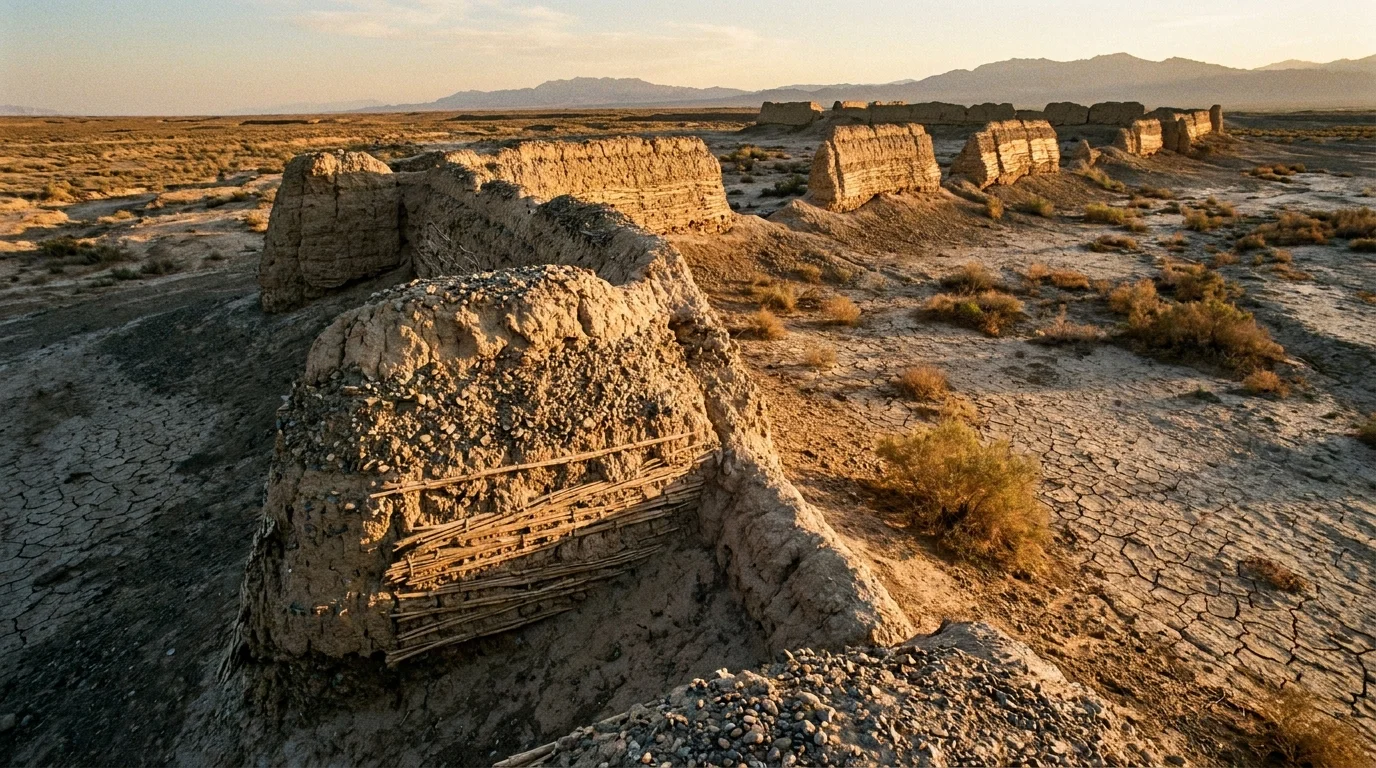
The Han dynasty, which began in 206 BC, repaired older sections and then did something new by extending the wall deep into the west. Under Emperor Wu, in the 2nd and 1st centuries BC, the wall reached across the Hexi Corridor in what is now Gansu province and out toward the edge of the Taklamakan region. The purpose was to guard the trade routes of the Silk Road and to protect the growing empire.
In the dry western deserts, builders could not always use plain earth, so they layered reeds, tamarisk branches, and gravel to make a firm structure. Some of these desert remains can still be seen. Historians often say that the Han sections make the total wall the longest of any period, and the Han effort continued for well over a century in different stages.
Between the Han and the Ming: Repairs and New Walls
After the Han fell, the wall did not stop growing. Several northern dynasties, including the Northern Wei, Northern Qi, Northern Zhou, and later the Sui, built or rebuilt walls to guard against threats from the steppe. The Sui rulers are recorded as gathering very large numbers of workers for short bursts of construction.
Not every dynasty took part. The Tang dynasty relied more on armies and alliances than on walls, and the Mongol-ruled Yuan dynasty had little reason to build defenses across lands it controlled on both sides. The Jin dynasty, which ruled northern China during the 12th century, constructed border defenses of its own, but these are less famous today. This long middle period shows that the wall was built in waves, not in a straight line of progress.
The Ming Dynasty: The Wall Most People Know
The wall you see in photographs, with brick walls, stone bases, and regularly spaced watchtowers, mostly comes from the Ming dynasty, which ruled from 1368 to 1644. After driving out the Mongols, the early Ming emperors began strengthening the northern border. Work then continued for well over two centuries, with major pushes after the Mongol capture of the Ming emperor in 1449 and again in the later 1500s.
In the 16th century, the general Qi Jiguang improved the design by adding hollow watchtowers that could store weapons and house soldiers. Famous tourist sections such as Badaling, Mutianyu, and Jinshanling come from this era, although many were rebuilt or restored in later times. Ming builders used fired bricks, cut stone, and lime mortar, and some studies suggest that sticky rice was mixed into the mortar in certain places to make it stronger. This more advanced construction is one reason Ming sections have lasted better than the older earthen ones.
How Long Is the Great Wall?
Length depends on which walls are counted. In 2012, China’s State Administration of Cultural Heritage announced the results of a national survey and reported that the walls of all dynasties together measure about 21,196 kilometers, or roughly 13,170 miles. The Ming sections alone were measured at about 8,850 kilometers, which includes constructed walls, trenches, and natural defensive barriers such as rivers and hills.
These numbers help explain the long timeline. A structure of this size, built with human labor and simple tools, could never have been finished quickly, and each dynasty added only part of the whole.
Who Built the Wall and How
The builders were mostly soldiers, local farmers who owed labor to the state, and convicts. Work was hard, and the remote locations made supplies difficult to move. Stories claim that huge numbers of workers died and were buried in the wall, but historians have not been able to confirm such figures, so these accounts are best treated as legend rather than proven fact.
Builders relied on local materials to save time and effort. In the mountains they used stone, in the plains they used earth, and in the deserts they used reeds and gravel. Workers moved materials by hand, on carts, and with animals, and in steep areas they sometimes carried bricks up narrow slopes.
Common Myths About the Great Wall
One popular claim is that the Great Wall can be seen from space with the naked eye. Astronauts have said that it is very hard or impossible to spot from low orbit without help, and China’s first astronaut, Yang Liwei, said in 2003 that he could not see it. The wall is very long, but it is also narrow and blends into the land around it.
Another myth is that it is one continuous wall built by one emperor. As shown above, it is a chain of separate and overlapping structures from many eras. A third idea is that the wall always stopped invaders, but in reality it worked best as part of a wider defense system that included soldiers, signals, and diplomacy, and it was crossed or bypassed several times in history.
Today’s Great Wall
In 1987, UNESCO added the Great Wall to its World Heritage List. Much of it has been damaged by weather, farming, stone theft, and tourism, and some early earthen sections are now only low mounds. Protection and repair work continues, though restoration is a topic of debate because some rebuilt parts look very different from the original.
Frequently Asked Questions
Was the Great Wall built in 10 years? No. Only the Qin dynasty’s linking of earlier walls is traditionally described as taking about ten years, and that was one stage of a much longer story.
Which part took the longest to build? The Ming wall took the longest as a single dynastic project, with work continuing for more than 200 years.
Who started the Great Wall? Several early Chinese states began building walls in the 7th century BC, and Qin Shi Huang later joined and extended them.
Final Thoughts
So, how long did it take to build the Great Wall of China? The most accurate answer is more than 2,000 years, spread across many rulers and many wall systems. The Qin dynasty needed about a decade for its famous unification project, while the Ming dynasty kept building and improving for over two centuries. Understanding this long, layered history shows why the Great Wall is not just one structure but a record of how China defended and shaped its borders across ancient and imperial times.
Disclaimer: This article is for general information and education only. Dates, distances, and labor numbers for ancient projects come from historical records and later surveys, and scholars sometimes disagree about them, so figures may vary between sources. Please check with official historical or heritage bodies before using this content for academic, professional, or travel decisions.
Explore More
Bacari North Park: Menu, Hours, Open Bar, Brunch, and Visitor Guide

I’m Muhammad Ubaid, founder of YBR Magazine. I research and write detailed guides on America’s National Parks — covering entry fees, permits, best times to visit, and planning tips — using official NPS sources and up-to-date information.