

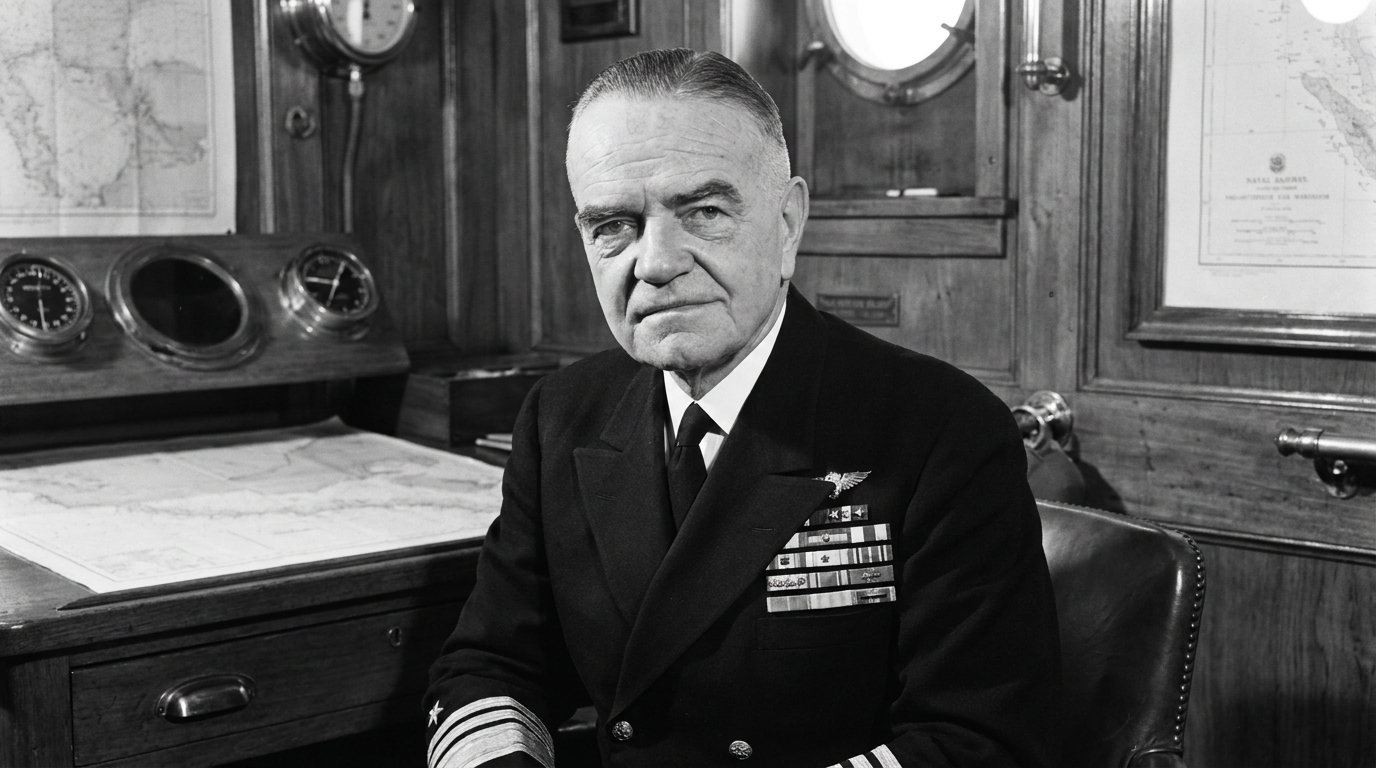
William Frederick Halsey Jr. is one of the best-known American naval leaders of the twentieth century. He is remembered for his aggressive style, his popularity with sailors, and his role in turning the tide of the Pacific War. He is also remembered for decisions that remain debated by historians today. This article covers his early life, his rise through the Navy, his major battles, the controversies around him, and the legacy he left behind.
Who Was William F. Halsey?
William F. Halsey was a United States Navy officer who rose to the rank of Fleet Admiral, the highest rank in the American navy. He was born on October 30, 1882, in Elizabeth, New Jersey, and died on August 16, 1959, at Fishers Island, New York. He is buried at Arlington National Cemetery.
Halsey became a household name during World War II, when American newspapers nicknamed him “Bull.” He reportedly disliked the nickname, and many of his friends and colleagues simply called him Bill. Even so, the name stuck, because it matched the public image of a bold commander who liked to attack the enemy directly.
Early Life and Naval Education
Halsey came from a family with naval connections, since his father also served as a Navy officer. As a young man he first considered a career in medicine and spent a short time studying at the University of Virginia. He then changed course and entered the United States Naval Academy at Annapolis, where he played football and graduated in 1904.
His early service took him around the world. He served aboard the battleship USS Kansas during the voyage of the Great White Fleet, the famous journey of American battleships around the globe between 1907 and 1909. He also gained experience commanding torpedo boats, which gave him early training in fast, close-range naval action.
World War I and the Interwar Years
During World War I, Halsey commanded destroyers operating from Queenstown, Ireland, where American ships helped escort convoys and hunt German submarines. His performance earned him the Navy Cross. After the war he continued to command destroyers and later held staff and diplomatic posts, including service as a naval attaché in Germany and several Scandinavian countries during the 1920s.
One of the most unusual steps in his career came in the mid-1930s. Although he was already in his fifties, Halsey trained as a naval aviator and earned his pilot wings in 1935. This was a significant change, because naval aviation was becoming central to modern warfare, and the Navy wanted its aircraft carriers to be led by officers who understood flying. After the training he took command of the carrier USS Saratoga, and he later became a rear admiral in charge of carrier divisions. By 1940 he was a vice admiral commanding the Navy’s main carrier striking force.
Halsey at the Start of World War II
When Japan attacked Pearl Harbor on December 7, 1941, Halsey’s task force was at sea, built around the carrier USS Enterprise. His ships had been delivering aircraft to Wake Island and were returning to Hawaii. Because the American carriers were not in port that morning, they survived the attack and became the core of the Pacific Fleet’s early counterattack.
In the first months of 1942, Halsey led carrier raids against Japanese-held islands, including strikes in the Marshall and Gilbert Islands in February. These raids did limited physical damage but gave American morale a badly needed boost. In April 1942, his task force escorted the carrier USS Hornet to launch the Doolittle Raid, in which sixteen Army bombers struck Tokyo and other Japanese cities. The raid caused modest damage, but it showed the Japanese people that their homeland was vulnerable and pushed Japanese planners toward the risky Midway operation.
Halsey missed the Battle of Midway in June 1942 because of a severe skin condition that put him in the hospital. He recommended Rear Admiral Raymond Spruance to take his place, and Spruance went on to win one of the most important victories of the war. Many people still wonder how Midway might have gone under Halsey, but the choice of Spruance proved a good one.
Command in the South Pacific and Guadalcanal
In October 1942, Halsey took over as Commander, South Pacific Area, during a very difficult period on Guadalcanal. American forces were fighting a desperate campaign for the island, and morale in the theater was low. Halsey’s energetic leadership and his willingness to visit troops and ships lifted spirits quickly. He was promoted to full admiral in November 1942.
During his time in this command, American and Allied forces fought a series of hard sea, air, and land battles, including the Battle of the Santa Cruz Islands and the Naval Battle of Guadalcanal. By early 1943 the Japanese had withdrawn from Guadalcanal. Halsey then oversaw the advance up the Solomon Islands chain, which included landings on Bougainville and a strategy of bypassing heavily defended Japanese strongholds such as Rabaul instead of attacking them directly. This approach saved lives and time, and it became a model for later Pacific operations.
Commander of the Third Fleet
In 1944, Halsey took command of what became known as the Third Fleet. The Navy used an unusual system in which the same ships and many of the same senior staff operated under two different numbers depending on who was in charge. When Spruance led, the force was called the Fifth Fleet, and when Halsey led, it was called the Third Fleet. The system let one team plan the next operation while the other carried out the current one.
Under Halsey, the fleet supported the invasions of the Philippines, struck targets across the western Pacific, and carried out large air raids on Formosa, the Philippines, Okinawa, and the Japanese home islands. These operations gave the Navy near-total control of Japan’s surrounding waters in the final year of the war.
The Battle of Leyte Gulf and Its Controversy
The most debated moment of Halsey’s career came during the Battle of Leyte Gulf in October 1944, the largest naval battle of World War II by many measures. Japan sent several forces to attack the American invasion fleet at Leyte. One of them was a northern force with aircraft carriers, which was actually a decoy carrying few aircraft.
Halsey took the bulk of the Third Fleet north to destroy those carriers. In doing so he left the San Bernardino Strait unguarded, and a powerful Japanese battleship and cruiser force passed through it and attacked a group of small American escort carriers and destroyers off Samar. The American ships fought back with remarkable courage and survived, though several were lost, and the Japanese force eventually withdrew.
Halsey later said he believed the Japanese carriers were the greatest threat and that he had to destroy them. Critics argue that he should have left part of his fleet to guard the strait or communicated his intentions more clearly. The episode also includes a famous misunderstanding: a message from Admiral Chester Nimitz asking where Task Force 34 was ended with extra padding words, “the world wonders,” which Halsey read as a sarcastic insult. The phrase was meant only to confuse enemy code breakers, but it made a tense moment even worse.
The Typhoons
Halsey’s fleet also suffered from severe weather. In December 1944, Typhoon Cobra struck the Third Fleet while it was operating in the Philippine Sea. Three destroyers, USS Hull, USS Spence, and USS Monaghan, capsized and sank, and about 790 men were lost along with many aircraft. A Navy court of inquiry criticized Halsey’s judgment but he was not removed from command.
In June 1945, another typhoon damaged ships of the Third Fleet near Okinawa. Although no ships were lost, the damage was serious, and a second inquiry again raised questions about his handling of the weather. Nimitz still chose to keep him in place, in part because of Halsey’s reputation and the nearness of the war’s end.
The Japanese Surrender
Halsey was present on the deck of the battleship USS Missouri in Tokyo Bay on September 2, 1945, when Japan formally surrendered. His flagship was the Missouri during the closing stage of the war, and he stood among the senior American officers for the ceremony. On December 11, 1945, he was promoted to Fleet Admiral. He became one of only four officers in the history of the U.S. Navy to hold that rank, along with Ernest King, Chester Nimitz, and William Leahy.
Language and Public Image
Halsey was known for blunt and sometimes harsh language about the enemy, and he used racial slurs about the Japanese that are rightly criticized today. His public statements reflected the wartime hostility that was common at the time, but they remain a troubling part of his record, and modern historians often point them out when discussing his image. At the same time, many sailors and officers admired him because he spoke plainly and showed concern for the men under his command.
Retirement and Later Life
Halsey retired from active duty in March 1947. That same year he published his memoir, Admiral Halsey’s Story, written with the journalist J. Bryan III. He remained a public figure and spent his later years in business, speaking, and supporting naval causes. He had married Frances Cooke Grandy in 1909, and they had a son and a daughter.
Honors and Legacy
Halsey received many American and foreign decorations, including the Navy Cross and several Distinguished Service Medals. Several U.S. Navy ships have been named in his honor, including the guided missile destroyer USS Halsey, which entered service in 2005.
His legacy is mixed but important. Supporters point to his role in restoring confidence in the South Pacific, his skill in handling carrier forces, and his strong leadership. Critics point to Leyte Gulf and the typhoons as examples of risk-taking that carried real costs. Most historians agree that he was a courageous and inspiring leader whose strengths and weaknesses were closely linked to his aggressive personality.
Frequently Asked Questions
Why was William F. Halsey called “Bull”?
American newspapers gave him the nickname during World War II because of his aggressive style. Halsey himself did not like it.
Was Halsey at Midway?
No. A severe skin condition kept him in the hospital, and Raymond Spruance took his place.
What rank did Halsey reach?
He became a Fleet Admiral in December 1945, the highest rank in the U.S. Navy.
What was Halsey’s biggest controversy?
The decision at Leyte Gulf to move the main fleet north after the Japanese decoy carriers, which left the landing area open to a Japanese surface attack.
When did William F. Halsey die? He died on August 16, 1959, at the age of 76.
Disclaimer: This article is for general educational and informational purposes only. It is based on widely accepted historical accounts, but details such as dates, casualty numbers, and interpretations of events may vary slightly between sources. Readers who need exact information for academic, legal, or professional use should check primary records, official U.S. Navy histories, and published biographies.
Explore More
Yulanda Simon: Who She Is, Her Link to Miguel A. Núñez Jr., and What Is Actually Known
I’m Muhammad Ubaid, founder of YBR Magazine. I research and write detailed guides on America’s National Parks — covering entry fees, permits, best times to visit, and planning tips — using official NPS sources and up-to-date information.

