
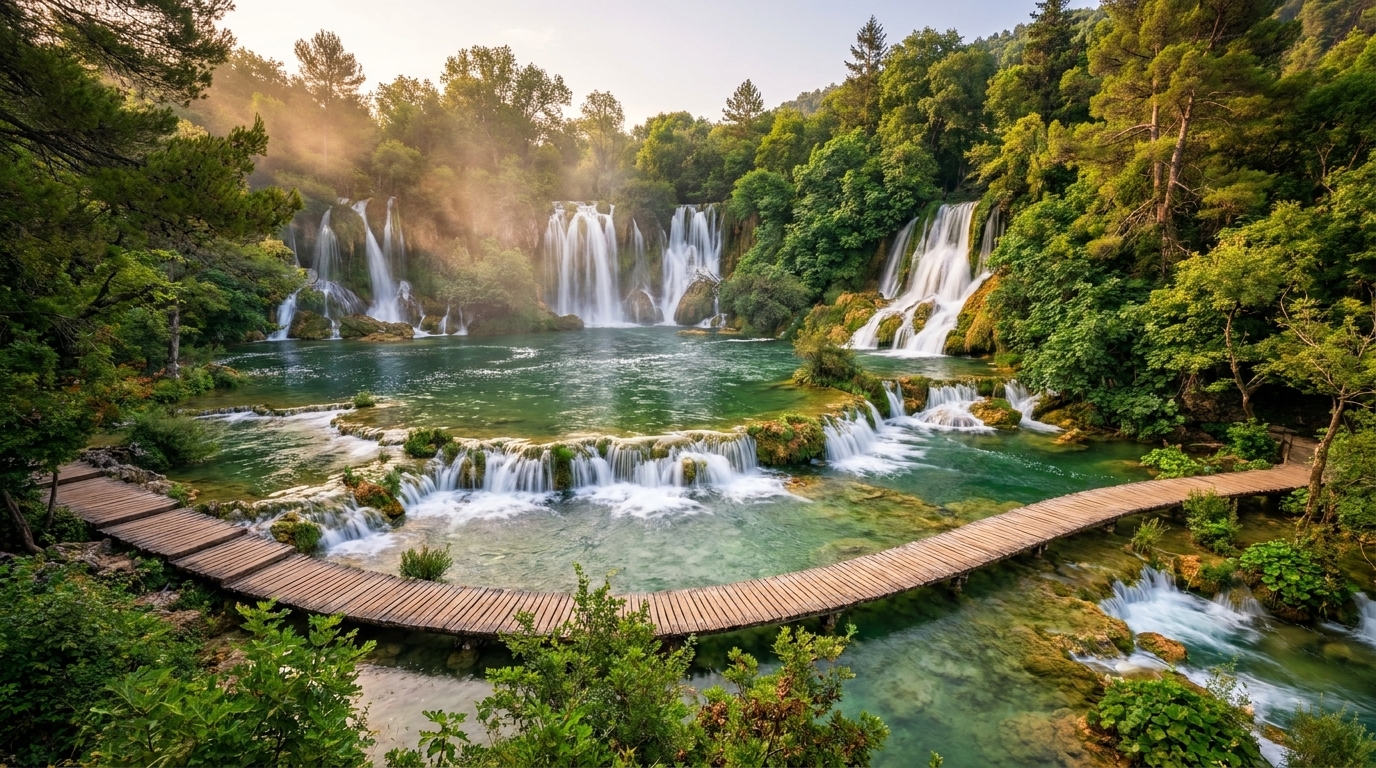
Krka National Park is one of the most beautiful natural places in Croatia, and it is easy to see why so many travellers add it to their Dalmatia trip. The park follows the Krka River through a green canyon, with clear pools, wooden walkways, old monasteries and a long line of waterfalls. It is a place where you can walk calmly, take a boat, learn some history and enjoy nature without needing any special outdoor skills. This guide explains everything a first-time visitor needs to know, from how the park formed to ticket prices, swimming rules, entrances and the best time to go.
What Is Krka National Park?
Krka National Park is a protected area in central Dalmatia, in the Šibenik-Knin region of Croatia. It was declared a national park in 1985 and covers about 109 square kilometres along the lower part of the Krka River. The river itself is around 72 kilometres long, and it begins near the town of Knin before flowing through limestone land and finally reaching the sea near Šibenik. Along the way it creates a series of travertine barriers, which are natural walls built slowly by moss, algae and minerals in the water. These living barriers are the reason the park has so many waterfalls and small lakes.
Because the park is so large, visitors often feel it is more than one attraction. In fact, it has several areas with different moods. Skradinski Buk is the busiest and most famous, Roški Slap is a wider and quieter series of cascades, and the upper part of the river has smaller sites that give a deeper look at nature, local culture and history. Many people see only the main waterfall, but those who give the park a little more time often say the quieter places were the best part of the day.
Why Krka National Park Is So Special
The main reason is the travertine. In a few places in Europe you can see waterfalls built by nature itself in this way, and Krka is one of the best examples. The barriers keep growing very slowly as long as the water stays clean and the plants and moss are healthy. That is also why the park is strict about rules, because the surface is delicate and can be damaged by too many visitors walking or swimming in the wrong places.
The park is also a home for wildlife. Researchers have recorded hundreds of plant species, many kinds of fish, bats, reptiles and more than two hundred bird species, which makes it important for bird watchers as well as families and casual walkers. Together with the clear green water and the shade of trees, this gives the park a calm and fresh atmosphere, even on hot summer days.
The Main Waterfalls You Should Know
The river has seven waterfalls in total, and each one has its own character. From the upper course to the lower course they are Bilušića Buk, Brljan, Manojlovac Slap, Rošnjak, Miljacka Slap, Roški Slap and Skradinski Buk. Not all of them are equally easy to reach, and the most popular ones are Skradinski Buk and Roški Slap.
Skradinski Buk

Skradinski Buk is the star of the park. It is a long cascade of seventeen travertine steps that spreads across roughly 800 metres and drops nearly 46 metres in total. A well-built system of wooden paths and bridges takes you right between the pools, small islands and falling water, so you can walk through the scenery rather than only look at it from a distance. The loop is easy and suitable for most ages, although it can feel crowded in the middle of the day during the busy season. Visitors usually plan between three and five hours for this area, because there are also old watermills, small exhibitions and places to rest.
Roški Slap
Roški Slap is located further upstream and feels more relaxed. Its water spreads over many narrow ledges and forms the famous “water necklaces”, which are thin lines of water that connect small pools like beads. It is a lovely place for photos, and the surrounding area includes a small walking route, old mills and a quieter atmosphere than the main waterfall. If you have time for only one extra stop beyond Skradinski Buk, this is a very good choice.
Other Places Worth Visiting Inside the Park
Visovac Island
Visovac is a small green island in the middle of the river, and it holds a Franciscan monastery that dates back to the fifteenth century. The monastery has a church, a small museum and a peaceful garden, and the whole island looks almost like a painting when you approach it by boat. Visovac is reached by a separate boat excursion, which is paid in addition to the normal entrance ticket, so it is worth checking the price and schedule before you go.
Krka Monastery
Further along the river is the Krka Monastery, an Orthodox monastery with a history that goes back to the fourteenth century. It is known for its calm setting and its Roman catacombs, and it adds a cultural and spiritual layer to a visit that is otherwise mostly about nature. Access is also usually combined with boat or organised excursions, so check the current schedule.
Burnum and the Upper River
In the upper part of the park you can find Burnum, the remains of a Roman military camp with a well-known arch. There are also visitor centres, including the Krka Eco Campus and the interpretation centre in Kistanje, that explain the river, its wildlife and the human story behind it using exhibitions and interactive displays. These areas are much quieter than Skradinski Buk, which makes them a good choice for people who prefer less crowded travel.
The Nikola Tesla Jaruga Power Plant
Below Skradinski Buk lies the old Jaruga hydroelectric power plant, which began working in 1895. It is linked to the early use of alternating current, and it is often mentioned as one of the earliest systems of this kind in Europe. This makes the park interesting not only for nature lovers but also for anyone who enjoys engineering history.
Entrances and How to Get There
Krka National Park has several entrances, and your choice changes the experience. The most common ones are Skradin and Lozovac for Skradinski Buk, and Roški Slap and Burnum for the upper areas.
From Skradin, a boat takes you across to Skradinski Buk. It is a pleasant way to start the day and it is included in the ticket according to the regular schedule. From Lozovac, a bus carries visitors down to the waterfall during the season when it runs, which is usually from spring to the end of October. Lozovac is a good choice if you arrive by car and want the quickest path, while Skradin is better if you want a small-town atmosphere with restaurants and a harbour before or after your visit.
By road, the park is easy to reach from major Dalmatian cities. Šibenik is the nearest large town and is only a short drive away. Split and Zadar are both about an hour or a little more by car, which makes Krka a very popular day trip from either city. Public transport is possible, but it is less flexible, so renting a car or joining an organised tour is usually easier. Always check parking rules and current access details before travelling, because some roads and entrances may change during the year.
Krka National Park Ticket Prices and Opening Hours
Ticket prices depend strongly on the season, and this is one of the most important things to plan around. In general, the park uses three price levels. In winter, from about November to March, an adult ticket is very cheap and costs around 7 euros, with lower prices for children and free entry for young children. In spring and autumn the adult price is usually around 20 euros. In the main summer period it can reach about 40 euros, but in the busiest months there is normally a discount for visitors who arrive in the afternoon, which can be a smart way to save money and also avoid the largest crowds.
The ticket usually includes the boat from Skradin to Skradinski Buk and the bus from Lozovac when it is running, as well as the seasonal bus to Roški Slap during the summer months. Extra activities such as the Visovac boat excursion are normally paid separately. Opening hours are also seasonal, with longer days in summer and much shorter days in winter, when the park may close around four in the afternoon. Because prices, schedules and access can change from year to year, you should always confirm the current details on the official park website before you travel.
Swimming in Krka National Park
This is one of the biggest questions visitors ask, and the answer changed a few years ago. Swimming at Skradinski Buk has been banned since January 2021. The reason was to protect the delicate travertine and to control the number of people at the busiest place in the park. Visitors who ignore the rule can be fined, and the staff do check.
Swimming is still allowed in a few designated areas further upstream, such as Roški Slap, Stinice and Pisak, but only during the summer swimming season, which runs from June 1 to September 30. It is done at your own risk, so take care on slippery stones and always follow the signs. If a refreshing swim is a big part of your plan, choose your date and location carefully and remember that water levels and conditions can change.
Best Time to Visit Krka National Park
Each season has its own benefits. Spring is probably the best balance, because the water flow is strong, the vegetation is fresh and green, and the temperatures are comfortable for walking. Prices are moderate and the crowds are usually smaller than in summer.
Summer is the busiest season and the most expensive, and the hot weather can make the walking paths tiring in the middle of the day. If you go in summer, arrive early in the morning or later in the afternoon, wear a hat and carry water. Autumn is calm, colourful and pleasant, with fewer tourists, and it is a wonderful time for photographers. Winter is the quietest and cheapest season, but some services and boat or bus connections do not run, and the days are short. Another thing to remember is that after very heavy rain the water level can rise quickly, and the park may close main sites for safety reasons, as happened in recent years during exceptional flooding.
Practical Tips for a Better Visit
Comfortable walking shoes with good grip are important because the wooden walkways and stones can be wet. Bring sun protection, a refillable water bottle and a light rain jacket in the cooler months. Arriving early is the simplest way to enjoy the waterfalls with fewer people, and many visitors find the first hours of the morning the most beautiful for photos.
Plan enough time. A short visit to only Skradinski Buk is possible, but a full day lets you add Roški Slap or one of the cultural sites without rushing. If you are travelling with children, the main boardwalk loop is a good choice because it is mostly flat and well marked. Finally, respect the rules of the park, stay on the marked paths and do not remove plants, stones or other natural items, since this is exactly what keeps the place beautiful for the next visitors.
Where to Stay and Eat Nearby
Skradin is the most charming base, with a small harbour, family restaurants and apartments, and it is very close to the main boat departure point. Šibenik is a larger town with a historic centre, more hotels and more evening options, and it is also close to the park. Local food in this region often includes fresh fish, grilled meat, olive oil, local cheese and the well-known Skradin risotto, so it is worth saving appetite for a proper meal after your walk.
Frequently Asked Questions
Is Krka National Park worth visiting?
Yes, it is worth visiting for its waterfalls, clean water, easy walking paths and mix of nature and history, and it works well for families, couples and solo travellers.
How much time do I need in Krka National Park?
Most people spend between three and five hours at Skradinski Buk, and a full day if they also want Roški Slap, Visovac or the upper river.
Can you swim in Krka National Park?
Not at Skradinski Buk, where swimming has been banned since 2021, but swimming is allowed in a few designated areas upstream during the summer season at your own risk.
Which entrance is best for Skradinski Buk?
Lozovac is the fastest by car because of the bus, while Skradin is more scenic because of the boat ride, so the best choice depends on your route and style.
Is Krka better than Plitvice Lakes?
They are different experiences. Plitvice is more famous for its many connected lakes and terraces, while Krka offers more variety, including monasteries, islands, boat trips and, in some places, a chance to swim.
Can I visit Krka National Park in winter?
Yes, and it is very quiet and cheap, but days are shorter and some transport services and attractions may not be available.
Final Thoughts
Krka National Park offers a rare mix of natural beauty, easy access and cultural interest, and it suits almost every kind of traveller. If you plan around the season, choose the right entrance, respect the swimming rules and give yourself enough time to see more than one waterfall, you will probably remember it as one of the highlights of your Croatian holiday.
Disclaimer: The information in this article is provided for general guidance only. Ticket prices, opening hours, boat and bus schedules, swimming rules and access to certain areas can change from season to season and may be affected by weather and local conditions. Please confirm all current details on the official Krka National Park website or with the park information service before you travel. The author and publisher are not responsible for any inconvenience, cost or loss arising from the use of this information.
Explore More
Huasteca Potosina: The Complete Travel Guide to Mexico’s Waterfall Paradise

I’m Muhammad Ubaid, founder of YBR Magazine. I research and write detailed guides on America’s National Parks — covering entry fees, permits, best times to visit, and planning tips — using official NPS sources and up-to-date information.