


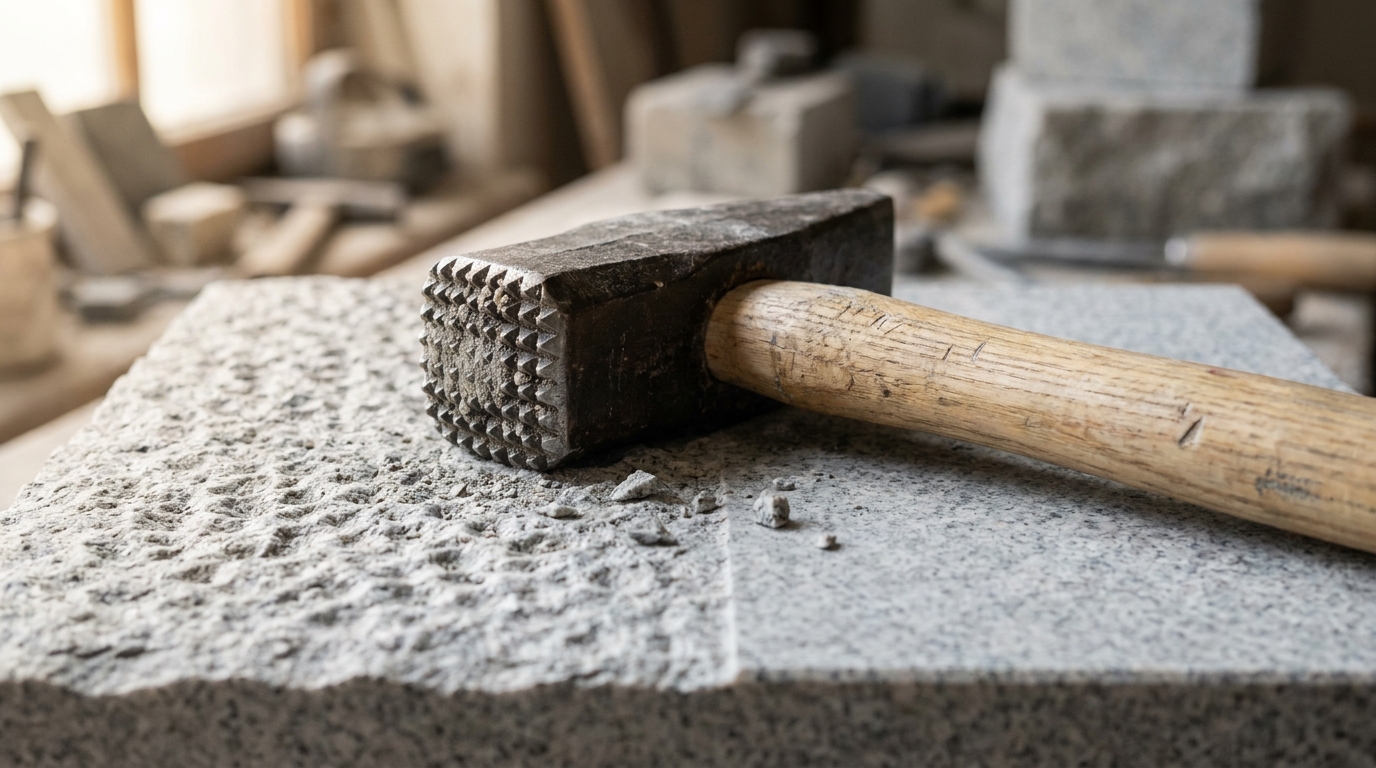
The Marshalltown Toothed Bush Hammer TBH4 is a hand tool sold for giving stone and concrete a rough, pockmarked surface that looks naturally weathered. Searching for it mostly turns up short retailer listings that repeat the same few lines, so this guide brings together what Marshalltown and its sellers have actually stated, explains how a toothed bush hammer works in practice, covers the dust and eye hazards, and points out the details that are not publicly confirmed.
Quick Facts
| Detail | What is confirmed |
|---|---|
| Product line | QLT Toothed Bush Hammers (Marshalltown’s own catalog name) |
| Model code | TBH4, listed by retailers as item number 10477 |
| Head weight | 4 lb (the line is offered in 3 lb and 4 lb versions) |
| Handle | Heavy-duty hickory; one US retailer lists it at 16 inches |
| Barcode (UPC) | 035965004770, as shown on a retailer listing |
| Surface result | Rough, pockmarked texture that mimics weathered stone |
| Maker’s safety note | Always wear safety goggles or glasses |
| Not found in sources reviewed | Tooth count, head dimensions, steel type, replaceable teeth, warranty terms |
What a Bush Hammer Does and Why Masons Use One
A bush hammer is a masonry tool with a grid of small conical or pyramidal points on a heavy metal head. Each strike pits the surface a little, and the repeated impacts build up a rough, even texture. The tool has been around for a long time, and a common account credits Joseph Richards with inventing it in 1831, although the reference page that repeats this also carries a note asking for better citations, so the exact history is worth treating with some care.
The finish is popular for both looks and function. Stone suppliers point out that a bush hammered surface grips better than a honed one, which is why it often appears on flooring in wet areas. On concrete, hammering exposes some of the aggregate, and it also gives new concrete or a new flooring layer more surface to bond to. Powered bush hammering machines exist for large jobs, and they are designed to imitate the look that a hand-swung hammer produces.
Marshalltown Toothed Bush Hammer TBH4 Specifications: What Is Confirmed
Marshalltown’s catalog describes its QLT Toothed Bush Hammers as tools that create a rough, pockmarked texture for a naturally weathered stone look on any masonry project. The same page says the hammers come in two head weights, 3 lb or 4 lb, each with a solid, heavy-duty hickory handle. A retailer listing for this model adds the 16-inch handle length and the barcode shown in the table above.
TBH3 and TBH4: the Weight Difference
The 3 lb version carries the code TBH3 and the item number 10476, while the 4 lb version uses TBH4 and 10477. The heavier head delivers more force with each swing, which helps on dense material, but it also tires the arm sooner on long sessions, so the choice comes down to the surface you plan to work and how long you will be swinging.
The manufacturer’s product page for the line also lists a shipping weight of 290 pounds along with a 12-piece outer pack. That figure clearly describes bulk shipping and not a single tool, so it should not be read as the weight of one hammer.
Details That Are Not Publicly Confirmed
Several things buyers often ask about are simply not stated in the listings reviewed. These include the number and pattern of the teeth, the size of the striking face, the type of steel, whether the head can be re-dressed or fitted with new points, and the length of any warranty. Some sellers also leave out the handle length. Until Marshalltown publishes these points, it is safest to treat them as unknown and to ask the seller or the manufacturer before you rely on them.
Where the Tool Works Best
Hand bush hammering suits small and detailed jobs such as softening the edges of cut stone, texturing a short step or a stepping stone, roughening a patch so it blends with the surrounding surface, or adding grip to a small walkway section. The Marshalltown Toothed Bush Hammer TBH4 fits that kind of work well because it is heavy enough to leave a clear texture yet still manageable with one hand for short sessions.
It is a poor choice for large floors or long walls. Even with air-powered tools, bush hammering is described in patent literature as a relatively slow process, and by hand the work is slower still. Contractors who cover big areas generally turn to powered bush hammer plates or rotary hammer bushing attachments instead.
How to Use a Toothed Bush Hammer Step by Step
Marshalltown does not publish a technique guide for this model that I could find, so the steps below reflect common masonry practice and should be adapted to your material.
- Prepare the surface. Make sure concrete is fully cured and stone is firmly set, then brush away loose grit. Lightly dampening the surface before you start can reduce the dust that rises.
- Test first. Strike a scrap piece or a hidden corner to see how deep the pattern goes with your swing, because the same hammer leaves a different texture on soft sandstone than on hard concrete.
- Swing with control. Hold the handle firmly and bring the toothed face down flat against the surface with a steady, repeatable stroke, letting the head weight do the work instead of forcing extra power.
- Work in overlapping passes. Move across the area in a regular pattern so the texture looks even, and keep your stroke strength consistent from the first row to the last.
- Go gently near edges. Heavy blows close to an edge or corner can chip it, so many masons use lighter taps there or leave a narrow border to finish last.
- Clean and check as you go. Clear dust and chips frequently, and look over the head and handle for loosening, cracks, or dulled points.
Safety: Eyes, Lungs, and Hands

Marshalltown’s one stated warning is to wear safety goggles or glasses, and that advice matters because striking masonry throws small chips and grit at face height. Gloves, sturdy footwear, and hearing protection for longer sessions are sensible additions even though the listings do not mention them.
Dust is the less visible hazard. According to OSHA, working with concrete, stone, brick, and mortar can release respirable crystalline silica, and a university safety program summarizing the risk notes that long-term exposure can lead to silicosis, lung cancer, and kidney disease. OSHA’s published guidance on powered chipping tools favors water spray at the point of impact or vacuum dust collection. I could not confirm how those construction rules apply to a purely manual hammer, so workers should ask their employer or check OSHA directly. For home projects, working outdoors, wetting the surface, keeping bystanders away, and wearing a properly fitted respirator rated for fine dust are reasonable precautions.
A retailer listing for the tool also carries a California Proposition 65 notice. These notices are common on tools sold in the United States and are generic warnings, not a statement about a specific substance in this hammer.
Is the Marshalltown Toothed Bush Hammer TBH4 Right for Your Project?
The tool makes sense if your work is small, hands-on, and focused on a rustic or non-slip look, and if you prefer a traditional wooden-handled hammer. It makes less sense if you need speed, a fine and very uniform texture, or a finish across a large slab. Other 4 lb toothed bush hammers exist from different makers, and their handle lengths differ, for example one commercial listing shows a 10-inch handle against the 16 inches reported for this model. A longer handle gives more reach and swing, while a shorter one usually gives tighter control in cramped spots.
When ordering the Marshalltown Toothed Bush Hammer TBH4, check that the listing names the TBH4 code or item number 10477, because Marshalltown’s catalog page covers both weights. Availability also varies, since one US retailer showed it as available only on backorder at the time of research. When it arrives, inspect the hickory for cracks, make sure the head sits tight on the handle, and store it dry to protect the wood.
Frequently Asked Questions
What does TBH stand for?
Marshalltown does not explain the code in the sources reviewed. It most likely stands for toothed bush hammer, but that is an inference and not an official statement.
Can it texture hard stone such as granite?
Marshalltown describes the tool for masonry projects in general and publishes no hardness limits. Harder stone will take more effort and leave a shallower mark, so a test on scrap material is the best way to judge.
Are the teeth replaceable?
This is not stated in the available listings, so it should not be assumed. Ask the manufacturer or seller before buying if you expect to re-dress or replace the points.
How is a bush hammer different from a stone mason’s hammer?
Marshalltown lists a 6 lb stone mason’s hammer for chipping edges or small pieces off stone, while the bush hammer is meant to texture a surface by repeated pitting, so they do different jobs.
Why do prices differ between sellers?
At the time of research, one retailer showed this model at a discounted price beside a much higher crossed-out price, and Marshalltown’s own page showed a higher price for the lighter TBH3. Neither figure is a confirmed list price for the TBH4, and prices change often, so compare current offers.
Conclusion
The Marshalltown Toothed Bush Hammer TBH4 is a straightforward, traditional tool for adding a weathered, grippy texture to small masonry areas, and its confirmed features are simple: a 4 lb head, a hickory handle, and a pockmarked finish. Buyers who want precise specifications, a warranty statement, or replaceable-tooth details will need to ask the maker, and anyone using it should protect their eyes and lungs as carefully as they would with any other stone-working tool.
Disclaimer: This article is for general information only and is not professional, safety, or legal advice. Product details, prices, and availability change and were drawn from public listings at the time of research, so confirm them with Marshalltown or the seller. Work involving concrete, stone, or masonry dust carries health risks, so follow the tool maker’s instructions, applicable workplace safety rules, and the guidance of a qualified professional.
Explore More
Bon Tool Mashing Hammer 11-177: Specs, Uses, Handle Replacement and Buying Guide

I’m Muhammad Ubaid, founder of YBR Magazine. I research and write detailed guides on America’s National Parks — covering entry fees, permits, best times to visit, and planning tips — using official NPS sources and up-to-date information.

