


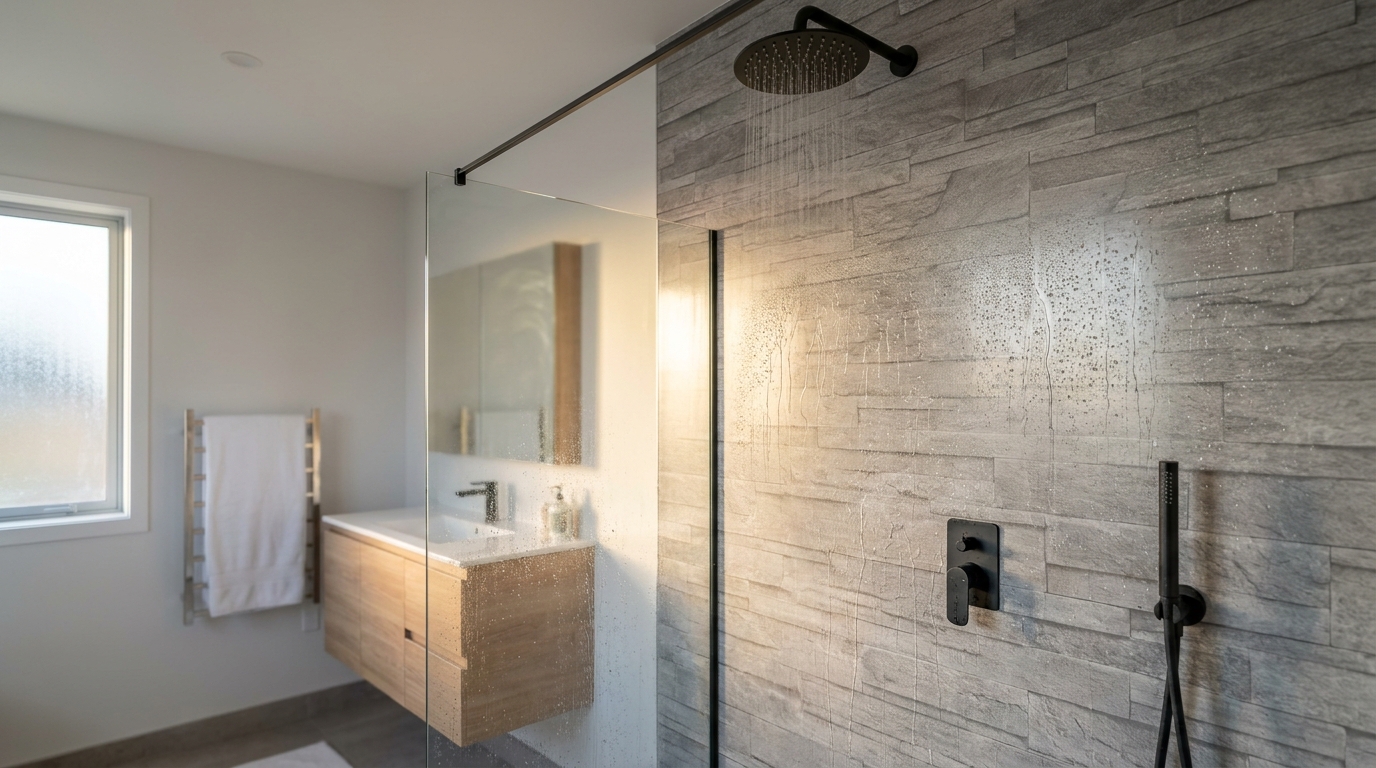
Choosing waterproof wall panels for bathroom walls has become a popular way to replace tiles and grout without a full rebuild, and it is easy to see why: a small room can often be covered in a day or two, and the finished surface has far fewer joints where water can collect. Still, the word “waterproof” on a product page does not tell the whole story, because the panel itself, the joints between panels and the wall behind them all decide how well the room copes with steam and splashes. This guide explains the main panel types, what they cost, how they are fitted and how to avoid the leaks and mould that catch many first-time buyers out.
Quick Facts at a Glance
| Topic | What most suppliers and installers report |
|---|---|
| Common materials | PVC, acrylic, laminate, composite and fibreglass sheets |
| Typical height | Around 2,400 mm to 2,440 mm in many UK ranges, with some guides listing up to 2,700 mm |
| Typical thickness | Roughly 4 mm to 15 mm depending on material, according to one UK shower panelling guide |
| How they are fixed | Mostly with adhesive and sealant rather than screws, so no holes are made in the wet surface |
| Fitting time | Often one to two days for a small bathroom, compared with about three to five days for tiling, according to a UK builder-booking guide |
| Biggest risk | Poorly sealed joints, or a moisture-sensitive core hidden under a waterproof-looking face |
| Poor fit | Spots near high heat, because PVC can soften or deform |
What “Waterproof” Really Means on a Wall Panel
Product pages often describe panels as “100% waterproof,” and some makers do back that with a guarantee, but the claim usually refers to the panel material rather than the finished wall. A solid PVC or acrylic sheet does not absorb water, yet moisture can still reach the wall behind it through unsealed corners, cut-outs for pipes or the gap left at the shower tray and ceiling. One UK retailer’s fitting guide describes its panels as fully waterproof only when sealed correctly, and a UK builder-booking site makes a similar point when it says panels are only as good as the preparation and sealing behind them.
The core is the second thing worth checking. Panels with a hollow or foam PVC core, or a solid acrylic or composite core, do not soak up water, whereas boards with an MDF or wood-fibre core under a laminate face are a different story. A UK home-building publication lists moisture ingress in MDF solid-core panels as a known weakness, and an Ideal Home feature on places to avoid panelling says that fully waterproof types suit a humid bathroom while wood or MDF does not. Because the surface can look identical, not every product sold as waterproof wall panels for bathroom use is waterproof all the way through, so it pays to read the core description on the data sheet rather than relying on the headline.
It is also worth knowing that many of the pages ranking for this topic are thin. Several are templated or machine-rewritten, some contain garbled phrases from automated rewording, and many repeat the same generic benefits without saying anything specific about cores, joints or sealing. Manufacturer installation manuals, data sheets and trade publications are far more dependable sources than these pages.
Main Types of Bathroom Wall Panels

The market is wider than most buyers expect, and each material trades price, weight, looks and robustness in a different way. The table below summarises what suppliers and buying guides say about the most common options.
| Type | Typical build | Strengths | Watch-outs |
|---|---|---|---|
| PVC | Hollow or foam core, often tongue-and-groove | Lightweight, usually the lowest cost, easy to cut with a fine-tooth saw or jigsaw | Lower heat resistance, combustible, and quality varies by grade |
| Acrylic | Solid sheet, often thin and glossy | Smooth, glass-like finish and strong water resistance | Heavier and costlier, and some suppliers advise fitting over a backboard |
| Laminate | High-pressure laminate over a composite or plywood core | Realistic stone and wood textures | Core material must be confirmed as water-safe |
| SPC or rigid composite | Dense, impact-resistant board | Suited to busy or commercial bathrooms, and some ranges are sold with fire ratings | Fire and water claims should be checked on the data sheet |
| Fibreglass sheet | Large single sheets | Waterproof and simple to wipe clean | Can look plain, and big sheets are awkward to carry into small rooms |
Finish matters as much as material for most homeowners. Tile-effect, ledgestone, slatted-wood and plain gloss designs are all widely sold, and wider boards mean fewer vertical joints across the wall, which is one reason a one-metre-wide panel is a popular choice for shower alcoves. Slim planks with tongue-and-groove edges, on the other hand, give a more traditional cladding look but add more joints that must be sealed.
Panels or Tiles: Which Suits Your Bathroom?
Both approaches waterproof the area around a shower, so the decision usually comes down to speed, appearance and how much work you want to do yourself. According to a UK home-building guide, panels are easy to keep clean, have no grout lines, cover large areas quickly and can often be fitted over existing tiles, while tiles are widely available, easy to lay on a DIY basis and offer far more freedom to create custom patterns. The same guide warns that quality varies hugely between panel products, which is why price alone is a poor guide.
Hygiene is another point in favour of panels, since grout is the part of a tiled wall that tends to stain and trap moisture, and a panelled wall removes most of it. A UK supplier of PVC cladding makes the same argument, adding that panels need no harsh scrubbing chemicals. Tiles still win for people who want a distinctive layout, a natural-stone feel or a finish that can be repaired one piece at a time, so a mixed approach, with panels in the shower and tiles elsewhere, is common.
What They Cost
Prices differ by country, material and supplier, and no independent source gives a single reliable figure, so the numbers below should be read as examples taken from retailer and contractor websites. A UK trade guide puts a basic PVC board of about one metre by 2.4 metres at roughly £20 to £40, with trims and seals adding about £20 to £50 for a shower, while premium acrylic or large-format boards can run from about £120 to £250 or more each. A US buying guide quotes about $700 to $2,000 for a standard acrylic shower surround and $1,000 to $3,000 or more for a custom laminate one.
One Australian supplier calculates that its panels work out at about $120 per square metre installed against about $140 for the cheapest tiles with low-cost labour, but this is a seller’s own comparison and ignores mid-range and premium tiles. The same UK trade guide notes that panel quality and finish are the biggest single cost driver, since a budget PVC board versus a stone-effect laminate or acrylic can triple the material bill. When budgeting for waterproof wall panels for bathroom projects, it is sensible to add adhesive, sealant, trims, corner profiles and end caps to the shopping list, because these are easy to forget and are needed on almost every job.
How to Choose Waterproof Wall Panels for Bathroom Walls
Match the panel to the wet zone
A shower enclosure faces direct spray and steam, a bath surround faces splashes, and a basin or feature wall faces only occasional drips. Inside a shower, a panel with a fully waterproof core and a proper joint system is the safer choice, whereas a decorative wall behind a vanity gives you more room to prioritise looks and budget. Panels with lower heat resistance, such as PVC, should stay away from anything that gets very hot.
Check joints, trims and accessories
Because the joints are where leaks usually start, the quality of the joining system deserves as much attention as the panel face. Look for matching internal and external corner profiles, bottom trims for the tray or bath, end caps and a recommended adhesive and sealant, and consider whether a ready-made installation kit from the same brand is available. Suppliers commonly estimate around one tube of adhesive and sealant per panel, which helps with quantities.
Ask for the data sheet
A good data sheet states the core material, thickness, water absorption and fire classification, and it removes the guesswork that marketing language leaves behind. Warranty terms are worth reading at the same time, since they sometimes depend on using the manufacturer’s trims and sealants. Ordering a sample is also helpful, because colours and textures often look different under bathroom lighting than they do on a screen.
Fitting Waterproof Wall Panels for Bathroom Use, Step by Step

Manufacturer instructions always take priority, but the process below reflects what several UK installation guides and manuals have in common. Many retailers describe fitting as a reasonable DIY project, though a shower enclosure leaves little room for error, so confidence with sealant and accurate cutting matters.
- Prepare the wall. The surface should be clean, dry, dust-free, flat and plumb, and glazed tiles should be degreased. If the wall is uneven, treated battens can be fixed first to create a flat base.
- Measure and plan. Dry-fit the panels, start from a corner and work outwards, and arrange joints vertically in wet areas. Planning the layout in advance avoids narrow slivers at the end of a run.
- Cut to size. A fine-tooth saw or jigsaw works for most panels, and one retailer suggests lightly sanding the back so the adhesive grips better.
- Fit the trims. Where a bottom trim is used, it is bedded in sealant on the tray or bath and checked for level before any panel goes up.
- Apply adhesive. Manufacturers typically specify vertical beads of adhesive or sealant roughly 100 mm apart, and each panel is pressed firmly into place, often with a straight edge, so the bond is even.
- Leave expansion gaps. Installation manuals commonly call for about 3 mm to 4 mm at the top, bottom and internal corners, because panels expand and contract with temperature.
- Seal everything. Fill the expansion gaps, cut-outs for pipes and the edges around fittings with a bathroom-grade, mould-resistant silicone, and allow it to cure fully before the shower is used.
Keeping Moisture Under Control
Sealant lines are the parts of a panelled bathroom that age first, so a quick look along corners, trims and the shower tray edge every few months helps catch small gaps before water gets behind the panels. If silicone cracks, peels or turns dark, it is better to cut it out and replace it than to layer new sealant on top. Good extraction or an opening window also matters, since steam that cannot escape condenses on cold surfaces and finds its way into any weak joint.
Day-to-day care is simple because there is no grout to scrub. Suppliers generally recommend wiping with a soft cloth and mild cleaner, and it is wise to check the manufacturer’s care sheet before using abrasive pads or strong chemicals, since gloss acrylic and textured laminate can react differently.
Frequently Asked Questions
Can bathroom panels be fitted over existing tiles?
Several UK suppliers say yes, provided the tiles are firmly stuck, flat, clean and degreased, and that a suitable adhesive is used. A tradesperson on an Australian DIY forum cautioned that any failure in the tile layer can make the panel bulge, so loose or hollow-sounding tiles are better removed first. The added thickness can also affect trims and fittings, which is worth measuring before you buy.
Do waterproof wall panels for bathroom showers need tanking behind them?
A UK builder-booking guide says professional installers often tank shower areas, corners and joints, citing NHBC guidance, but this is not a universal rule and some panel systems rely on sealed joints alone. A panel retailer’s feature-wall advice also recommends a waterproof membrane on the wall first. The safest approach is to follow the panel maker’s instructions and any local building requirements.
Are PVC bathroom panels fire safe?
PVC is combustible and gives off smoke, and standard PVC panels are not necessarily fire-rated, although fire-retardant variants exist. Some other wet-wall products do carry formal classifications, and one UK laminate range reports a B-s1,d0 rating under EN 13501-1, according to a RIBA Journal product feature. Home bathrooms carry a low fire risk, but rented, commercial or regulated buildings may need a specified rating, so check the data sheet.
Do hollow-core panels really reduce condensation?
Some manufacturers say a honeycomb PVC core gives a warmer surface and therefore less condensation. I could not find independent test results confirming how large the effect is, so it is best treated as a supplier claim rather than a substitute for ventilation.
Can the panels be used outside the shower?
Retailers describe them as suitable for bath surrounds, splashbacks, basin walls and full-height feature walls as well as showers. Some also market them for kitchens and other humid rooms, although the heat limits of PVC still apply near cookers.
How long do bathroom wall panels last?
No independent source gives a dependable lifespan, and figures quoted online are usually warranty bands that differ by brand and material. Comparing warranty terms, including any conditions about trims, sealants or installation, is a more reliable guide than a general number.
Conclusion
Waterproof wall panels for bathroom renovations can deliver a clean, low-maintenance and fast-to-fit result, but the outcome depends less on the sales description than on the core material, the joint system and the care taken with sealing. Reading the data sheet, matching the panel to the wettest zone and following the manufacturer’s fitting method will do more to prevent leaks than any single product choice.
Disclaimer: This article is for general information only and is not professional building, plumbing or safety advice. Prices, product ranges, fire classifications and building requirements vary by country, region and supplier and may change over time. Always follow the manufacturer’s installation instructions and local regulations, and consult a qualified installer for shower enclosures or anything affecting waterproofing, electrics or fire safety.
Explore More
Waterproof Paneling for Shower Walls: Materials, Costs, and Installation Guide

I’m Muhammad Ubaid, founder of YBR Magazine. I research and write detailed guides on America’s National Parks — covering entry fees, permits, best times to visit, and planning tips — using official NPS sources and up-to-date information.

