


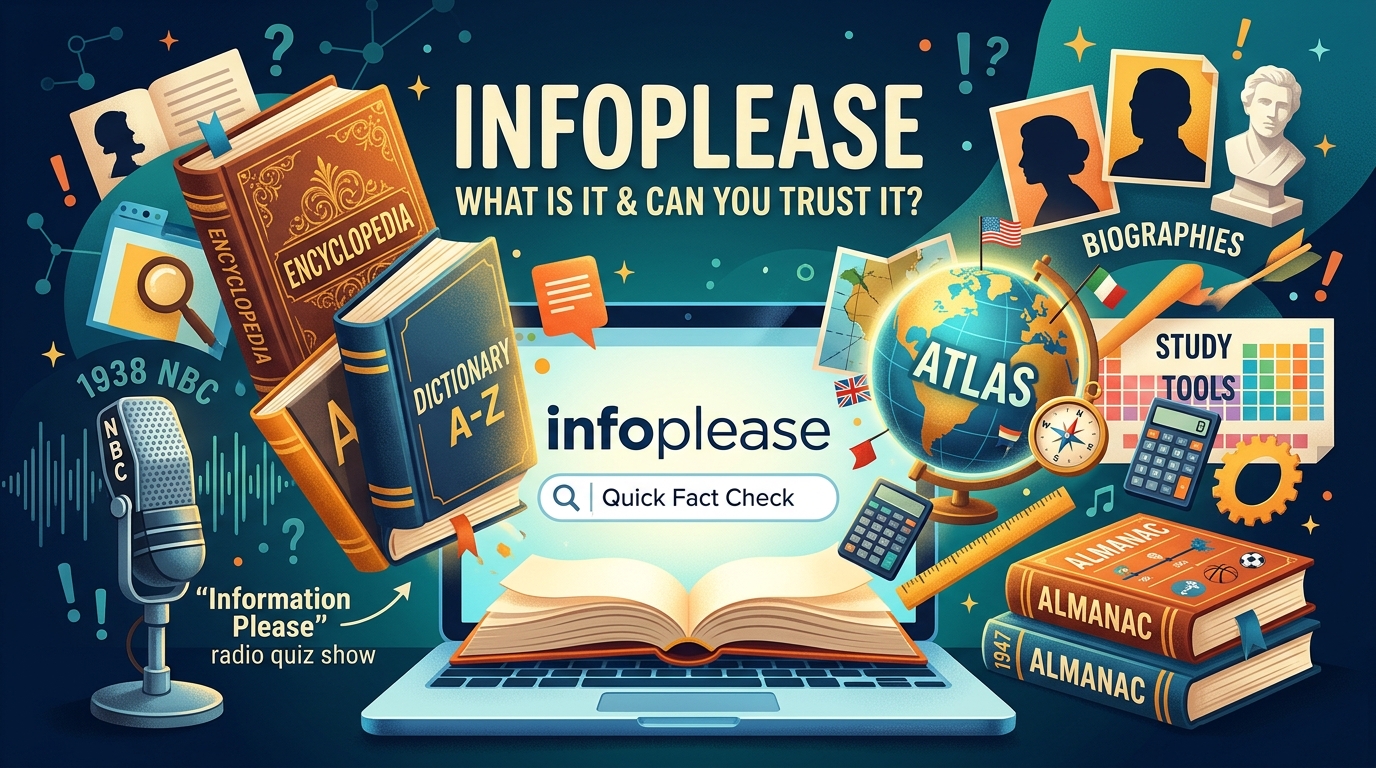
The Infoplease website is a good place to start a quick fact check, a school assignment or a bit of background reading, and a weaker place to stop when the stakes are high. It gathers an encyclopedia, a dictionary, a thesaurus, an atlas, almanacs and biographies under one search box, and much of that material traces back to publishers that existed long before the site did. Knowing where each part comes from is the fastest way to decide when it can carry your answer and when you should check somewhere else.
This guide covers where the site came from, what is actually inside it, how reliable it appears to be, how to cite it, and what to do when a page looks dated. It reflects what could be confirmed as of November 2026, and where a current detail could not be confirmed, the text says so.
Where Infoplease came from: a 1938 radio quiz show
The name comes from Information Please, a radio quiz created by producer Dan Golenpaul that first aired on NBC’s Blue Network on May 17, 1938. Listeners mailed in questions for a panel of experts led by host Clifton Fadiman, and the whole idea was to see whether ordinary people could stump the specialists. In 1947 Golenpaul edited the first Information Please Almanac, a yearly reference book. It kept that title through 1997, then appeared as The TIME Almanac with Information Please from 1998, and publication records list the print run as ending in 2013.
The website arrived in 1998 as a free online home for that almanac line. Pearson bought the Family Education Network, which included Infoplease, in August 2000, and sold it to Sandbox Partners in May 2015. Citation examples on the site itself later credited “Sandbox Networks, Inc., publishing as Infoplease,” while a media-rating organization describes the owner as the London-based Sandbox Group. No current official statement naming the 2026 owner turned up, so the exact corporate name is best treated as unconfirmed.
This history explains the site’s personality. It reads like an almanac, with compact fact pages, lists and tables, rather than like a long-form magazine.
What you can actually look up there
Instead of one big database, the site is a bundle of separate reference works that happen to share a search box. The table below shows what each part offers and what the publicly available descriptions say about its origin.
| Section | What it offers | Origin worth knowing |
|---|---|---|
| Encyclopedia | Short articles on people, places, science and history | Drawn from the Columbia Encyclopedia, published by Columbia University Press. Library guides disagree on whether the edition is the fifth or the sixth, so check the copyright line on the page |
| Dictionary | Definitions and spelling help | Based on the Random House Webster’s Unabridged Dictionary; the site’s own citation examples show a 1997 Random House copyright |
| Thesaurus | Synonym lists | Credited to WordNet, a Princeton University project |
| Atlas | Country, state and city profiles, maps and flags | Older help pages credit maps to Magellan Geographix |
| Almanacs | General, entertainment and sports facts, records and timelines | Library listings name the TIME/Information Please almanac, an ESPN sports almanac and an A&E entertainment almanac |
| Biographies | Profiles of notable people | One university library described more than 30,000 entries in an older listing |
| Study tools | Calculators, a spelling checker, a periodic table, conversion charts | Listed by school libraries as homework helpers |
In its older form, the site’s help pages explained that one search covered the almanacs, the encyclopedia and the dictionary together, with a drop-down to narrow the search to a single work. That layout may have changed, so if a search returns too many mixed results, try the section menu instead.
Is Infoplease reliable?

On balance the evidence points to a dependable but conventional reference source. The site’s editorial policy says the team has two core priorities, and the first is that information be clear and accurate. Its current-events pages, according to a review by Media Bias/Fact Check, draw on outlets such as Reuters, the BBC, The Guardian and the Associated Press. That reviewer rated the site high for factual reporting with a clean fact-check record, but also described a slight left-leaning tone in how it covers politicians. A rating like this is one organization’s opinion, and the review is now a couple of years old, so use it as a data point rather than a verdict.
The more practical limit is age. A definition from a 1997 dictionary or an encyclopedia entry on a historical event rarely goes stale, but a population figure, a sports record or a ranking can change within a year. Before you rely on any number, look for a date or copyright line on the page, and for anything that moves, confirm it with the organization that publishes the figure, such as a statistics agency or a league.
Money is the other thing to know. The same reviewer reports that the site earns its revenue from advertising, which is normal for a free reference site and does not by itself affect accuracy. It does mean the layout is built around ad placements, so expect a busier page than a library database would give you.
How to cite Infoplease without losing marks
The site says its own citations follow MLA style. The pattern it gives is the article title in quotation marks, the site name, the copyright date with the company name, the access date and the full URL. For individual authors, such as a named writer of a fact sheet, the name goes first.
One detail is easy to miss. The site’s examples cite dictionary and thesaurus entries by their underlying work, for instance a Random House dictionary entry “on Infoplease,” rather than as a generic Infoplease page. Following that habit makes your reference list more precise and shows your teacher you know where the definition came from. If your course uses APA or another style, general style-guide advice for pages without a personal author is to treat the organization as the author, but your instructor’s rules come first.
A final tip for statistics: if an almanac table credits a government agency or another original source, cite that original wherever you can. Many instructors prefer it to a second-hand copy, and it protects you if the Infoplease page is later revised.
Fact Monster, the children’s sibling
Infoplease owns a second site called Fact Monster, aimed at children. It launched in 2000 under the name Infopleasekids.com, covers subjects such as sports, geography, history, health and biography, and won a Webby Award for best youth site in March 2001. A 2016 review by a Kent State University librarian in Reference Reviews called it visually appealing with variety for kids of all ages, while noting that navigation can be difficult, citations are lacking and the simple games may distract. For younger students, that review suggests an adult should help with source-checking.
Using or sharing Infoplease content
Students have long been told they may use the information in school projects as long as they credit the site. Archived versions of the site’s terms went further and said its content could not be reprinted, republished online or used commercially without permission, and that a permissions request form was available. Those archived terms may have been updated since, so if you plan to reuse text on a blog, in a product or in a publication, read the current terms and ask permission first. Linking to a page is a different matter, and the older help pages invited sites to link to Infoplease and use its logo.
When another source is the better choice
Different jobs call for different tools. For fresh statistics, go straight to the agency that collects them. For breaking news, a news outlet with named reporters will be faster than any reference site. For a deep dive into a topic, books and academic journals will give you the arguments and evidence that a short encyclopedia entry has to leave out.
Wikipedia is the usual comparison. It is far larger and updated constantly by volunteers, while Infoplease content comes from established publishers and an editorial team, which some reviewers find easier to cite. Neither should be your last stop. Treat both as maps that point you to the original documents.
Explore More

I’m Muhammad Ubaid, founder of YBR Magazine. I research and write detailed guides on America’s National Parks — covering entry fees, permits, best times to visit, and planning tips — using official NPS sources and up-to-date information.

