


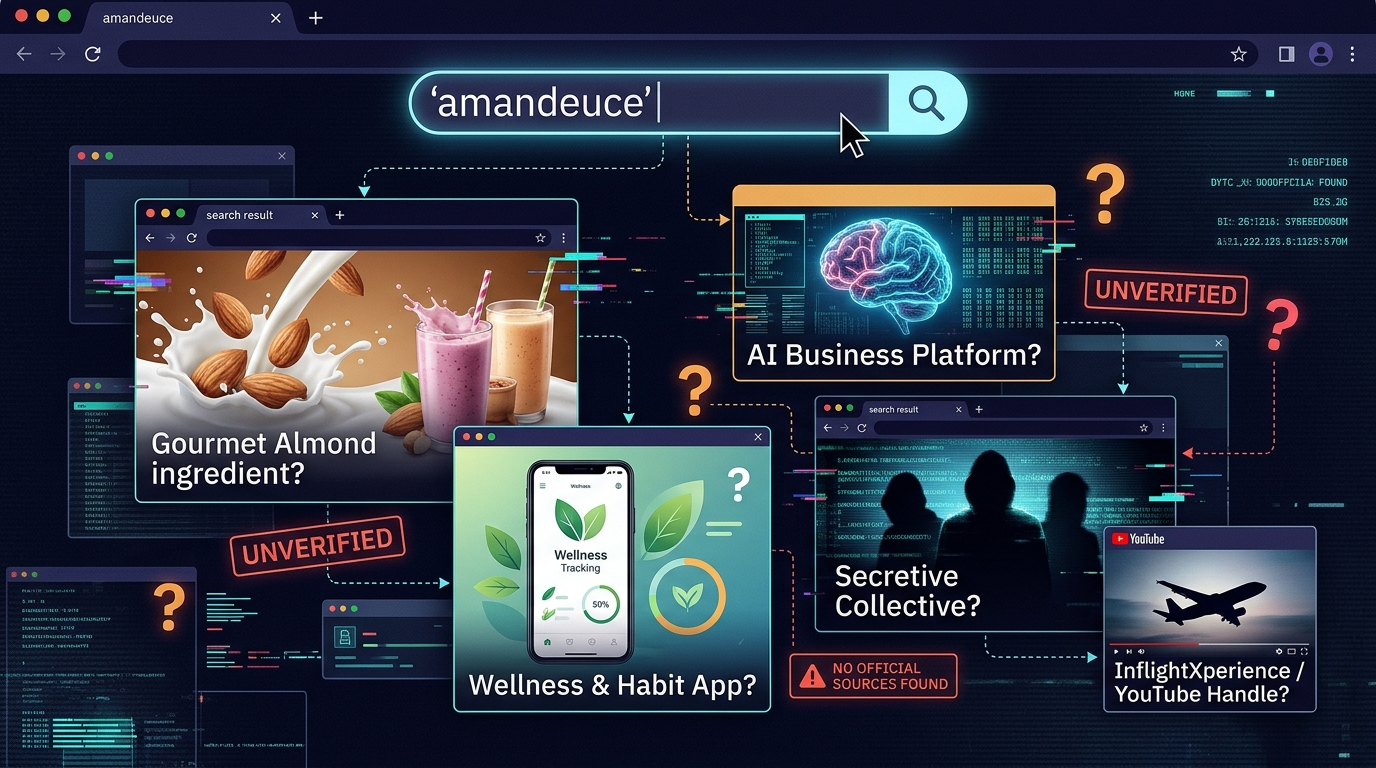
If you searched for amandeuce hoping for a clear definition, the honest answer is that no official or authoritative source defines it. Searching it in November 2026 returns dozens of pages that describe it as a gourmet almond ingredient, an AI business platform, a wellness app, or a secretive tech collective, and these descriptions cannot all be true. This article sorts out what the term is tied to on the web, what only one weak source claims, and what appears to be invented, so you can decide how much of it to trust.
What can be confirmed, and what cannot
No company website, government page, dictionary, encyclopedia entry, or recognized news outlet came up in a search for the exact term as a product, ingredient, software platform, or organization. That absence matters, because a real product with real users normally leaves at least one official page behind. Everything else in this article is built on that starting point: the word is widely repeated, but almost nothing about it is sourced.
The one specific, checkable claim comes from a single article saying that amandeuce is the original YouTube handle of an aviation creator who now runs a channel called InflightXperience. That page says the public name changed around 2019 to 2020 while the handle stayed the same. I could not find the channel itself, an interview, or any independent report that confirms this, so it should be treated as unconfirmed rather than as fact.
Why the same word has so many different meanings
The pages that rank for this word share a pattern. Several carry near-identical text under different site names, and those sites have nothing to do with the topic: a school, a guitar company, a sports association, a language-learning service, and others. On some of them the article text is mixed with unrelated fragments such as game codes, tax tips, and meme headlines, which is a sign the content was produced automatically in bulk rather than written by someone who knows the subject.
The headlines follow the same formula as well. Titles promise a “shocking secret,” an “untold mistake,” or something that is “taking over the market,” and the body text then describes a different kind of thing each time. One version treats the word as a food ingredient, another as enterprise software, a third as a habit-building app, and a fourth as a brand that supposedly mishandled personal data. A real subject does not change category from page to page, so the more reasonable reading is that the word is being used as a placeholder to attract searches.
The claims you will see, and how much support each has
| Claim found online | Kind of support found |
|---|---|
| Almond-based powder or creamer used in smoothies and desserts | Repeated across many sites, with no recipe source, producer, or ingredient label |
| AI platform for business, with encryption and integrations | General marketing language, with no company, pricing, or documentation |
| Habit and routine app based on neuroscience | Vague wording plus a note telling readers to “review the app,” with no app identified |
| Brand that made a data-privacy mistake | No incident, regulator, date, or news report named |
| Secretive collective of technologists and artists | Story-style text with no names or verifiable events |
| Experience engine that raises engagement by up to 60 percent | A percentage with no study, client, or method behind it |
| Original handle of an aviation YouTube creator | One article only, not independently confirmed |
The pattern in the table is the useful part. Claims with numbers lack a source for the numbers, claims about companies lack a company, and claims about food lack a food producer. Until one of those gaps is filled by something checkable, none of these descriptions should be treated as a fact about the world.
Is it related to the French word for almond?
The spelling is close to two real French terms, and that may explain why some pages jump to an almond story. In French, amande means almond, and amande douce is the phrase for sweet almond, which comes from the almond tree, Prunus amygdalus, a member of the rose family. One of the spam-style pages even claims the word is built from “amande” plus a suffix meaning a single force, but that explanation is stated without any source.
A similar spelling is not evidence of a link. Nothing found connects amandeuce to the French phrase, to any almond product, or to any food company, so the almond angle is best seen as an attempt to give the word a story rather than a documented origin.
Names that look similar but are not the same thing

Some readers land on this term while actually looking for something else with a close spelling. Amandean is a separate, real company that sells nutritional supplements and describes its name as a blend of the Amazon and the Andes, which has no connection to the word discussed here. Amande on its own is a French word and also a given name, said to come from a Latin root related to love. If you meant one of these, searching that exact spelling will serve you better.
How to check a claim like this yourself
The same steps work for any unfamiliar term that suddenly appears everywhere. First, look for a primary source, such as the website of the company that supposedly makes the thing, a regulator’s record, or a named person speaking in public. Second, notice whether the page is on a site whose normal subject matches the article, because a food recipe on a guitar company’s site deserves suspicion. Third, check whether specific numbers come with a named study or client, and treat figures without one as marketing. Fourth, see whether other independent pages describe the same facts in different words, since copies of one text are not separate confirmations.
A fifth step is to look at the writing itself. Text that is built around repeating a phrase, ends with a list of keywords, or promises a secret without ever stating it was most likely written to attract clicks, not to inform.
Questions people ask
Is it safe to buy or eat anything sold under this name?
There is no verified product with this name to evaluate, so there is no label, producer, or testing information to rely on. If a page asks you to buy, subscribe, or install something called amandeuce, the lack of any identifiable seller is a reason to be careful before handing over payment or personal details.
Is it a scam?
That cannot be said from public evidence, and calling it one would go beyond what is known. What can be said is that the descriptions are inconsistent and unsourced, which is enough reason not to act on them.
Could the meaning change?
Yes. A person, company, or project could adopt the name tomorrow, and the YouTube handle claim might be confirmed by the channel owner at some point. This article reflects what could be checked in November 2026.
The bottom line on amandeuce
Right now, amandeuce has no confirmed definition beyond one unverified report that it is a YouTube handle. Everything else attached to it appears to be repeated, unsourced, or contradictory, and the sheer number of pages does not make the claims more reliable. If a reliable source such as an official site or a named, accountable author starts using the term, it will be worth looking again, and until then the safest approach is to treat confident descriptions of it as unproven.
Explore More
Mbaile: What This Irish Word Means and Why It Starts With “mb”

I’m Muhammad Ubaid, founder of YBR Magazine. I research and write detailed guides on America’s National Parks — covering entry fees, permits, best times to visit, and planning tips — using official NPS sources and up-to-date information.

