


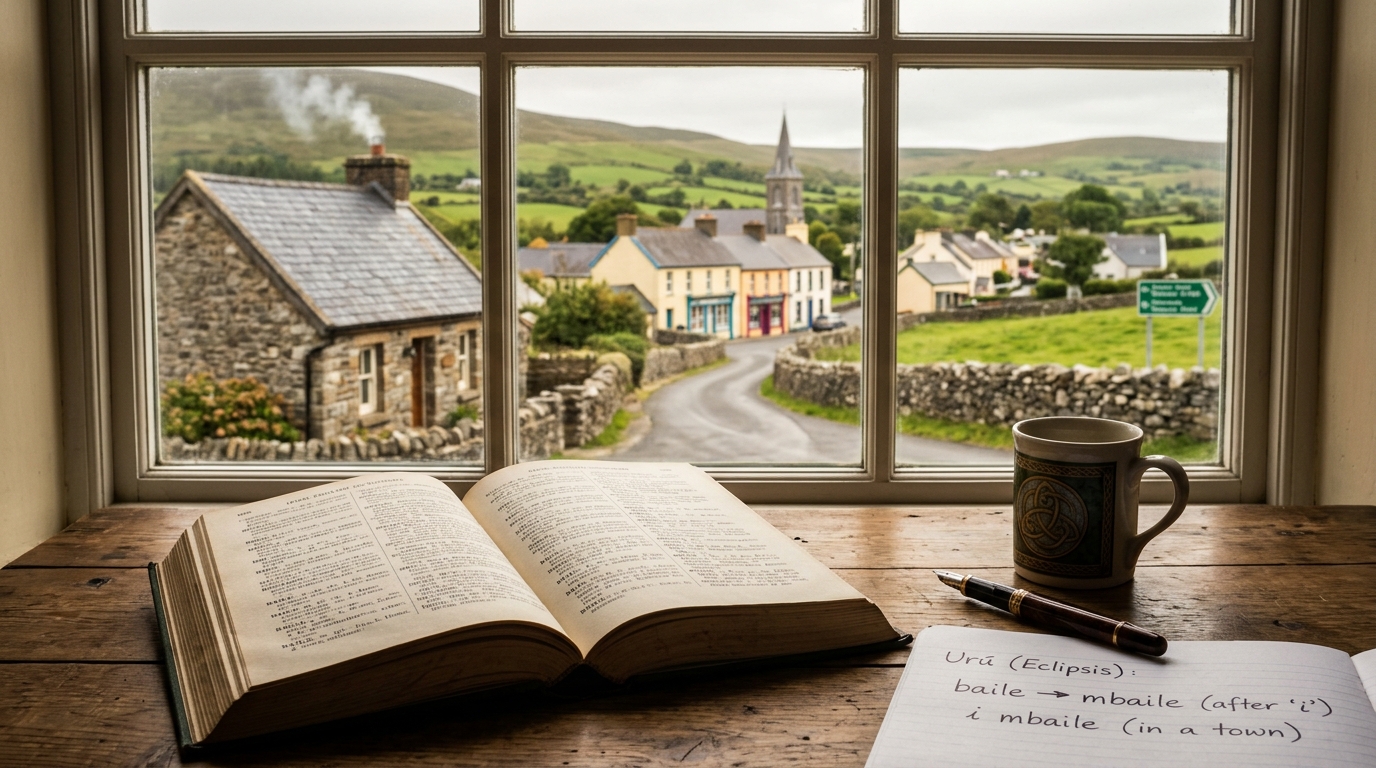
Mbaile is not a word you will find on its own in an Irish dictionary. It is baile, the ordinary word for home or town, wearing a different beginning that appears after certain words, most often the preposition i, which means “in”. The extra m comes from a spelling and sound change called eclipsis, known as urú in Irish, and it explains phrases such as i mbaile is i gcéin, which the Ó Dónaill dictionary translates as “at home and abroad”. This guide covers what baile means, when eclipsis applies, where dialects disagree, and how the same pattern shows up in the Irish name for Dublin.
What does baile mean in Irish?
The Ó Dónaill Irish–English dictionary, first published in 1977 and searchable on the Foras na Gaeilge site teanglann.ie, lists baile as a masculine noun with the plural bailte. Its first sense is “home”, which gives everyday expressions such as ag baile for “at home” and as baile for “away from home”. Its second sense is a place or settlement, so a baile fearainn is a townland, a baile beag is a village, and a baile mór is a town. The entry was still online when checked in November 2026.
Because one word covers both home and town, a speaker can use it for the house they grew up in or for the market town nearby, and the surrounding sentence decides which is meant. That double meaning also explains why the word sits at the start of so many Irish place names.
How does baile change after i and the article?
Irish has two initial mutations, lenition (séimhiú) and eclipsis (urú). Lenition softens the first consonant, which is why baile appears as bhaile after many words. Eclipsis works differently: it puts a new sound in front of the original one, and for the letter b the new sound is m, so the word is written with mb. Both letters stay on the page, but in speech only the m is heard.
Learner references and dialect descriptions agree that the preposition i (“in”) triggers eclipsis in every dialect, so “in a home” or “in a town” without the article is i mbaile. Eclipsis also follows most prepositions when the article an comes between them and the noun, which the dictionary illustrates with a phrase meaning “in this town”. Two further triggers are the genitive plural article, as in na mbailte, and the numbers seven to ten, which is why a Donegal County Council local area plan covering seven strategic towns carries the Irish title wording Seacht mBaile Straitéiseacha.
Baile in real phrases: when it changes and when it stays put

The table below gathers phrases from the Ó Dónaill dictionary and from an Irish public-sector guideline on working-from-home allowances. Reading across the rows shows that baile changes only when a particular word comes before it, and that the change is not always the same one.
| Irish phrase | Meaning | What happens to baile |
|---|---|---|
| baile mór | a town | Nothing, this is the base form |
| ag baile | at home | Nothing, because ag does not mutate the noun by itself |
| i bhfad ó bhaile | far from home | Lenition after ó |
| dul chun an bhaile | to go home | Lenition, because the noun is in the genitive after the article |
| i mbaile is i gcéin | at home and abroad | Eclipsis after i |
| obair ón mbaile | working from home | Eclipsis after ó combined with an |
Notice that ó followed by the article gives eclipsis, while ó on its own gives lenition. The article is what changes the outcome, and that small detail accounts for most of the confusion learners have with this word.
Sa bhaile or sa mbaile: which one is correct?
Both are used by real speakers, and which one you meet depends on the dialect. Standard written Irish uses lenition after sa, the contraction of i and an, which gives sa bhaile for “at home”. Connacht Irish eclipses instead, and Panu Höglund’s overview of Irish dialects says Munster Irish does the same, giving the eclipsed form. Ulster Irish tends to favour lenition after prepositions that carry the article.
An online Irish dictionary records the Galway form of sa bhaile as the eclipsed variant, with a pronunciation transcription that begins with an m sound, so the variant is documented rather than a spelling slip. A learner following a standard course will usually be taught the lenited form, but the other is not an error in the dialects that use it. Some regional differences within Munster are described only in learner forums, so treat fine detail there with caution.
Dublin, Ballymote and other place names
The most familiar example is Dublin, whose Irish name Baile Átha Cliath becomes i mBaile Átha Cliath when you say “in Dublin”. The eclipsing letter is written in lowercase while the place name keeps its capital, which is why a lowercase m sits right beside a capital B. The official placenames database Logainm lists Baile Átha Cliath as the validated Irish name and records the genitive as Bhaile Átha Cliath, yet another shape of the same word.
The name means “town of the hurdled ford” and recalls a crossing of the River Liffey where woven hurdles helped people get across. The English name Dublin comes from a different source, Dubh Linn, meaning “black pool”, and Logainm’s early citations include a note describing the place as deep black water. Two names for one city therefore preserve two different features of the same stretch of river.
Baile also opens many other names. Baile an Mhóta is Ballymote in County Sligo, Baile an Locha is Ballinlough in County Roscommon, Baile Átha Luain is Athlone, and Baile an Tí Mhóir is Baltimore in West Cork. In these names it is usually the word after baile that mutates, as in Mhóta, which is the lenited form of Móta. Not every English “Bally” comes from baile, either: some begin with béal, meaning “mouth”, such as Béal an Átha, the Irish name of Ballina, which means “mouth of the ford”.
How is it pronounced?
Irish spelling keeps the original letter visible, but speakers pronounce only the eclipsing sound. The Galway form mentioned above is transcribed as an m followed by a short a and a soft “ly” sound, which an English speaker could approximate as “MAL-yuh”. For the base word, a classroom lesson from Coding Ireland renders Baile Átha Cliath as BAL-ya AW-ha KLEE-ah, so both forms share the same soft “ya” ending and differ only in the first consonant.
Common mistakes and a note on spelling
The first mistake is searching a dictionary for the eclipsed form on its own. Dictionaries list the noun under baile, and the Ó Dónaill entry even abbreviates the eclipsed form as a bare “m” with a tilde inside its example phrases, trusting the reader to know the pattern. Looking up the base word is the reliable route.
The second mistake is the capital letter. When a common noun is eclipsed, nothing is capitalised, but with a proper noun the capital belongs to the name itself, which is why a common noun and a place name look so different on the page. A third mistake is assuming the word has an English meaning. It does not, and some searchers may simply have mistyped the English word “mobile”, though that is only a guess. For this exact spelling, the Irish grammatical form is the only established meaning in the reference works consulted.
Does it have its own dictionary entry?
No, it is a surface form of baile, produced by the sentence around it, much like a verb changing its ending. A learner who understands that one rule can read these phrases without memorising each one separately, and can predict similar forms for other nouns beginning with b, such as i mbosca for “in a box”.
The short version
In short, mbaile is baile in disguise: look at the word before it to see why it changed, and the dictionary entry for baile will tell you what it means.
Explore More
Leash CodeHS Answers: What the Exercise Really Asks and How to Solve It Yourself

I’m Muhammad Ubaid, founder of YBR Magazine. I research and write detailed guides on America’s National Parks — covering entry fees, permits, best times to visit, and planning tips — using official NPS sources and up-to-date information.

