


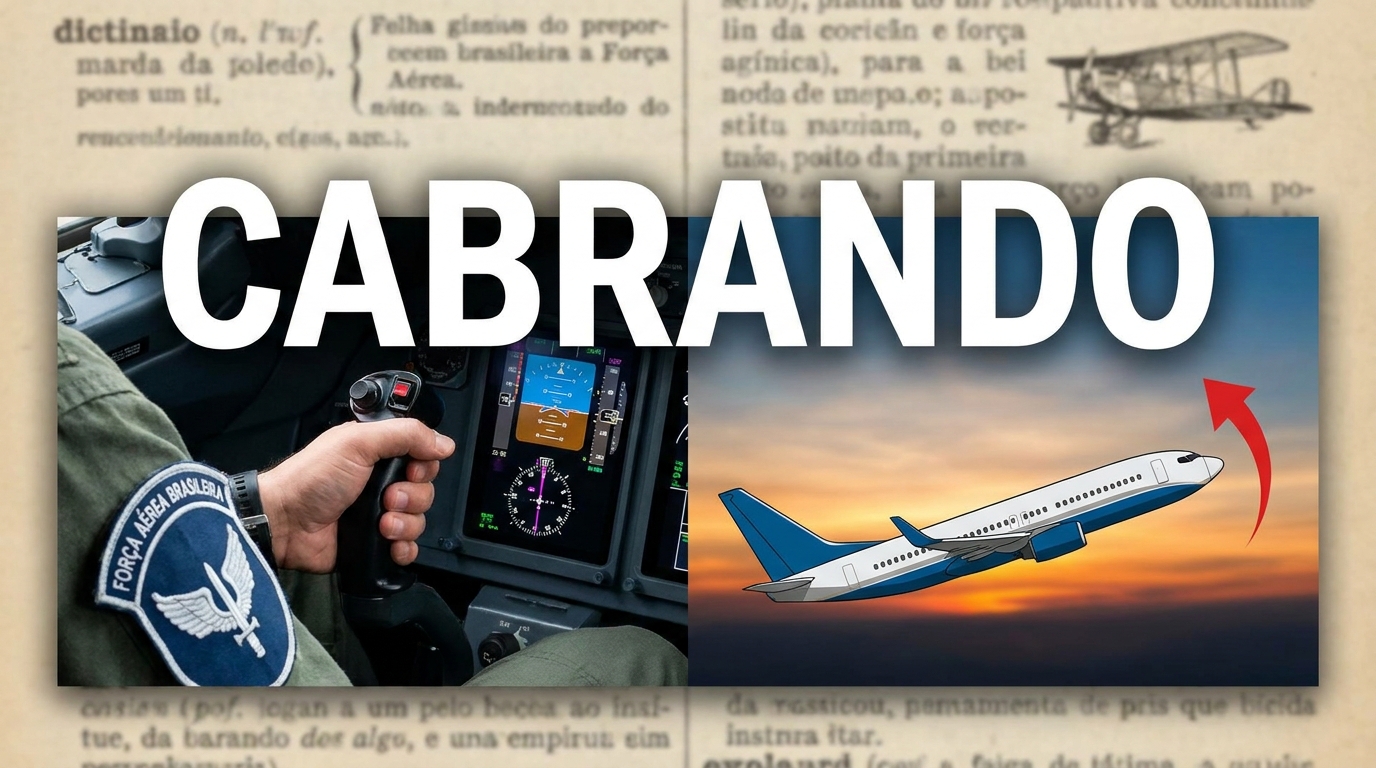
Cabrando is the gerund of the Portuguese verb cabrar, which in aviation means making an aircraft fly with its nose raised, in other words pulling the nose up. This is the meaning given by Portuguese dictionaries and used in official Brazilian aviation documents, and it is the only meaning I could confirm from authoritative sources. Searching for the word as of November 2026 also turns up pages describing a driving technique, a leadership method, a crisis-communication platform, a productivity problem and even a farm bull. None of those descriptions is backed by a dictionary or a recognised institution. This article explains the verified meaning, how it works physically in an airplane, where the term appears in real documents, and how to spot the unreliable pages.
This is general educational information about a word and basic flight physics. It is not flight instruction, so follow your aircraft’s manual and a qualified instructor for anything you do in the air.
What does cabrando mean in Portuguese?
The Priberam dictionary lists cabrar as a transitive and intransitive verb meaning to make an aircraft fly, or to fly, with the nose up. Infopédia, the dictionary published by Porto Editora, shows the full conjugation, including the gerund cabrando, the past participle cabrado, and present-tense forms such as cabro, cabra and cabram. The same site also quotes entries from the European Union’s IATE terminology database that pair the English phrases “nose up” and “to pull the nose up” with cabrar. So the verb is part of recognised multilingual technical vocabulary and not only pilot slang.
In practice, cabrando describes an action in progress. A pilot who is cabrando is pulling the nose of the aircraft upward, much as an English speaker would say “pitching up” or “pulling back.” In Brazilian Portuguese the progressive is usually built with estar plus the gerund, as in “o piloto está cabrando a aeronave” (an illustrative sentence of my own), while European Portuguese more often uses estar a plus the infinitive.
Is cabrando a Spanish word too?
It looks Spanish, and many readers assume it is slang built on cabra (goat) or cabrón. The Real Academia Española dictionary does list a related verb, cabrear, but its gerund is cabreando, not cabrando. Its recorded senses are putting goats onto a piece of land, annoying or putting someone in a bad mood (informal), boring or tiring someone (Chile), and deceptively dodging someone in games (Peru). I found no Spanish dictionary entry for cabrar in the sources I checked. Any Spanish meaning of cabrando would therefore be informal or regional, and the Academy does not confirm it.
Italian is a closer relative. Wiktionary, a community-edited dictionary, lists the Italian verb cabrare with an aeronautical sense of “to zoom,” which fits the Portuguese idea of raising the nose to climb. That does not make the languages interchangeable, but it shows the word belongs to a family of flight terms across Romance languages.
What happens to an aircraft when a pilot is cabrando?

In the FAA’s handbook diagrams, moving the control stick or column aft raises the elevator and points the nose up. That changes the aircraft’s pitch attitude, and pitch changes the angle of attack, which is the angle between the wing and the oncoming air. More angle of attack generally means more lift. This is why the FAA’s Pilot’s Handbook of Aeronautical Knowledge tells pilots to apply elevator back pressure in a turn, where extra lift is needed, and to ease it off as the turn ends. The steeper the turn, the more back pressure is required.
There is a limit, called the critical angle of attack. The FAA defines a stall as a rapid loss of lift caused by exceeding it, and it stresses that a stall can happen at any pitch attitude or airspeed. Its own handbook example is an aircraft in a steep dive at 100 knots whose pilot suddenly pulls back hard. The flight path cannot change instantly, so the angle of attack jumps from very low to very high. This is why cabrando is not the same thing as climbing. Raising the nose helps an aircraft gain height only when there is enough speed and power to support the higher angle of attack. Otherwise the aircraft can trade away speed until the wing stops producing lift.
The opposite input is called picar, which lowers the nose. It is the usual partner term in Portuguese flight vocabulary, and Brazilian certification text refers to a “picar” attitude response when discussing how an aircraft behaves in a nose-down pitch.
Where the term shows up in real aviation documents
Brazil’s civil aviation authority, ANAC, uses the verb in its safety material. One of its flight alerts describes a pilot who realised the aircraft was flying lower and slower than needed to clear trees on a hill ahead, and who decided to cabrar the aircraft to gain height without success. In a final report on a 2017 occurrence, the investigators consider it probable that the takeoff rotation was commanded below the planned speed, or that the elevator command was applied excessively in the cabrar direction, or both.
Both documents use the word the same way. It names the nose-up input, and the trouble comes from how much and when the input is applied, not from the input itself. The same vocabulary appears in training research. An academic study of Brazilian Air Force aviator cadets measured the strength of the cabrar and picar movements alongside other control movements, which suggests the pair is standard in how Brazilian pilots are taught to describe stick forces.
Why searching this word gives such confusing results
The top results for the word are a good example of how a rare term can attract automated or low-effort content. In the pages I read, cabrando is described as a refined turning maneuver said to have started in motorcycle sport, as a crisis-communication platform with message testing tools, and as a leadership philosophy supposedly derived from a Spanish verb meaning “to tame.” Other pages call it an emerging productivity trap, a calibration process for devices or game settings, and a bull’s role in Iberian farm traditions. One page is a sports-news item that repeats the same sentences about “developments” without naming a single match, player or event. A few results are simply forum usernames, which say nothing about the word.
Those descriptions cannot all be right, since they contradict each other, and several share the same recycled titles across unrelated websites. Warning signs include no named author, no cited source, phrases like “studies show” with no study, and glossy claims such as “the hidden technique that changes everything.” In the sources I checked, no dictionary, driving school, motorsport body or management institution defines the word in any of these ways. The driving version is the most likely to mislead because it sounds plausible, but the only vehicle sense I could verify is the aircraft one.
How to read the word when you meet it
Context decides almost everything. If the text is Portuguese and concerns aircraft, pilots, takeoff or flight safety, cabrando means pulling the nose up, and the surrounding sentence usually tells you whether it was done correctly. If you meet the word in a Spanish sentence, check whether the writer meant cabreando (making someone angry), since a missing letter is the most likely explanation. If you meet it in an English article promising a secret technique or a productivity breakthrough, treat the claim as unverified until a dictionary or named expert confirms it.
The short version
Cabrando comes from a real, dictionary-listed aviation verb whose meaning is narrow and well documented: raising the nose of an aircraft. The rest of what the internet attaches to the word was not supported by any authoritative source I could find, so the safest approach is to rely on Priberam, Infopédia and official aviation documents, and to read cabrando as a pitch-up input unless a trustworthy source says otherwise.
Explore More
Matarecycler: What Is Actually Verified About This “AI Recycling System”

I’m Muhammad Ubaid, founder of YBR Magazine. I research and write detailed guides on America’s National Parks — covering entry fees, permits, best times to visit, and planning tips — using official NPS sources and up-to-date information.

