


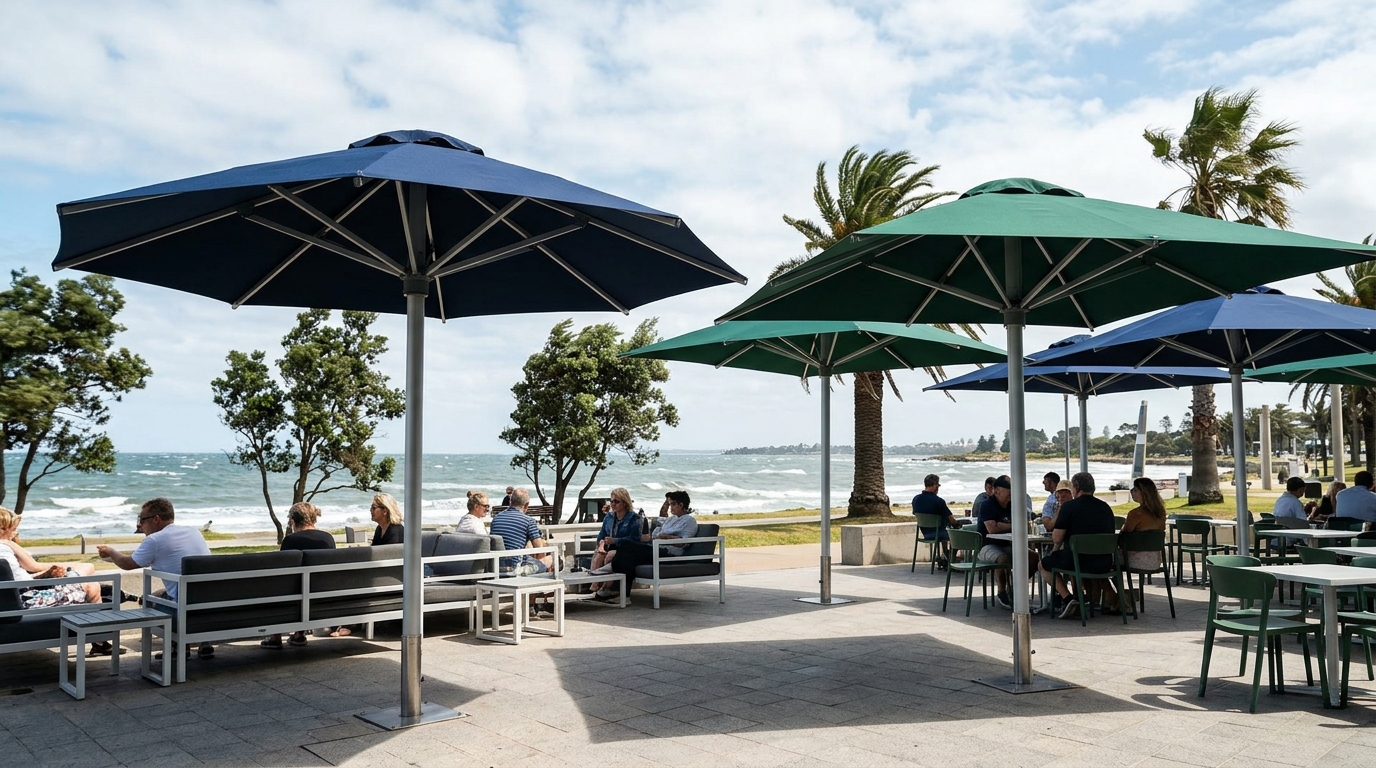
Ausbrella is a range of heavy-duty market umbrellas made in Melbourne by Awnet, an Australian family-owned company that has been in the business since 1980. It is promoted as “the world’s strongest umbrella” and comes in two lines, Storm and Hurricane 160+, both sold with an engineer’s certificate and a five-year warranty on the frame and acrylic canopy. This ntx magazine guide sorts out what the wind figures mean, which claims come with paperwork and which are simply the maker’s words, and what a buyer should check before placing an order. The details below reflect Awnet’s own pages as they stood in late November 2026.
What an Ausbrella is, and what it is not
The name belongs to a commercial pole umbrella of the kind you see over café tables, resort pools and council plazas, not to a handheld rain umbrella. According to Awnet’s website, its owner Chris Pierias saw a need for a stronger, sturdier and safer umbrella and rebuilt the design from scratch. The features it lists are a twin-skin aluminium pole, a fabric cover that bolts onto the frame, an opening system with no ropes or pulleys, and a matching in-ground stainless steel socket. The Storm page adds that the frame has eight radial arms with a registered interlock system. Awnet’s pages describe the pole as both “patent pending” and “patented” and quote application number 2014200765, so the patent status is worth confirming if it matters to your purchase.
Searching for this word turns up some confusing results. A few auto-generated pages describe it as a futuristic transport system run by a company called Atlas Transportation Systems, with vehicles said to reach hundreds of miles per hour. Nothing from a manufacturer, a reseller or a business directory backs that up, and Awnet’s own site, a hospitality supplier’s product listings and company profiles all describe an umbrella. Ordinary umbrella shop listings also show up because of the similar spelling, and none of them relate to the brand.
Storm or Hurricane 160+: which model is which?
The two lines differ mainly in how much wind they are designed for and where Awnet recommends them. The table pulls together the figures Awnet publishes.
| Storm | Hurricane 160+ | |
|---|---|---|
| Wind figure on Awnet’s pages | 135 kph (product page) or 140 kph (range page) | Wind tunnel tested beyond 160 kph |
| Area Awnet recommends | Most Australian regions | Region C on the Australian wind zone map |
| Pole | Twin skin | Double twin skin, described as patented |
| Warranty | 5 years on frame and acrylic canvas cover | 5 years on frame and acrylic canvas cover |
Both lines come in square and octagonal shapes according to a hospitality reseller, and Awnet says custom sizes are available. No official size chart appeared on the pages reviewed, so dimensions need to be confirmed with Awnet or a dealer.
The Storm figure is not consistent. The dedicated Storm page says 135 kph, while the Ausbrella range page says 140 kph. The Storm page appears to have been last edited in 2023 and the range page in November 2026, so 140 may be the newer number, but Awnet has not said so. Hurricane figures vary in wording too, from “beyond 160” to “in excess of 160”, and an Awnet article on pool umbrellas gives 161. Those variations make sense once you see how the test was run, and the engineer’s certificate for your exact model is the place to settle the number.
What a 160 kph wind tunnel result actually tells you

Awnet says the Hurricane was tested at the wind tunnel facility of Monash University, which it describes as the largest and fastest in the Southern Hemisphere, and that the tunnel tops out at 161 kph. That explains the “beyond 160” wording. It means the umbrella was still standing at the fastest speed the tunnel could produce, not that a failure point was measured. Awnet’s own video commentary says the umbrella can clearly handle stronger winds, but no failure speed has been published.
On the paperwork side, Awnet says its designs are certified by the engineering firm Don Moore & Associates, and that the certificate and the Monash report are available on request. That is a stronger evidence trail than most market umbrellas offer, but the ratings are still the manufacturer’s, and no independent ranking of commercial umbrellas that backs the “world’s strongest” label turned up in this research.
It also helps to know that an umbrella rating and a regional wind rating are different yardsticks. A figure of 160 kph works out to roughly 44 metres per second. The Australian wind loading standard, AS/NZS 1170.2, states regional design speeds in metres per second for rare gusts hitting buildings, so lining the two up is Awnet’s guidance for choosing a model, not a statement from the standards body. A separate American test method, ASTM F3512-21, exists for judging the wind safety and durability of market umbrellas. None of the Awnet pages reviewed say the Ausbrella was tested to it, so ratings from different makers may not be directly comparable.
Site, region and footing matter as much as the rating
Awnet says the Hurricane 160+ is designed for Region C, which it describes as covering metropolitan Brisbane and the coastal areas from above Coffs Harbour to Broome. The Storm is pitched at most other regions. The company publishes a wind region and terrain guide for matching a model to a site, which makes sense because an open waterfront or rooftop faces very different gusts from a walled courtyard. The map itself could not be read in full during this research, so it is best taken from Awnet directly.
An umbrella is only as secure as what holds it down. Awnet calls the full stainless steel in-ground socket its council-approved option, offers a slip bolt system when a socket is not possible, and says weighted bases are permitted by some councils only when nothing more secure can be used. No source reviewed says an Ausbrella should be left open during a severe storm, and the usual advice to close any market umbrella when it is not in use still applies.
Is an Ausbrella worth it for a home pool or a café?
Awnet’s pages place the range at resorts, council open areas and luxury outdoor spaces, and the Hurricane page also mentions pools at home. Prices are not published. Resellers send enquiries to a quote form, so any cost figure you read elsewhere is unconfirmed. Awnet says it has no minimum order, builds in its own Melbourne factory, and normally manufactures within 15 working days, though lead times shift with the season.
The useful comparison is with Awnet’s standard umbrellas, which the company says are tested beyond 120 kph and carry a three-year warranty. The Ausbrella adds a higher wind figure and two more years of cover. Whether that is worth paying for depends on the site: a sheltered courtyard may be well served by a standard model, while an exposed coastal terrace or rooftop is where a certified higher rating earns its cost. That is a reasoning aid rather than an engineering opinion, and a certifier can give a firm answer for a particular location.
Questions to ask before you order
A short list of checks can save a lot of trouble, because the published material leaves several points open.
- Exact rating for your size and shape. Ask which kph figure and which certificate apply to the model you want, since the Storm number appears as both 135 and 140.
- The documents. Request the engineer’s certificate and the Monash report, which Awnet says it supplies on request.
- The base. Confirm which footing the rating assumes and whether your council, landlord or body corporate accepts it.
- Warranty terms. The five-year cover is stated, but wind damage conditions are not spelled out online. Awnet’s FAQ lists fading cover of three years for screen print and one year for digital print on its umbrellas, so check whether the same applies to a printed Ausbrella canopy.
- Timing. Ask for a current lead time, especially ahead of summer.
The bottom line on Ausbrella
Ausbrella is a real, well-documented commercial umbrella with more testing evidence than most in its category, and its two lines are easy to tell apart once the Storm figure is clarified. The “world’s strongest” label remains a marketing claim, though, and the sensible way to buy is to treat the ratings as a starting point, get the certificate in writing, and match the model and footing to the site. This article is general information drawn from the manufacturer’s public statements and is not engineering advice.
Explore More
Fanisco: What the Name Really Refers To and Which Online Claims Don’t Hold Up

I’m Muhammad Ubaid, founder of YBR Magazine. I research and write detailed guides on America’s National Parks — covering entry fees, permits, best times to visit, and planning tips — using official NPS sources and up-to-date information.

