


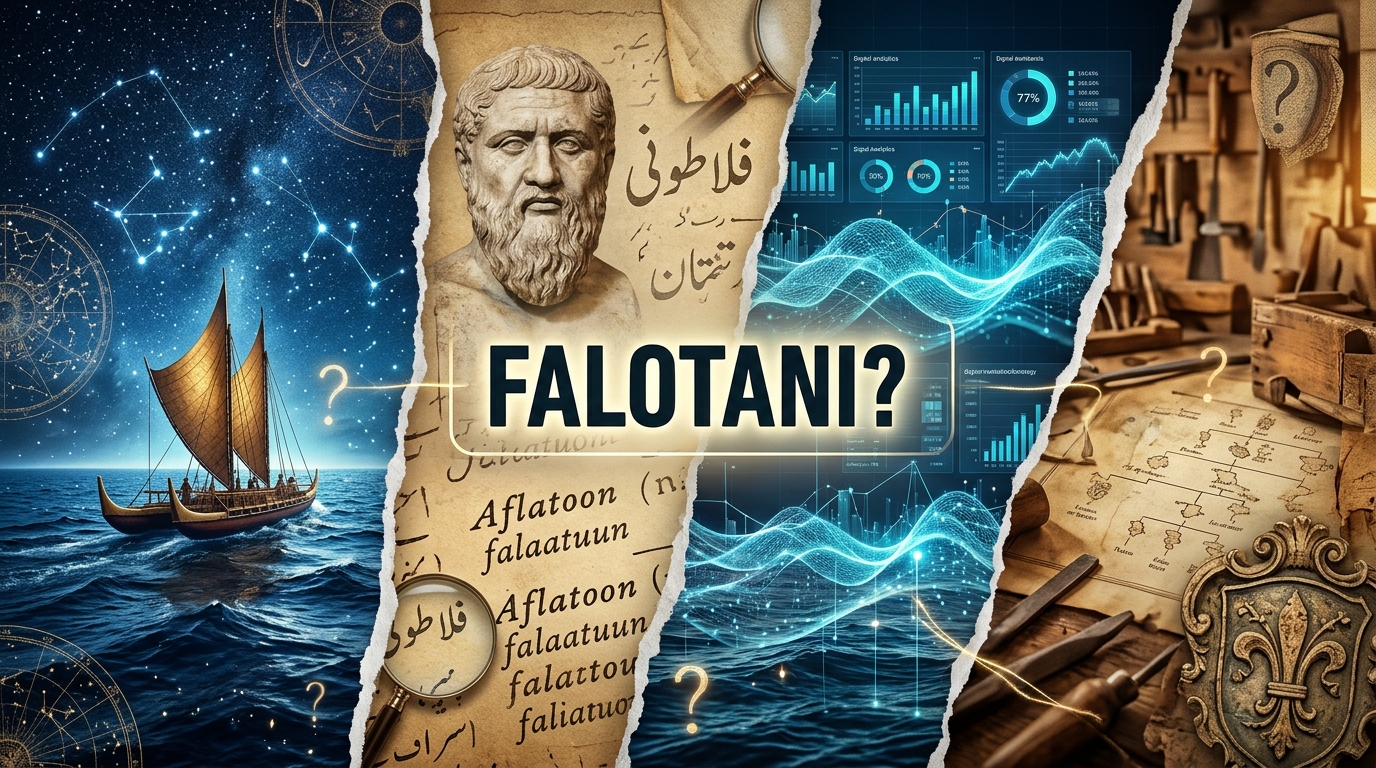
If you searched for falotani and landed on pages describing an ancient Polynesian navigation art, a digital marketing method, an Italian craft family, and a life philosophy all at once, your confusion is reasonable. Those explanations cannot all be true, and when they are checked against dictionaries and against the organizations that actually study Pacific voyaging, most of them have nothing behind them. The one explanation with real linguistic support points to the Urdu and Hindi word for the Greek philosopher Plato, written in Roman letters in a way that people often spell differently.
The rest of this article separates what can be confirmed from what looks like blog copy repeated from page to page, so you can decide which meaning fits the place where you came across the word.
Why do search results for falotani give four different meanings?
The top results do not agree with each other, and that disagreement is the first clue. One page calls falotani a guiding philosophy rooted in Polynesian navigation, another says it is probably an invented word with no fixed meaning, a third links it to Plato, and a fourth suggests it could be a lost Italian family name. Several of these pages use cautious phrases such as “it seems likely” or “research suggests” without naming any research, which is a sign that the writer is guessing.
The table below gives a quick overview of each claim and what a check of independent sources turned up, and the sections after it explain the evidence in more detail.
| Popular claim | Where it appears | What checking found |
|---|---|---|
| A Polynesian navigation philosophy | Several lifestyle and blog pages | Polynesian wayfinding is real and well documented, but no source ties it to this word |
| A digital strategy or marketing method | Marketing-style blog posts | No company, framework, or published method with this name turned up |
| An Italian surname or craft guild | One magazine-style article, presented as a theory | Pure speculation; no matching record found in the surname resources checked |
| A Roman-letter spelling of the Urdu and Hindi word for Plato | A smaller number of pages | Backed by dictionary entries for closely related spellings, though this exact spelling is informal |
The Polynesian navigation story: a real tradition with a borrowed label

Traditional Polynesian wayfinding is genuine and well studied. Navigators crossed thousands of kilometers of open Pacific without compasses or charts, reading the rising and setting points of stars, the direction of ocean swells, the flight of birds, and other signs in nature. The Polynesian Voyaging Society, which according to a Hawaii legislative resolution was founded in 1973, helped revive the practice, and its canoe Hōkūleʻa reached Tahiti on June 4, 1976, after covering roughly 2,400 miles.
One detail that the falotani pages leave out is that the navigator who guided that 1976 voyage, Mau Piailug, came from Satawal in Micronesia rather than from Polynesia. He was invited because no traditional navigators remained in Hawaii at the time, and he taught his methods so that the knowledge would survive. None of the scientific, governmental, or voyaging-society material reviewed for this article uses the word, and searches aimed at Samoan, Tongan, and other Pacific dictionaries returned nothing for it either.
So the connection appears to be a story attached to the word rather than a fact about it. A real and admired tradition is being used as a backdrop for a term that has no recorded place in it, and readers who repeat this claim risk attributing something to Pacific cultures that those cultures never said.
Why the digital strategy and philosophy claims do not hold up
The marketing explanation says the term describes adaptive campaigns that “read data waves” the way a navigator reads ocean swells. It sounds clever, but no agency, software product, academic paper, or industry body using the name came up in the results, and the pages making the claim give no examples of a campaign built this way. A vivid metaphor combined with a word nobody can contradict is an easy way to fill a page, and that is what these posts look like.
The philosophy versions are just as vague. Some describe self-control and intentional living, others describe harmony between thought and action, and one refers to unnamed indigenous belief systems connecting land and spirit without saying which community holds that belief. A genuine cultural concept normally comes with a named people, a language, and a written or spoken source, and none of these pages supply any of the three.
The Plato connection: the one explanation with real evidence
The explanation that holds up best starts with the Arabic form of Plato’s name, which became Aflatoon in Urdu and Hindi. The Rekhta dictionary, a respected reference for Urdu words, lists the word as meaning Plato and also as a figurative term for a very clever person, or for someone overly clever, boastful, or pedantic. It records the related form falaatuun with the plain meaning of Plato, and falaatuunii with the meaning of something Platonic or relating to Plato. Wikipedia’s entry on the term likewise describes it as a colloquial Hindustani word for a pompous or eccentric person.
If you read those Roman spellings aloud, this form is a natural way for someone to type the Urdu word that is written فلاطونی in its own script. There is no single standard way to write Urdu in English letters, so spellings such as falaatuuni, falatooni, and falotani are all plausible attempts at the same sound. This is also the only explanation that matches how people really use the word, since it fits a term used in conversation rather than a brand-new concept.
The tone depends on the speaker. In everyday talk, calling someone an Aflatoon can be a compliment about intelligence, a teasing remark about someone who acts as if they know everything, or a sarcastic jab, and dictionary idioms such as the one about people who walk around as if they were Plato’s grandchildren lean toward the mocking side. It should be said clearly that no authority has confirmed that this is where the exact spelling falotani comes from; it is the best-supported reading, not a proven etymology.
What about the Italian surname idea?
One article suggests the word could be a variant of the Italian surname Falettoni, possibly describing a family of craftsmen or a village that has since disappeared. The article itself presents this as a theory, and it is built entirely on how similar the two names look. Italian surnames with endings such as -ani, -oni, and -etti are common, so resemblance proves very little, and the genealogy and surname resources checked for this article did not list it as a family name. Until a record turns up, this idea is best treated as an unconfirmed guess.
How to judge any page that explains the word
A trustworthy explanation of an unusual word should point to something outside itself, such as a dictionary entry, a named language, or an organization that can be contacted. It should also stay consistent with other reliable material, which the Polynesian and digital marketing claims fail to do because the reference works on Pacific voyaging never mention the term. Be especially careful with pages that promise benefits, trends for the coming year, or a method you can apply, since a word with no verified origin cannot support those promises.
Dates matter as well. The pages that rank for this word were mostly published within the last year, and several repeat each other’s phrasing, which suggests copying rather than independent research.
Questions readers ask about falotani
Is falotani a real word?
It is a real search term and a plausible informal spelling, but it does not appear as a headword in the English or Pacific-language references that were checked. Treat it as a variant spelling rather than an established dictionary entry.
Can I use it as a username or brand name?
Nothing found suggests that an official organization owns it, but that is different from legal clearance. If you plan to build a business around it, search trademark databases in your country first, and avoid claiming a Polynesian or indigenous origin that cannot be backed up.
What if someone used the word in a message to me?
If the sender is an Urdu or Hindi speaker, the most likely meaning is a comment about being very clever or acting overly clever, so the surrounding tone and your relationship with the person will tell you whether it was praise or teasing.
The bottom line on falotani
The honest answer for falotani is that it has no confirmed, official definition, and that the colorful stories attached to it are not supported by independent sources. The reading with the strongest evidence connects it to the Urdu and Hindi words for Plato and for a clever or self-important person, while the Polynesian, marketing, and Italian explanations remain unproven. At NTX Magazine we would rather tell readers that a word has no verified origin than invent one, and if a reliable source ever documents a different meaning, this is the kind of claim that should be rechecked.
Disclaimer: This article reflects publicly available information as of November 24, 2026. Word origins can be debated, and a new authoritative source could change the picture. It is general information, not linguistic or legal advice.
Explore More
Coyyn Explained: What It Really Is and Why Search Results Disagree

I’m Muhammad Ubaid, founder of YBR Magazine. I research and write detailed guides on America’s National Parks — covering entry fees, permits, best times to visit, and planning tips — using official NPS sources and up-to-date information.

