


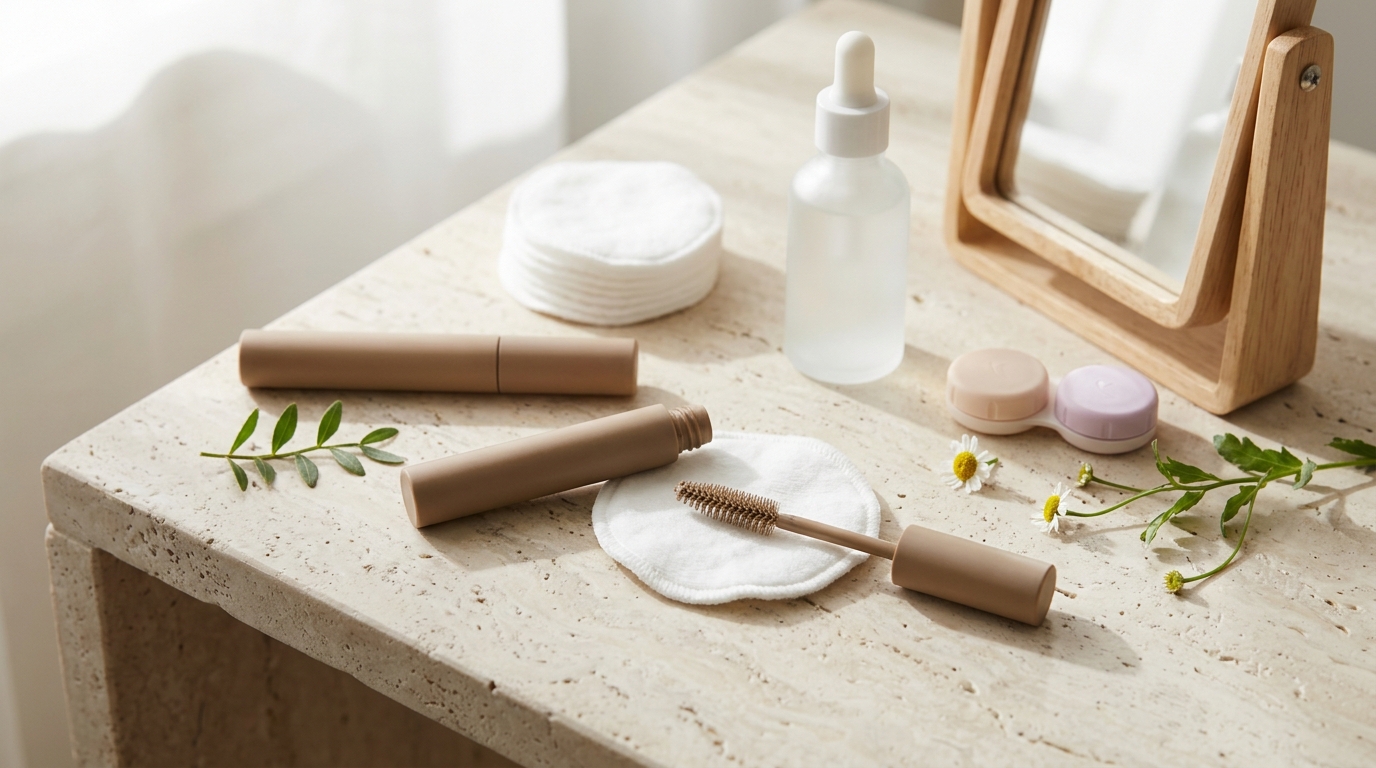
The best mascara for sensitive eyes is not a single brand but a formula that stays on your lashes instead of drifting into your eyes, avoids the ingredients most often linked to reactions, and is fresh, clean and fully removed every night. That answer is less exciting than a ranked list, but it is the one that holds up to checking: no regulator, laboratory or independent body publishes a verified ranking of mascaras for sensitive eyes, and the lists that dominate search results rest mostly on editors’ trials and customer reviews, with several openly stating that they earn commissions on purchases. This guide explains how to work out what your eyes are reacting to, which formula types suit which problem, what the claims on the box actually promise, and when a reaction calls for a doctor rather than a different tube.
This article is general information and does not replace advice from your own eye doctor or dermatologist.
Why “sensitive eyes” can mean three different problems
“Sensitive” describes how your eyes feel, not a diagnosis, and the same word covers problems with very different fixes. Sorting yours into one of the groups below is more useful than any shortlist, because a shedding mascara, an allergy and an underlying eye-surface condition each need a different response.
| What you notice | What may be behind it | What to look at first |
|---|---|---|
| Watering, a gritty feeling or redness within hours of applying; black flecks on cheeks or under lenses | Particles from the mascara reaching the eye surface | Formula type, fibres, and the age of the tube |
| Itchy, swollen, scaly or red eyelid skin that shows up a day or more later and can linger | Allergic contact dermatitis, a delayed reaction to something touching the skin | Stopping the product, recording its ingredients, and seeing a doctor if it persists |
| Dryness, burning or crusty lid edges that happen with every brand | Dry eye or eyelid inflammation that makeup may aggravate rather than cause | An eye examination |
The allergy row deserves a closer look, because it is where people most often blame the wrong product. A 2024 review in the journal Cutis reports that allergic contact dermatitis is the most common cause of eyelid dermatitis, estimated at 46% to 72% of cases worldwide, and that the thin, flexible skin of the lids is unusually prone to it. The same review notes that some reports tie eyelid allergy more often to products used on the scalp or face, or to allergens carried over from the hands, than to products applied directly to the lids. A five-year patch-testing review from a metropolitan contact dermatitis clinic found a similar pattern, with shampoos and makeup the two product types most often linked to reactions. If your lids keep flaring, swapping mascaras alone may therefore not solve it, and patch testing by a dermatologist is the route to a real answer.
Washable, tubing, waterproof or fibre: which formula is gentlest?
Washable formulas are designed to come off with ordinary cleanser and water, which means less tugging at lashes and lids at night. Therapeutic optometrist Reena Patel told Today that the best mascaras for sensitive eyes are hypoallergenic and not waterproof, and ophthalmologist Rupa Wong has been quoted in the beauty press saying waterproof formulas are hard to remove and can cost you lashes in the process. Both are professional opinions rather than trial results, and some brand pages say waterproof mascara is fine with contact lenses, so no single rule is universally accepted. The strongest argument against waterproof formulas is practical, because removal is where most of the friction happens.
Tubing mascara works differently. It is described as leaving small polymer sleeves around each lash that slide off with warm water and light finger pressure, and it features in many contact-lens and sensitive-eye roundups because it is said to flake less. Those descriptions come from manufacturers, retailers and beauty editors; no independent clinical study showing that tubing formulas irritate less than washable ones turned up in the research for this article. A hospital-group explainer on tubing mascara is careful to say it is a cosmetic rather than a treatment and that tolerance varies, and one beauty review notes that tubing formulas can dry out faster in the tube.
Lash-lengthening fibres are the clearest type to skip. Contact lens safety guidance attributed to the American Optometric Association, republished by several hospital health libraries, advises against lash-extending mascara because the fibres can irritate the eyes. The American Academy of Ophthalmology (AAO) makes a related point about glitter and sparkle products, which it calls a common cause of corneal irritation or infection, particularly for people who wear contact lenses. Shimmer and glitter top coats belong in the same category.
“Clean” and “natural” labels deserve the same scepticism. A consumer guide from MyVision.org points out that where an ingredient comes from says nothing about whether it is safe for your eyes.
What “hypoallergenic” and “ophthalmologist-tested” really promise

The US Food and Drug Administration (FDA) states that no federal standards or definitions govern the word “hypoallergenic” on cosmetics, and that manufacturers are not required to send the agency evidence for the claim. The agency once tried to write a definition, but cosmetic companies challenged it and a federal appeals court struck it down in 1977. In practice the word means what each company wants it to mean, which is why dermatologist Rajani Katta has said no FDA requirement dictates what a hypoallergenic product must or must not contain.
“Ophthalmologist-tested” is similarly loose. Health Canada’s consumer guidance says the claim refers to safety rather than effectiveness and that no regulations standardise the type or number of tests behind it. Behind both claims sits a broader fact: the FDA does not test cosmetics before they are sold, and companies are responsible for making sure their products are safe. “Fragrance-free” is somewhat firmer, since the FDA does regulate that claim, though Katta describes it as a legal definition more than a medical one.
None of this makes the labels useless; they show a company at least thought about the eye area. They are simply a starting filter. The ingredient list is the part you can actually act on, and the FDA requires one on eye cosmetics sold to consumers, treating products without it as misbranded.
Ingredients dermatologists actually find in eyelid reactions
Patch-testing research gives a clearer picture of triggers than marketing does. The Cutis review names metals (nickel above all), fragrances, preservatives, acrylates and topical medications as the main eyelid allergens. The clinic review’s top ten included carmine, a red pigment; cetrimonium chloride and related surfactants; the preservatives methylisothiazolinone and formaldehyde; the fragrance components balsam of Peru and linalool; and nickel. For mascara specifically, an AARP feature quoting dermatologist Susan Nedorost lists the formaldehyde-releasing preservative quaternium-15, shellac and propylene glycol among ingredients that can set off reactions. These are possibilities that affect some people, not universal hazards, and only patch testing can show which one is yours.
Metals are worth a second look if mascara swaps change nothing. The Cutis review points out that nickel turns up in eyelash curlers as well as costume jewellery, so a lid rash can come from the curler rather than the product.
Preservatives deserve a nuanced reading. They are a known allergy trigger, yet the FDA explains that they exist to stop bacteria and fungi growing in the tube, which is also why adding water to a dried-out mascara is discouraged: it dilutes that protection. A “preservative-free” mascara is therefore not automatically gentler on the eye; it may simply remove a safeguard, and if one specific preservative is your trigger, the ingredient list will tell you which to avoid.
How to introduce a new mascara so you can tell what caused a reaction
The AAO advises adding only one new eye makeup or care product at a time, particularly if you react easily, and waiting until you know the first is fine before adding another. Changing a mascara, a remover and an eye cream in the same week makes any reaction impossible to trace. Writing the opening date and a photo of the ingredient list somewhere handy also pays off, because the AAO recommends finding out the ingredients after a reaction so you can watch for them in other products and tell your doctor.
Many guides suggest dabbing a product on your forearm first. That is a reasonable precaution, but it is not the same as clinical patch testing, which the dermatology literature treats as the way to diagnose contact allergy, and no source reviewed here confirms that an at-home test reliably predicts eyelid reactions. Allergic reactions are also delayed, so a product that feels fine on day one has not necessarily passed.
Habits that protect sensitive eyes more than any brand choice
The AAO and the FDA both point to roughly three months as the limit for an opened mascara, and the FDA notes that manufacturers usually advise two to four months. The rule traces back to a 2008 study in Optometry, in which 40 women used one of two non-waterproof mascaras daily for three months and just over a third of the tubes showed microbial growth. Growth in a tube is not the same as an infection, and most people will not have problems beyond three months, but it explains the guideline. Dried-out mascara should be thrown away rather than moistened with water or saliva, and the FDA has advised against storing cosmetics above about 85°F (29°C) because preservatives can lose effectiveness, as in a hot car. Never share mascara, and skip store testers; the AAO calls avoiding samples altogether the safest choice. If you get an eye infection, discard all the eye makeup you were using.
Nightly removal matters as much as the tube itself. The AAO says to remove all eye makeup before sleep and cites a case of a woman who slept in mascara for more than 25 years and developed lumps beneath her eyelids. Advice on removers varies: the AAO describes petroleum jelly and tear-free baby shampoo as effective and eye-doctor-approved options, while several optometry sources favour oil-free removers, particularly for contact lens wearers. Whichever you choose, keep it out of your eyes, rinse it off thoroughly, run a clean cotton swab along the base of the lashes, and avoid gritty scrubs near the eyes. Clumped lashes should never be separated with anything sharp, mascara should not go on in a moving vehicle, and after eye surgery you should wait until your surgeon says makeup is safe.
Wearing mascara with contact lenses
Contact lens guidance is consistent on order: put lenses in before makeup and take them out before removing it. The CDC also advises avoiding oily cosmetics and hand sanitiser before touching lenses. There is one wrinkle, since the American Optometric Association–attributed guidance reproduced by health libraries says soft lenses go in before makeup while rigid gas permeable lenses go in afterwards, so ask your eye care provider which applies to you. Eyeliner on the moist inner rim of the lid is discouraged for lens wearers, and fibre and glitter products are best avoided because particles can lodge under the lens. If your eyes turn red or irritated, take the lenses out and speak to a healthcare provider rather than carrying on.
When irritation is a reason to stop and get checked
The FDA’s instruction is simple: stop using an eye cosmetic immediately if it causes irritation, and see a doctor if the irritation persists. It also advises avoiding eye cosmetics while the skin around the eye is inflamed. Rarely, an infected corneal scratch can become a corneal ulcer that threatens sight, so pain, worsening redness, discharge or any change in vision should be examined promptly rather than managed at the makeup counter. The FDA encourages people to report rashes, burns or other serious reactions to cosmetics, and your doctor may know which products tend to cause trouble.
Choosing with confidence
Picking the best mascara for sensitive eyes comes down to matching the formula to your pattern, reading the ingredient list rather than the slogan, and treating a new tube as a trial. If your eyes are fine with a fragrance-free, easy-to-remove formula that you replace on schedule and remove each night, you have found what works for you, whatever the packaging claims. If they are not, the problem may lie elsewhere, and the checks in this guide, followed by a professional opinion, are the faster route.
Explore More
Best Tattoo Numbing Cream: What Clinical Trials, FDA Warnings, and Artists Actually Say

I’m Muhammad Ubaid, founder of YBR Magazine. I research and write detailed guides on America’s National Parks — covering entry fees, permits, best times to visit, and planning tips — using official NPS sources and up-to-date information.

