
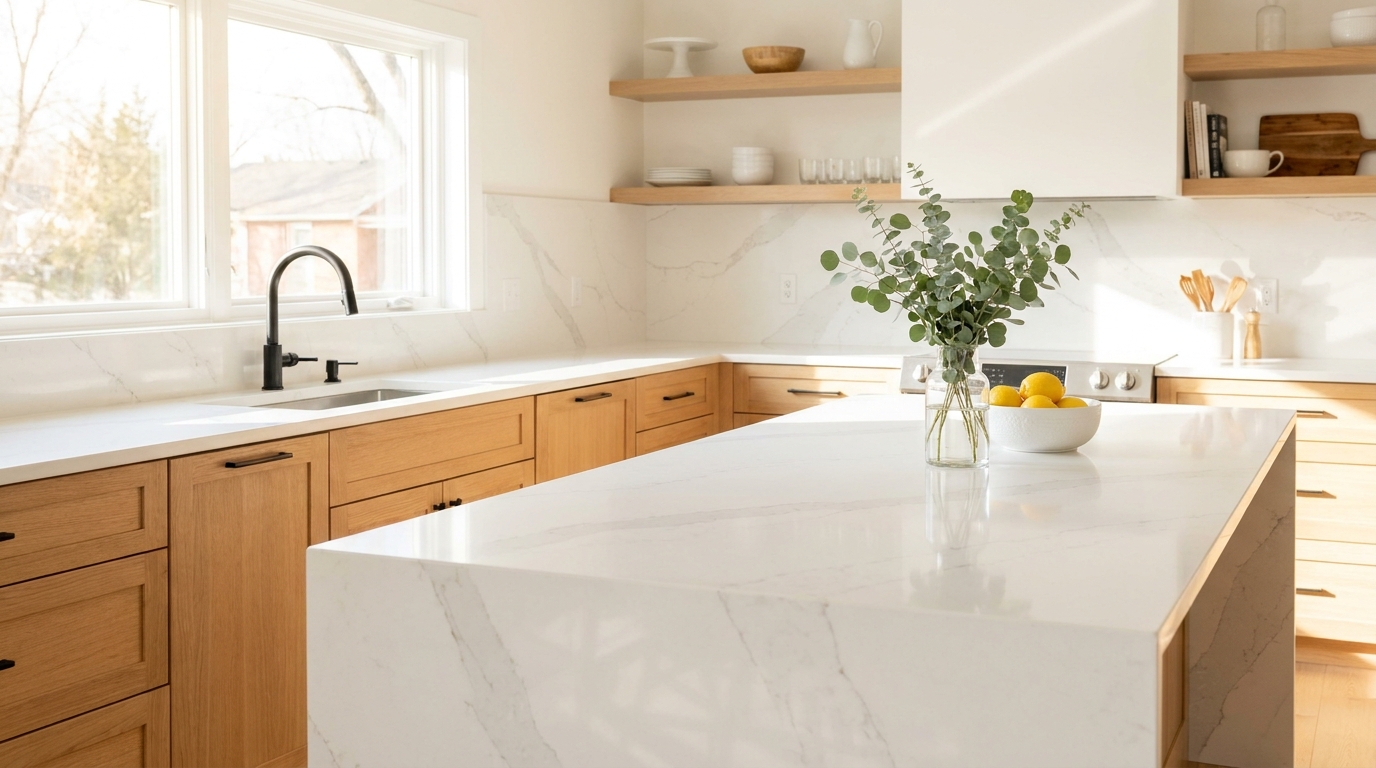
If you are planning a remodel, one of the first things you will want to know is how much is quartz countertops likely to add to your budget. The honest answer is a range rather than a single number, because the price follows the slab you choose, the layout of your space, your location, and the shop that cuts and installs the material. This guide pulls together 2026 figures from cost guides, local fabricators, and trade reporting, and it points out where those sources disagree.
Prices have also been harder to pin down this year because of a new federal safeguard on imported quartz slabs that took effect in August. Many articles ranking for this topic were written before that change, so they may understate what some homeowners are being quoted now.
Quick Facts: How Much Is Quartz Countertops at a Glance
| Item | Typical figure in 2026 | Notes |
|---|---|---|
| Installed price per square foot | $50 to $150 | Premium and designer patterns can go past $150 |
| Common sweet spot | $70 to $100 per square foot | Mid-range slab from a known brand, per one industry guide |
| Average full kitchen | About $3,500 | Cost data from Fixr shows a range of $2,600 to $4,400 |
| Labor share of the total | 15% to 50% | Depends heavily on layout and region |
| Square and eased edges | No extra charge | Ornate profiles cost more |
| Import tariff status | 25% inside quota, 50% above it | Applies to imported quartz slabs since August 15, 2026 |
How Much Is Quartz Countertops Per Square Foot Installed?
The range in the table is the one most reputable cost guides agree on, but the spread has a few causes worth understanding. A slab-pricing guide from Slabwise notes that entry-level slabs can wholesale for roughly $25 to $40 per square foot, while a premium designer pattern can wholesale for $75 or more. Fabricators then add their markup along with the cost of templating, cutting, polishing, and installation, which is where the gap between a budget quote and a high-end quote really opens up.
You will also see much lower numbers online, such as $40 to $75 installed, and these deserve some caution. Several of the pages that publish them are thin, undated, or nearly identical to one another, and they rarely tie the figures to a named fabricator or a real quote. Local fabricator pages tell a different story, with a Chicago supplier describing most homeowners spending $75 to $130 per square foot and a Tampa contractor describing $60 to $200 installed. Labor estimates conflict too: Fixr puts typical installation labor at $10 to $35 per square foot, while Slabwise reports $30 to $50 in most markets and $50 to $70 in expensive metros like New York, San Francisco, and Seattle.
How the shop prices the job matters as well. A Florida fabricator explains that many quartz brands are sold by the square foot, whereas natural granite often requires buying whole slabs, so a small quartz job can cost less than the same area in granite. Whichever way you are quoted, ask whether the price covers waste, seams, and leftover material, since two quotes that look similar can treat those items very differently.
How Much Is Quartz Countertops for an Average Kitchen?
Most kitchens need somewhere between 30 and 80 square feet of countertop, depending on whether there is an island and how many cabinet runs you have. The figures below are simple arithmetic based on the per-square-foot ranges above, so treat them as planning estimates rather than quotes.
| Countertop area | Common range ($70 to $100 per sq ft) | Wider range ($50 to $150 per sq ft) |
|---|---|---|
| 30 sq ft (small kitchen) | $2,100 to $3,000 | $1,500 to $4,500 |
| 50 sq ft (mid-size kitchen) | $3,500 to $5,000 | $2,500 to $7,500 |
| 80 sq ft (large kitchen with island) | $5,600 to $8,000 | $4,000 to $12,000 |
Your fabricator will measure the real area during a template visit, and the final number often shifts once backsplashes, waterfall ends, or extra cutouts are added. For that reason, a written, itemized estimate is far more useful than a verbal figure given over the phone.
What Makes the Price Go Up or Down

Slab grade, brand, and color
Quality tier is the biggest single driver. Cost data from Fixr says some translucent or brightly colored quartz varieties can run up to 50% more per square foot because of the custom manufacturing they require, and slabs with dramatic veining or unusual colors generally sit at the top of the scale. Thicker slabs also tend to cost more, so it is worth confirming which thickness a quote assumes before comparing offers.
Edges, cutouts, and layout
A square or eased edge usually comes at no extra charge, but ornate profiles such as ogee or dupont can add as much as $1,050 to a standard-size kitchen, according to the same Fixr data. Sink cutouts, cooktop openings, and faucet holes add fabrication time, and undermount sinks generally require more finishing work than drop-in styles. Layout matters more than most people expect: a simple U-shaped kitchen with a single sink cutout is a straightforward job, while an L-shaped plan with an island means more seams, more cuts, and more waste.
Labor, location, and extras
Regional labor rates and shop minimums explain why the same job can swing widely between metro areas. One industry guide says identical projects in the same city have been quoted 35% to 40% apart by different shops. Removal of old countertops, plumbing disconnection, and backsplash work are commonly priced separately, so check what each quote includes before assuming it is the full cost.
Popular Quartz Brands and What They Cost
Published brand figures vary a good deal, and most of the numbers online come from fabricators and retailers who sell these products, so they work best as rough guides. The ranges below are installed estimates gathered from several fabricator-run guides.
| Brand | Approximate installed range per sq ft | What to know |
|---|---|---|
| MSI | $55 to $80 | Often described as the value choice among major brands |
| Silestone | $55 to $85 | Widely distributed, with a 25-year warranty according to one guide |
| Hanstone | $60 to $85 | Mid-range pricing with consistent quality |
| Caesarstone | $65 to $95 | Usually priced a little below Cambria |
| Cambria | $60 to $150 | Sources disagree widely, from about $55 to $125 up to $100 to $200 or more |
Cambria is made in the United States and offers a lifetime transferable warranty, which several guides cite as part of its premium. That origin may matter more this year, since domestically made slabs are not subject to the new import duties discussed below.
How Quartz Compares With Other Countertop Materials
Quartz sits in the middle to upper-middle part of the market, and its price range overlaps heavily with natural stone. One guide finds granite and quartz within $5 to $20 per square foot of each other at mid-range grades, while another says quartz usually costs somewhat more at the same quality level.
| Material | Typical installed range per sq ft |
|---|---|
| Laminate | $15 to $60 |
| Solid surface (such as Corian) | $35 to $100 |
| Granite | $40 to $140 |
| Concrete | $55 to $150 |
| Quartzite | $60 to $200 or more |
| Marble | $45 to $250 |
Because these figures come from different guides with different assumptions, the order of the cheaper and pricier materials can flip depending on the specific stone or pattern you pick.
How 2026 Tariffs Are Changing Quartz Prices
After an International Trade Commission investigation into rising imports, the President signed a proclamation on July 31, 2026, creating a four-year safeguard tariff-rate quota on imported quartz surface products, effective August 15. Under the measure, imports within the annual quota face a 25% duty and imports above it face 50%, according to industry and trade coverage. These duties stack on top of existing antidumping and countervailing duties, and the rates are scheduled to step down in later years. Quarried stone such as granite, marble, soapstone, and quartzite is excluded, and the proclamation also exempts certain developing countries, so the effect on any given slab depends on where it was made.
The measure is also being contested. A group of importers filed a complaint at the U.S. Court of International Trade on August 21 seeking to overturn the injury finding behind the tariffs, and a coalition of domestic manufacturers has moved to defend them, so the outcome is not settled as of late October 2026.
No official national figure shows how much consumer prices have moved. Before the decision, senators who opposed the tariff cited an estimate that a 50% duty could add roughly $504 to $1,036 to an average kitchen priced at $3,500, and a Pittsburgh-area fabricator told Axios he expected increases of 30% to 50%. After the safeguard began, a Charleston-area fabricator said in a company press release that its quartz material prices had risen about 25% on average, while adding that not every color or project is affected equally. These are individual claims rather than independent measurements, which is why the answer to how much is quartz countertops can differ from one shop to the next this fall. A practical step is to ask each fabricator where the slab was produced and how long the quote is guaranteed.
Smart Ways to Lower the Bill
- Collect at least three written, itemized quotes, including one from an independent fabricator and one from a big-box program, since an industry guide reports big-box quotes for in-stock colors often landing at $55 to $75 per square foot.
- Choose an in-stock color or a remnant for small projects like vanities and bar tops, where a full slab would leave a lot of unused material.
- Stick with a standard edge and keep the layout simple to limit seams, cutouts, and fabrication hours.
- Ask whether a domestically produced or tariff-exempt slab is available in a similar pattern, and compare it with natural stone options that fall outside the safeguard.
Is Quartz Worth the Money?
Quartz is an engineered product made of ground stone bound with resin, which gives it consistent color and pattern from slab to slab. Most manufacturers describe it as non-porous and not in need of sealing, although a few cost guides claim otherwise, so it is sensible to read your brand’s care instructions and warranty terms. The material can be damaged by very hot pans, which is one reason many installers recommend always using trivets.
Whether the price is justified depends mostly on how much you value low maintenance and a uniform look. If you prefer one-of-a-kind natural patterns or plan to put hot cookware directly on the counter, a natural stone may fit better.
Frequently Asked Questions
How much is quartz countertops for a bathroom vanity?
It depends on the size of the top and the shop’s minimum charge. At $70 to $100 per square foot, a 6-square-foot vanity top would come to roughly $420 to $600, but small jobs are often priced as a minimum or from a remnant, so ask the fabricator directly.
Does a quartz quote usually include the sink cutout and backsplash?
A standard quote typically covers templating, fabrication, and installation with one straight edge. Extra cutouts, backsplashes, plumbing work, and old countertop removal are frequently listed separately, so request an itemized breakdown.
Do quartz countertops cost anything to maintain?
Day-to-day care is usually just mild soap and water, and most brands say no sealing is needed. The main risk is heat, since hot pots can scorch or melt the resin, and that damage generally cannot be repaired in place.
Will prices fall if the tariffs are overturned?
That is not publicly confirmed. The court challenge is still pending, and even if the duties were removed, fabricators would not necessarily lower prices immediately.
What is the difference between quartz and quartzite?
Quartz is a manufactured surface made from crushed stone and resin, while quartzite is a natural stone quarried from the earth. Quartzite is harder to cut and polish, and it is not covered by the quartz safeguard tariffs.
Does a thicker quartz slab cost more?
Usually yes, because thicker slabs use more material and are heavier to handle and install. Confirm the thickness in every quote so the comparison is fair.
Conclusion
The best way to settle how much is quartz countertops for your own home is to measure your space, pick two or three patterns in different price tiers, and request itemized quotes that state the slab origin, thickness, edge, and cutouts. With tariffs still in flux, a written price guarantee and a quick comparison with natural stone can protect your budget more than any national average.
Disclaimer: The prices in this article are estimates compiled from public cost guides, fabricator information, and trade reports as of October 2026, and they are not quotes or professional advice. Costs, tariff rules, and court rulings can change, so confirm current details with licensed local fabricators, contractors, and official sources before making purchase or financial decisions.
Explore More
Types of Outdoor Water Spigots: A Practical Guide to Choosing the Right One

I’m Muhammad Ubaid, founder of YBR Magazine. I research and write detailed guides on America’s National Parks — covering entry fees, permits, best times to visit, and planning tips — using official NPS sources and up-to-date information.