
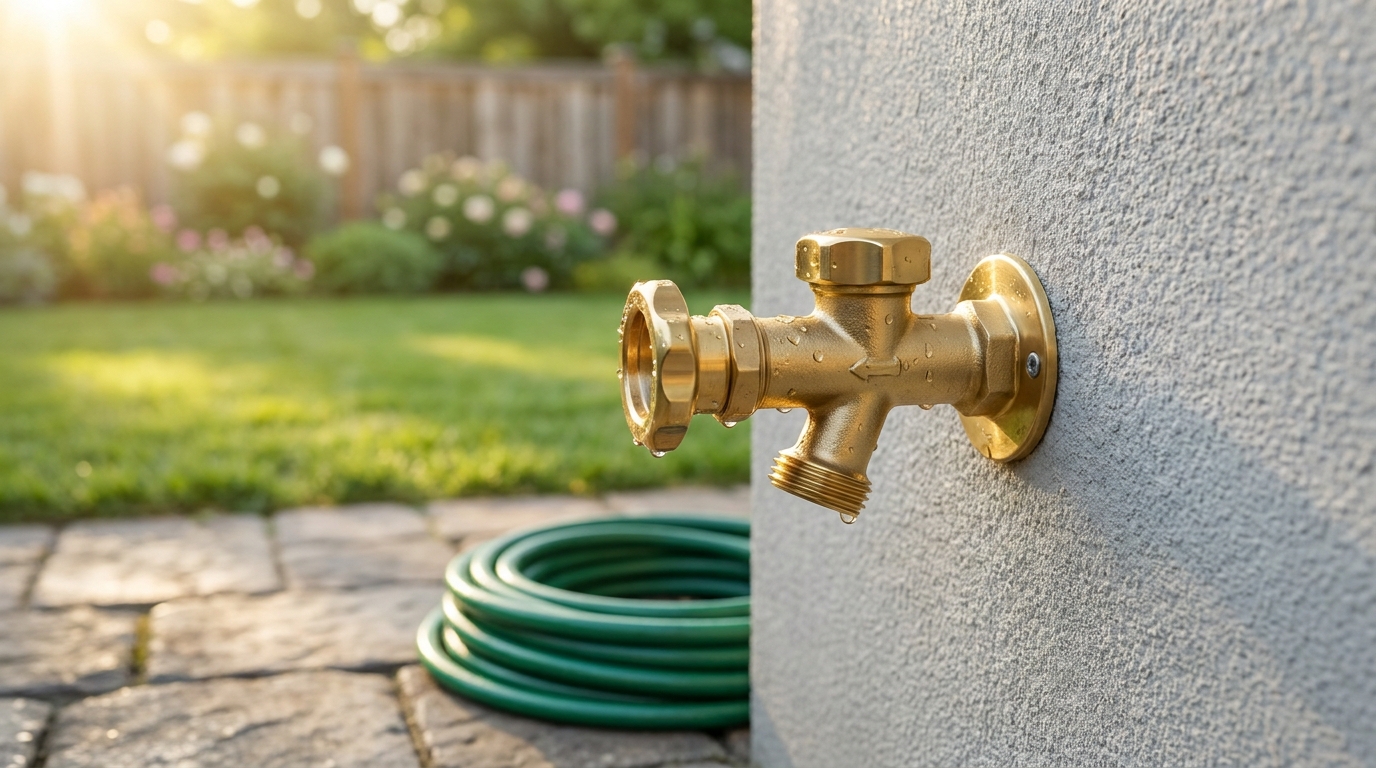
Walk around almost any home and you will find a small brass fixture near the base of a wall that supplies water for the garden hose. Although it looks simple, the choice between the different types of outdoor water spigots affects whether your pipes survive winter, whether your drinking water stays protected from contamination, and how much maintenance you will face over the years. This guide explains each style in plain language, shows where the popular online lists contradict one another, and helps you match a spigot to your climate and your yard.
Quick Comparison
| Type | Best for | Freeze-resistant | Installed where |
|---|---|---|---|
| Standard hose bibb | Mild climates, low budgets | No | Exterior wall |
| Frost-free sillcock | Places with freezing winters | Yes, if sloped and hose removed | Exterior wall |
| Anti-siphon (vacuum breaker) spigot | Protecting household water from backflow | Depends on the model | Exterior wall |
| Ball valve spigot | Quick on/off and low upkeep | Not by itself | Exterior wall |
| Yard hydrant | Gardens, barns, and distant water points | Yes, when buried below the frost line | Freestanding in the ground |
| Outdoor sink or shower | Cleaning, cooking, and rinsing off | Varies by plumbing | Patio, deck, or outdoor kitchen |
Spigot, Hose Bibb, Sillcock, or Faucet: What Is the Difference?
People use all of these names for the same general job, which is moving water from household plumbing to a place outdoors. Angi explains that hose bibbs and spigots are frequently used interchangeably and can look nearly identical, with the main technical distinction being that a hose bibb has a threaded spout designed to accept a garden hose. Plumbers also say sillcock or wall hydrant, particularly when talking about the longer models that pass through the wall.
For shopping purposes, the labels matter less than the features printed on the packaging. Look for words such as frost-free, anti-siphon, or vacuum breaker, because those describe what the fixture actually does and which situations it is safe to use in.
Why Online Lists of Spigot Types Disagree
If you search this topic, you will notice that the results do not agree on how many categories exist. Some pages claim there are only two kinds, compression spigots and frost-free spigots, but several of those pages have nearly identical wording and appear to be rewritten copies of one another. Compression describes the internal valve mechanism rather than a separate category of fixture, so treating it as a peer of frost-free models mixes two different ideas.
More careful sources organize the field by function instead. Angi, for example, lists spigots and hose bibbs alongside frost-free faucets, anti-siphon valves, ball valves, yard hydrants, and outdoor kitchen faucets, which is closer to how the types of outdoor water spigots are actually sold and installed. This guide follows that function-first approach.
The Main Types of Outdoor Water Spigots
Standard Hose Bibbs
The standard hose bibb is the simplest and most affordable option, and it is what most older homes have. House Digest notes that most of these use globe valves, which rely on internal washers and packing that eventually wear out and need replacing. Because the valve seat sits close to the outside of the wall, water stays trapped in the fixture after you shut it off, and Angi points out that most standard outdoor spigots are not freeze-proof and must be turned off and drained before cold weather arrives.
Where winters stay above freezing, a standard hose bibb is often perfectly adequate. In colder regions, it makes more sense to treat one as a starter fixture to replace rather than a long-term choice.
Frost-Free Sillcocks

A frost-free sillcock, also sold as a freeze-proof or freezeless hose bibb, solves the trapped-water problem with a long stem. The handle sits outside, but the shutoff seat is located deep inside the wall, in the heated part of the house, so the exposed barrel can empty itself after use. Manufacturer guidance consistently stresses that this only works when the fixture is tilted slightly downward toward the outside, because a level or upward-angled barrel holds water that can freeze.
Exact slope recommendations are not uniform across manufacturers. One sillcock manual calls for roughly a quarter inch of drop per foot, while another manufacturer’s guide describes a slope of several degrees, so it is best to follow the instructions that come with the specific model you buy. Every source reviewed also agrees on one maintenance point: a hose left attached over winter prevents the barrel from draining and is described as the most common reason these fixtures still burst.
Anti-Siphon and Vacuum Breaker Spigots
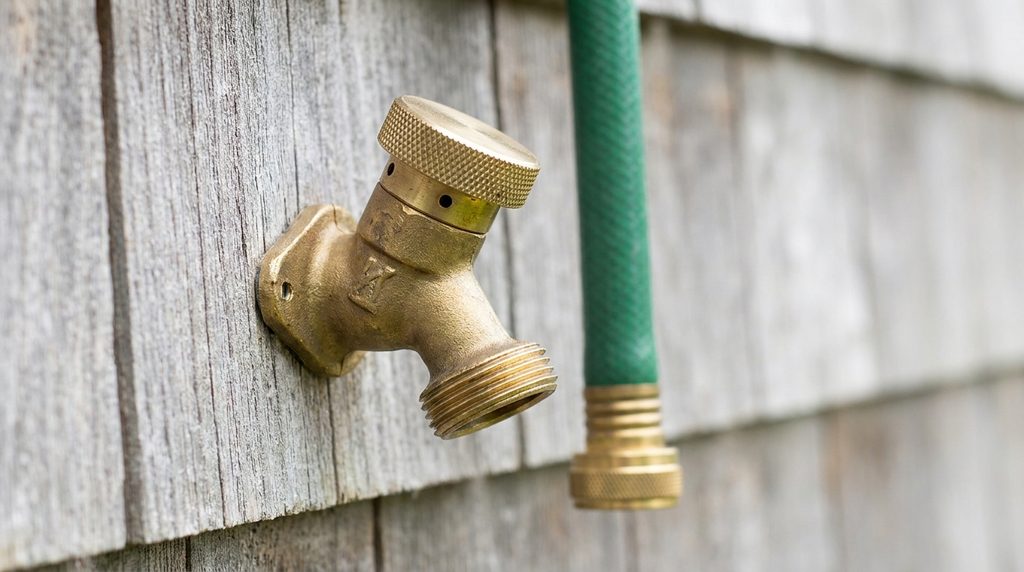
Anti-siphon spigots exist to stop dirty water from being pulled backward into your home’s supply. This can happen if the water pressure drops while a hose is lying in a bucket, a pool, or a puddle of fertilizer. According to LawnStarter’s cost guide, these fixtures use one-way valves so that contaminated hose water cannot mix with the clean supply.
Not every backflow device offers the same level of protection. Industry standards describe a hose connection vacuum breaker (ASSE 1011) as a single-check device with an atmospheric vent, while a hose connection backflow preventer (ASSE 1052) adds a second check valve to also handle backpressure. A separate standard, ASSE 1019, covers freeze-resistant wall hydrants with built-in vacuum breakers. Local utilities and plumbing codes in several U.S. states, including North Carolina and Louisiana, require hose connections to be protected, although rules differ by location, so your water provider is the final authority on what applies at your address.
Two practical limits are worth knowing. Public-utility guidance states that these breakers are not rated for continuous pressure, which means they are poor protection for in-ground sprinkler systems. A typical hose-end breaker may also spit water if it fails or faces backpressure, as noted in one supplier’s troubleshooting table.
Ball Valve Spigots
A ball valve spigot opens and closes with a quarter turn of the handle, in contrast to the multiple full turns that a globe-style valve needs. House Digest explains that a ball with a hole through its center rotates to allow or block flow, and that these valves generally need no regular maintenance, while an aging globe valve almost certainly will. Their main appeal is convenience and long life, particularly for households that switch the water on and off many times a day.
Yard Hydrants
When the water point needs to stand away from the house, such as at a garden bed, a barn, or a livestock trough, a yard hydrant is the usual answer. It works like a very long valve, with the handle at the top and the shutoff plunger buried deep underground below the frost line. When you close the handle, a drain port opens and the water in the standpipe empties into a bed of crushed stone, and Boshart reports that a hydrant buried four feet deep takes roughly 45 to 60 seconds to drain, with the time varying by bury depth and the quality of the drain bed.
Hydrants are commonly sold by bury depth, with lengths ranging from about two feet to six feet or more. A home-inspection guide adds an easy-to-miss detail: a hydrant can be perfectly frost-free while the pipe feeding it runs shallowly under a path or flower bed, and that supply line can still freeze and burst. Some models also include a dual-check backflow device, so it is worth looking at the specifications.
Outdoor Sinks and Showers
At the decorative and functional end of the range are outdoor sinks and showers, which are plumbed more extensively than a simple spigot. LawnStarter describes outdoor sinks as ranging from utility styles to outdoor kitchen setups, and another cost guide notes that they can be supplied with both hot and cold water. They usually require drainage planning as well, which is a major reason their installed cost is higher than that of a hose connection.
What Is Inside: Common Valve Styles
Beyond the outside shape, the valve inside decides how a spigot feels to use and how often it needs service. Globe or compression valves are the most widespread and rely on washers that press against a seat, which explains why worn washers, packing, and valve seats are the usual culprits when a fixture leaks, according to This Old House. Ball valves use the quarter-turn design described above, and gate valves are an older style that This Old House says is now less common because the stem tends to break over time.
Materials matter too. Lawn Love notes that spigots are usually made of brass or plastic, and brass is generally the more durable choice for a fixture that will face sun, rain, and daily handling. Finishes such as chrome, brushed nickel, and oil-rubbed bronze are mainly a matter of appearance.
How to Choose Among the Types of Outdoor Water Spigots
Start with your climate, since freezing weather is the single biggest factor. If winter temperatures regularly drop below freezing, a frost-free sillcock or a buried yard hydrant is the safer foundation, whereas a standard or ball valve fixture can serve a warm region well. Next, think about how the water will be used, because a spigot that feeds a hose for pressure washing or fertilizer sprayers calls for backflow protection that a purely decorative fixture would not.
Then consider the location. A wall-mounted fixture is the natural pick next to the house, while anything more than a few steps away from the building points toward a yard hydrant. Finally, look at your budget and your appetite for upkeep, remembering that a slightly more expensive fixture with a long service life is often cheaper than repeated repairs.
What Spigots Cost
Published cost figures vary quite a bit, and they mostly describe U.S. labor and material prices, so treat them as rough guides. LawnStarter reports a national average of about $360 for installing a new spigot, with a typical range of $190 to $415, and gives $200 to $430 for frost-free models and $230 to $435 for anti-siphon ones. Lawn Love gives a wider overall range of $150 to $500, which shows how much the totals shift depending on how far the new fixture is from existing plumbing and how much labor is involved. Prices across the types of outdoor water spigots rise sharply once drainage, hot water lines, or trenching enter the picture, as they do with sinks, showers, and hydrants.
Seasonal Care for a Standard Spigot
A fixture that is not freeze-resistant needs a little attention each autumn. Remove the hose first, since a connected hose can ruin both the hose and the fixture, then close the interior shutoff valve if your home has one and open the outdoor handle so the remaining water can run out. Doing this before the first hard frost takes only a few minutes and spares you from discovering a split pipe when the weather warms up.
Frequently Asked Questions
Can I put a vacuum breaker on any outdoor spigot?
Only on one with a hose-thread outlet, and only if the breaker is designed for that fixture. A manufacturer’s specification sheet warns that its standard add-on hose bibb vacuum breakers should not be used on frost-free hydrants, and it directs buyers to a different model made for that purpose.
How long should a frost-free sillcock be?
The length should match the thickness of your wall, measured from the outside surface to the interior water pipe. One manufacturer’s guide advises choosing a model slightly longer than that measurement so there is enough room to make the connection inside.
Can I install a spigot myself?
It depends on your plumbing experience, and sources disagree on how hard it is. Some guides say it is a reasonable project for a capable DIYer, while a manufacturer’s guide recommends hiring a plumber if you lack experience, since the inside connection may involve soldering, threaded fittings, or push-fit connections. Hunker adds that some local codes also require a separate shutoff valve just before the faucet.
Does a ball valve spigot protect against freezing?
Not on its own. A ball valve describes how the water is switched on and off, not how deep the shutoff sits inside the wall, so a fixture only offers freeze protection if the product is specifically labeled frost-free or freeze-resistant.
Why would a yard hydrant freeze if it is frost-free?
The most common reasons are poor drainage and a shallow supply line. If the drain bed is blocked or the pipe feeding the hydrant is not buried below the frost line, water can remain where it is exposed to freezing temperatures.
What should I do if water leaks around the handle?
A leak at the stem usually points to a loose packing nut. One manufacturer’s troubleshooting guide suggests tightening it gently, and replacing the packing washer if that does not stop the leak.
Conclusion
The best choice among the types of outdoor water spigots comes down to three questions: how cold your winters get, how far the water point is from the house, and whether you need backflow protection. For many homes, a frost-free anti-siphon sillcock covers all three, while a yard hydrant or an outdoor sink serves more specialized needs. Checking the fixture’s labeling and your local plumbing rules before buying will save time and avoid problems later.
Disclaimer: This article is for general information only and is not professional plumbing, engineering, or legal advice. Plumbing codes, backflow requirements, frost depths, and prices differ by region, so confirm the rules with your local water utility or a licensed plumber before installing, replacing, or modifying any outdoor water fixture.
Explore More
How to Repair a Cracked Tile: A Step-by-Step Guide for Floors and Walls

I’m Muhammad Ubaid, founder of YBR Magazine. I research and write detailed guides on America’s National Parks — covering entry fees, permits, best times to visit, and planning tips — using official NPS sources and up-to-date information.