


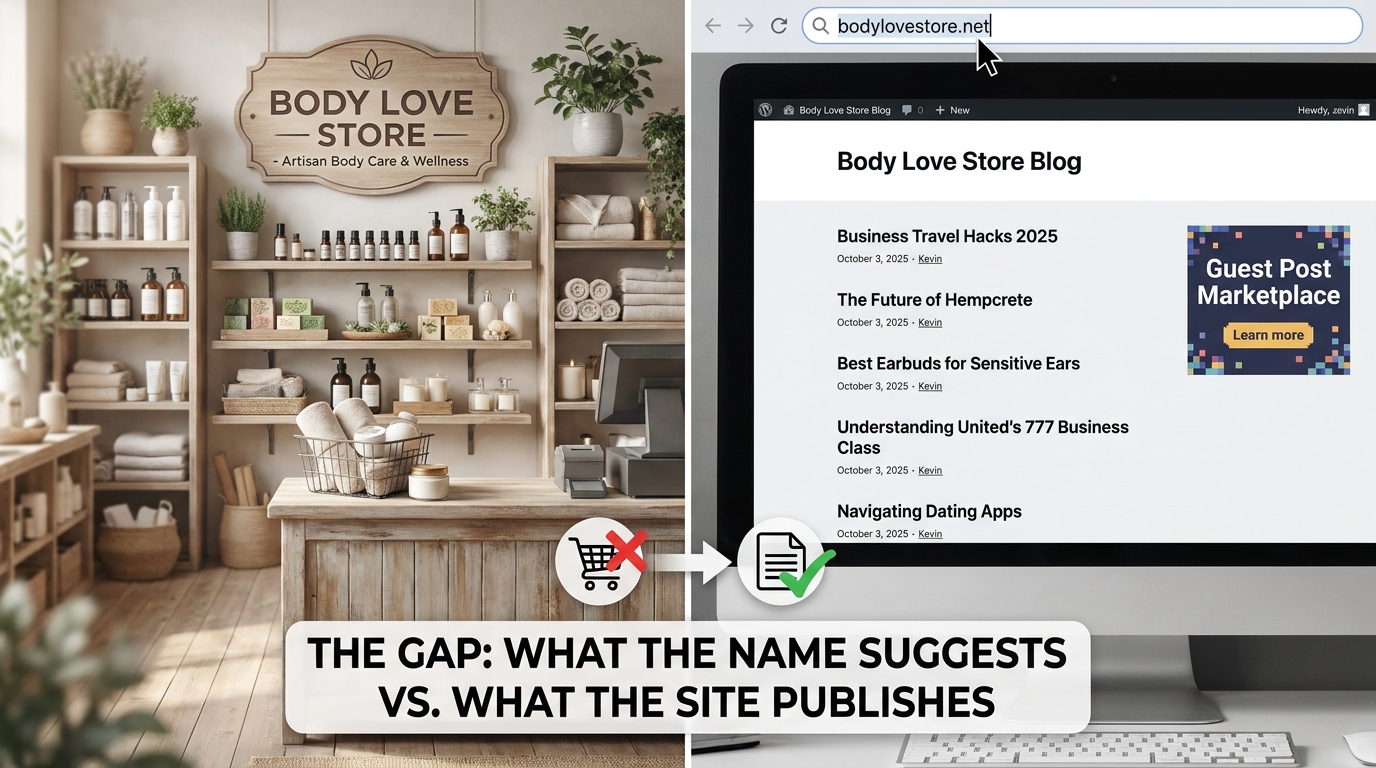
Anyone who types bodylovestore.net into a browser expecting a body care shop will find something else: a WordPress blog called Body Love Store that publishes articles on business travel, home building, earbuds, dating apps and similar subjects. When the pages were checked for this article on November 24, 2026, none of them showed a product listing, a shopping cart or a checkout. That does not make the site harmful, but it does mean the name and the content point in different directions, and that gap is the most useful thing a visitor can understand before deciding what to do next.
What the site actually publishes
Seven topic areas run across the top menu: business, education, finance, home improvement, law, lifestyle and technology. The home page showed four posts for each category it listed, and the headlines jump around widely. One covers hempcrete building materials, another looks at earbuds for sensitive ears, a third at United’s Boeing 777 business class cabin, and two more are about dating apps. Every post seen carried the same byline, “Kevin,” and the same publication date of October 3, 2025, and the archive menu lists no month other than October 2025. When checked, the site had nothing newer than that.
The design is a ready-made WordPress theme called Popular Blog from Adore Themes, which the footer credits, and the copyright line runs to 2026. Image banners that link to an outside address appear at the top of pages, inside articles and at the bottom, and the sidebar carries an advertisement for a guest post marketplace. An ad like that says nothing about whether this particular site sells posts, but it does show the pages are set up to display third-party promotions. Commenting requires a login, and the recent comments box was empty.
Why the name sounds like a shop when the site is not one
“Body Love” is a popular name, and several unrelated businesses use it. Anyone searching from memory, or from a half-remembered ad, can easily land on the wrong one. The table below separates a few that turn up in search results, based on how each describes itself on its own pages. Nothing found in searches connects any of them to the blog discussed here, and these pages can change, so treat the table as a snapshot.
| Name | What it says it is | Where it lives |
|---|---|---|
| Body Love Self Care Shop | A self-care lifestyle brand focused on feminine care and hygiene, selling online with local pickup from a studio in Fayetteville, Georgia | Cratejoy marketplace |
| Body Love Shop (Body Liberation Photos) | A curated collection of body-positive goods and artwork from fat, plus-size, LGBTQIAP+ and BIPOC creators, run by photographer Lindley Ashline | bodyliberationphotos.com |
| Body Love Shop (Body Love Yoga) | A small store for yoga films, a book and gift cards, with prices in Swedish kronor | bodylovetantra.com |
| BODYLOVE store | A clothing and merchandise page selling hoodies, joggers and tees with slogan prints | kaylabrenda.com |
If your goal was to buy skincare, lotion or fitness gear, none of these is the site in this article, and the blog does not sell anything of that kind.
Is it safe to open, and what can be said about its reputation?

The pages checked asked readers for nothing beyond a login prompt on the comment form, and no payment form appeared anywhere. The outside banners are the part to be careful with, since clicking an ad sends you to a third party whose reliability the blog cannot vouch for. Reading the articles carries about the same risk as reading any ad-supported site.
On reputation, searches turned up no Trustpilot page and no ScamAdviser report for this domain, so there is no independent rating to point to in either direction. That absence is not a verdict. It is worth knowing how such rating tools work, though, because people often cite them as proof. ScamAdviser explains that its score weighs signals such as how old the domain is, how far ahead it is registered, whether the owner’s details are hidden, how much traffic it gets and whether outside reviews exist. The company itself says a legitimate site can score poorly on these points, for example when it is new or uses privacy protection. A score is a prompt to look closer, not a judgment of honesty.
Several basic facts are not publicly confirmed and are left open here: who owns the site, when the domain was first registered, and who pays for its upkeep.
What the writing itself tells you
One article was read in full, the piece on Air India’s business offerings. It credits the airline’s changes to its takeover by the Tata Group and then describes upgrades to seats, service, apps and loyalty benefits in broad terms, with no figures, dates, quotes or named sources attached. It also repeats the same lowercase phrase in italics three times, a habit more typical of writing aimed at search engines than of an editor’s polish. Several headlines follow a matching pattern too: four of the eight titles in the front-page news ticker start with “Beyond,” and two of those share the exact opening “Beyond the Swipe.”
None of this proves the content is wrong. It does mean the posts read as general overviews rather than reporting, and the site has finance and law categories whose articles were not reviewed here. For decisions involving money, contracts or legal rights, an official government page or a qualified professional is a better foundation than any anonymous blog. Nothing here is a verdict on the site’s intentions, only a description of what was visible on the dates checked.
What a clearly identified publisher looks like
A fair comparison is a publication that tells readers who it is. NTX Magazine, for example, is published through the North Texas Commission and describes itself as a business-to-business title for companies weighing relocation or expansion in the North Texas region, with details on who receives it and how it is distributed. Readers can see who stands behind it and why it exists.
The blog behaves differently. Its menu and footer link to no About, Contact, privacy or shipping page, it states no purpose beyond its categories, and the only people-related detail is a first-name byline plus an email address that the page hides behind a protective script. Many small blogs are run this way, so it is not a red flag on its own, but it does leave readers with less to check.
If you came looking for a body care shop
Searching for a domain name usually means one of two things: you were sent a link and want to know whether to trust it, or you remember a shop name and typed it as a web address. In the second case, search for the brand’s name together with words like “official site” or “reviews,” and compare what independent pages say against what the shop says about itself.
Before paying any online seller, a few checks catch most problems:
- Look for a business name, postal address and working contact details on the checkout or policy pages, not only a form.
- Read the return and shipping terms before adding anything to the cart, since vague or missing terms are a common complaint pattern.
- Find reviews on sites the seller does not control, and be wary when a shop’s own page shows only perfect ratings.
- Pay with a method that offers a dispute process, such as a credit card, rather than a bank transfer or gift card.
- Screenshot the product page and price, so you have a record if the item or the promise changes.
If a message, ad or text sent you to this domain with a promise of a discount or prize, treat it with extra caution, because the blog itself offers neither.
What would change this picture
The assessment above reflects a site frozen at one moment: a single month of posts, no named owner and no shop. It would deserve a fresh look if the site added a real About page with a named publisher, started dating new posts across later months, or introduced products with clear seller details. Until then, bodylovestore.net is best treated as an unsigned general blog whose name suggests a store it does not appear to operate.
Explore More
kingddy.com: What the Site Is, Who Publishes It, and How Far to Trust Its Articles

I’m Muhammad Ubaid, founder of YBR Magazine. I research and write detailed guides on America’s National Parks — covering entry fees, permits, best times to visit, and planning tips — using official NPS sources and up-to-date information.

