


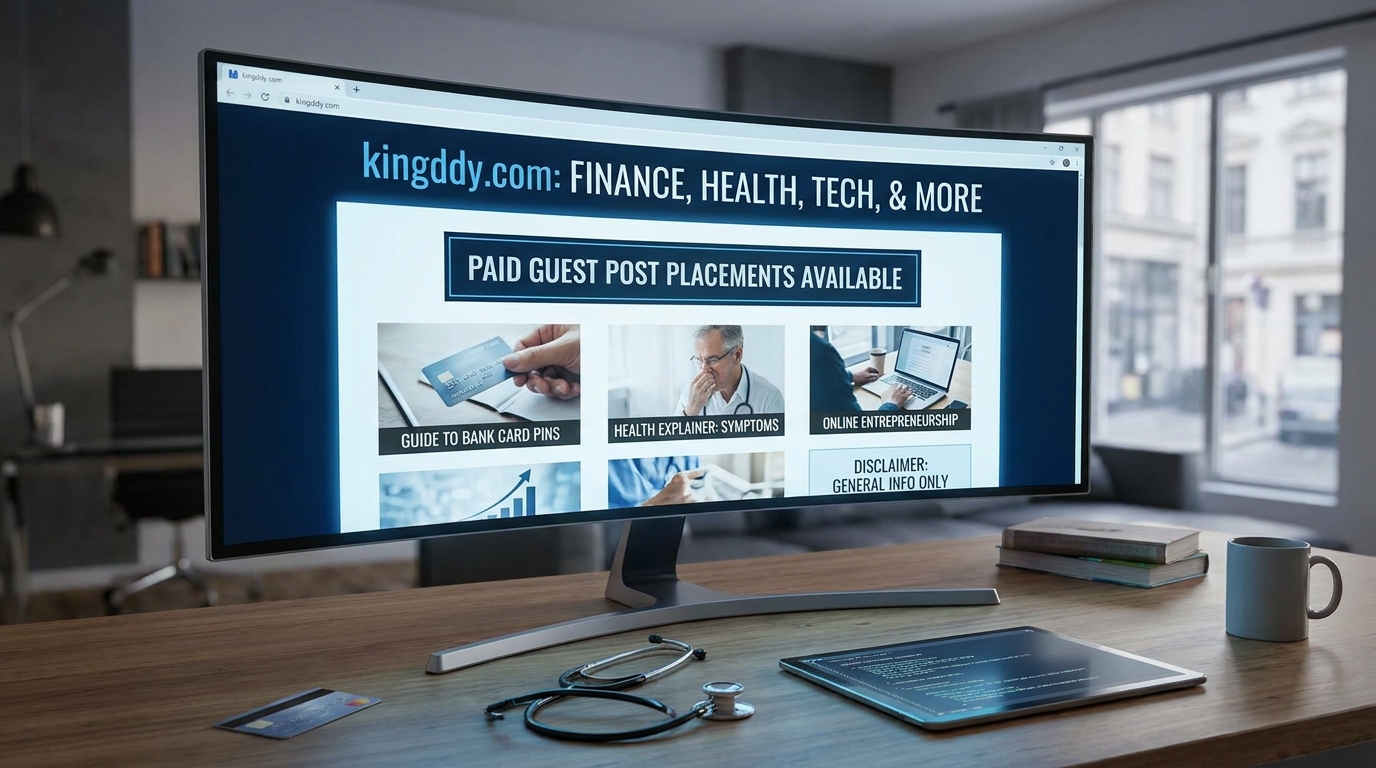
Most people reach kingddy.com through a search for something very specific, such as how to set a bank card PIN or what a particular symptom could mean, and only then ask who is behind the page. The short answer, as of November 24, 2026, is that it is a small general-interest blog covering finance, health, technology, education and several other topics, and that it openly sells paid guest-post placements. No owner, company name or author biography appears on the pages reviewed for this article. What follows explains what the site publishes, what it says about itself, what remains unconfirmed, and how to read its articles sensibly.
What the site publishes and how it describes itself
The site runs on WordPress and sorts its posts into eleven categories: technology, finance, business, education, health, lifestyle, travel, home improvement, law, real estate and pets. Its homepage calls it a modern digital media platform for technology, business, finance and digital trends, and its footer describes an independent digital publication that also covers AI and startups. The posts on the front page tell a slightly different story. They include a guide to net banking in Jammu and Kashmir, a walkthrough for generating a credit card PIN, teaching strategies for students with autism, an introduction to online entrepreneurship courses, and a run of health explainers on conditions such as testicular cancer, testicular torsion, Peyronie’s disease and chronic urinary incontinence. Older posts on renewable energy storage and micro frontends in web development sit in the technology section.
In other words, the stated focus is technology and business, while a large share of what is actually on the front page is health and personal finance. The archive is modest as well. The front page paginates into only three pages, and the monthly archive confirms that posts go back to August 2023, with newer pages added during 2026.
It looks like a news site, but it does not publish news
The navigation includes a block labelled Main News, and the theme underneath is a news-magazine template, so first-time visitors often assume they are reading reporting. The material is closer to evergreen explainers: general guides meant to stay searchable over time, which is exactly how the site’s own guest-post page describes the content it wants. On the pages reviewed there were no datelined reports, no named reporters and no corrections policy. A reader looking for breaking developments will need a different source.
How the site is funded: paid guest posts
The clearest information about money comes from the site’s own guest-post page, published in May 2026. It states that guest contributions are reviewed and approved as paid editorial placements, that publishing is not free, and that pricing can depend on topic category, link placement, article length and timing. Contributors are told to supply at least 1,000 words of original text with natural anchor text, relevant outbound links and no excessive promotional language. The page invites marketing agencies, SEO professionals, brand owners and content marketing teams, and it says agencies can ask about bulk publishing.
Paid guest posting is a common practice and not wrongdoing in itself, but it changes how a reader should weigh an article. A post may exist mainly because someone paid for a link, not because an editor decided readers needed that topic. The guidelines page does not say whether paid posts carry a visible sponsored label. The sidebar also shows a banner for a guest post marketplace that points to an outside company, adoovy.com, and the guest-post page lists a link to the same company under a “Content Marketing Companies” heading. Whether any relationship exists between that company and the site is not explained anywhere that could be found.
Who is behind kingddy.com? What is and is not public

No individual or company is named as the owner on the homepage, the guest-post page or the article pages reviewed. Articles carry a first-name byline, Jamie, with no biography or credentials beside it. Contact is by an email address that the site shields from scrapers and by a contact form. The footer lists profiles on X, LinkedIn, Pinterest, GitHub and Mastodon, while the Facebook icon simply links back to the site’s own homepage instead of a Facebook page. Legal pages are present: a privacy policy, terms and conditions, a DMCA page, a disclaimer and a guest post policy.
Several facts are not publicly confirmed in the material checked: who owns or edits the site, when the domain was first registered, how many people visit it, and whether any article is reviewed by a qualified professional. A search for independent trust ratings and user reviews specific to this domain turned up nothing usable, only results for similarly spelled sites. A missing rating is not a bad sign by itself, but it does mean there is no outside verdict to lean on in either direction.
What the site’s own disclaimer asks of readers
The disclaimer page says the content is for general informational and educational purposes, that accuracy, completeness and reliability are not guaranteed, and that nothing there counts as financial, legal or medical advice. It adds that external links lead to sites the publisher does not control. That is a standard protective statement, yet it matters here because finance, health and law are three of the categories the blog actively publishes in. The publisher is, in effect, asking you to verify before you act.
A closer look at the finance and health posts
The bank card PIN guide makes a useful sample. It advises choosing a PIN that mixes numbers, letters and special characters, which does not match how card PINs normally work, since they are numeric. Its generation steps fit into a few sentences (open the bank’s portal, find the PIN section, verify your identity, set a new PIN, confirm it) without naming any specific screens or options. A reader will do better in the bank’s own app, website or branch, where the real steps and security prompts appear.
The health listings use a chatty tone and open with phrases such as “Let’s talk about”, and the listings show no named medical reviewer. For symptoms, official health services and clinicians are the safer starting point. Sudden severe testicular pain, for example, is treated by health services such as the NHS as an emergency, so reading explanations first can cost valuable time.
A simple rule of thumb is to treat the blog as a starting point and confirm anything consequential at the original source:
| If you came for | Better first stop |
|---|---|
| Setting or resetting a card PIN | Your bank’s official app, website or helpline |
| Understanding a symptom | A national health service website or a doctor |
| A legal or tax rule | The relevant government or regulator page |
| Learning a technical concept | Official documentation or a recognised publisher |
Easy to confuse with other “king” names
The spelling has two d’s, k-i-n-g-d-d-y, and search engines often blend it with unrelated domains. Results for near matches include betting-style pages that use King in their names and trust-checker entries for differently spelled shops and sites. Nothing on the blog connects it to any of them, so a review or warning you find about a similar name should not be applied here without checking the exact spelling.
How to check any unfamiliar site in five minutes
Start with the About and Contact pages and look for a named company, a postal address or a person you can find elsewhere. Then run the domain through a public registration lookup to see when it was created, keeping in mind that many owners hide their details behind privacy services, which is normal and not a warning on its own. A trust checker such as the website checker offered by Get Safe Online, which draws on ScamAdviser data from dozens of sources, adds a rough signal, though a score is a prompt for caution and not a verdict. Finally, search the exact domain name in quotation marks together with the word reviews, and read only the results that match the spelling.
Quick answers
Is it safe to open?
The pages reviewed are articles only, with no shop or payment form, and commenting requires a login. That keeps the risk low, but no independent safety rating was found, so never enter card or banking details because an article tells you to.
Is it written by AI?
The site does not say how its text is produced. The file names of its logo and social-sharing images include “ChatGPT”, which indicates those images came from an AI image tool, but that says nothing definite about the articles themselves.
The bottom line
Taken together, kingddy.com is best understood as a small multi-topic blog funded by paid placements, with undisclosed ownership and general-purpose articles that its own disclaimer says should not be relied on for finance, law or medicine. Read it for orientation, confirm anything that affects your money or health with the original provider, and look again if the site later adds an ownership page, author profiles or sponsored labels.
This article describes a website as it appeared on November 24, 2026. It is general information and not financial, legal or medical advice.
Explore More
Cyanová: What the Word Really Means and Why Online Guides Get It Wrong

I’m Muhammad Ubaid, founder of YBR Magazine. I research and write detailed guides on America’s National Parks — covering entry fees, permits, best times to visit, and planning tips — using official NPS sources and up-to-date information.

