

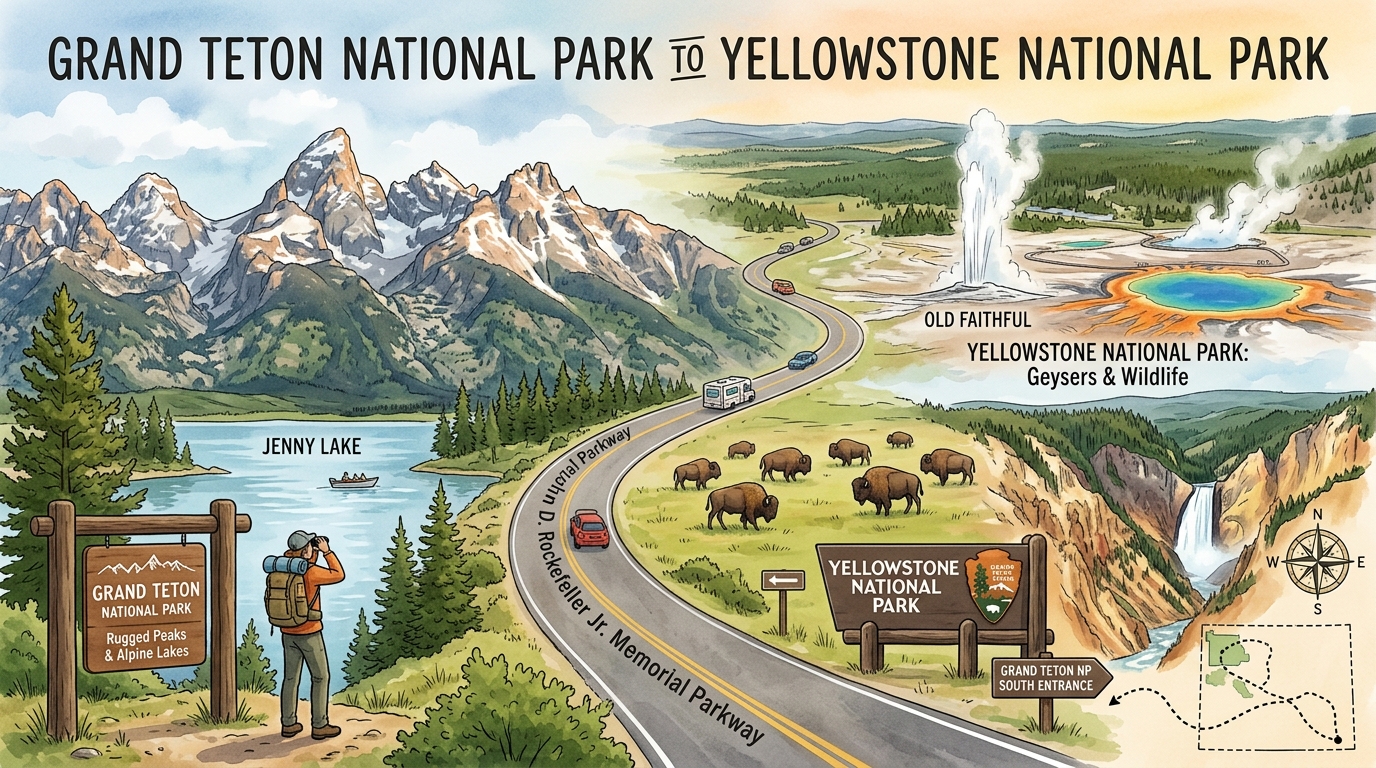
Planning a mountain road trip that links Grand Teton National Park to Yellowstone National Park brings visitors through one of the most stunning contiguous protected corridors in the American West. These two neighboring Wyoming parks feature wildly contrasting geology, shifting from towering, jagged granite walls to hissing geothermal calderas. Travelers moving between these natural wonders cross a unique geographic threshold that connects alpine habitats directly with volcanic basins.
Exact Mileage and Driving Durations Between the Parks
The distance from Grand Teton National Park to Yellowstone National Park varies depending on where your journey begins inside the southern park boundaries.
Drivers starting from northern lake areas like Colter Bay face a short 30-mile drive north that takes approximately 45 minutes to reach the South Entrance of Yellowstone National Park under normal summer traffic conditions. Visitors beginning their trip further south near the town of Jackson or the Craig Thomas Discovery and Visitor Center will log roughly 50 to 60 miles over an hour and fifteen minutes of windshield time. For a deeper look at planning your extended stay in the area, you can review this helpful weeklong trip plan for Grand Teton to make the most of your mountain adventures.
| Starting Point in Grand Teton | Destination Yellowstone Gate | Approximate Mileage | Drive Time |
|---|---|---|---|
| Colter Bay Village | South Entrance | 30 miles | 45 minutes |
| Jackson Lake Lodge | South Entrance | 25 miles | 35 minutes |
| Town of Jackson | South Entrance | 55 miles | 1 hour 15 minutes |
Following the Parkway Corridor and Connecting Roads
Navigating the route from Grand Teton to Yellowstone relies entirely on a single, well-maintained federal highway corridor.
Drivers must take U.S. Highway 89 and U.S. Highway 191 north, which channels traffic seamlessly across the John D. Rockefeller, Jr. Memorial Parkway and directly into the lower loop of Yellowstone National Park. This connecting parkway acts as a natural buffer zone where the landscape slowly flattens out from sharp alpine peaks into dense pine forests and river valleys. Travelers who want to ensure they have enough time to explore everything can also check out our guide on planning a complete visit to Yellowstone National Park to organize their daily sightseeing schedules.
Scenic Pullouts and Geothermal Highlights Along the Drive
The road corridor between the two preserves offers several rewarding viewpoints where motorists can pause to take in the scenery.
Jackson Lake Lodge provides wide, sweeping views across Willow Flats where moose and elk frequently graze in the early morning hours. As the highway tracks north alongside the winding Snake River, quiet gravel pullouts give visitors a chance to stretch their legs and watch the rushing mountain water before entering the volcanic interior of Yellowstone.

Seasonal Gate Closures and Park Admission Logistics
Preparing for your inter-park road trip requires a firm understanding of seasonal road accessibility and standard park entry regulations.
The connecting highway between Grand Teton and Yellowstone closes to standard wheeled vehicles every autumn, typically shutting down in early November and staying blocked by deep snow until late May. During the summer operating season, standard federal entry passes cover admission to both national parks for a consecutive seven-day window, meaning visitors do not need to purchase separate tickets at each gate.
Frequently Asked Questions
How far is Yellowstone National Park from Grand Teton National Park?
The distance is about 30 miles from the northern part of Grand Teton to the South Entrance of Yellowstone, taking roughly 45 minutes of driving time.
Do I need a separate pass for each park?
No, Grand Teton National Park and Yellowstone National Park are managed together, so a single standard entry pass covers admission to both parks for a period of seven days.
Are the roads between Grand Teton and Yellowstone open all year?
No, the connecting parkway closes to regular automobiles in the winter due to heavy snow and only reopens for the summer season in late May.
What is the best time of day to drive between the parks?
Early morning is the best time to drive between the parks to avoid heavy traffic congestion and to catch the best lighting for wildlife viewing.
Can I see bears along the driving route?
Yes, both black bears and grizzly bears inhabit the corridor between Grand Teton and Yellowstone, and they are frequently spotted near the roadways by observant drivers.
What entrance gate is closest to Grand Teton?
The South Entrance of Yellowstone National Park is the absolute closest and most direct entry point for travelers coming north from Grand Teton.
Disclaimer: Park fees, road opening dates, and travel conditions can change due to weather or administrative updates. Always verify current operating hours and alerts on the official National Park Service websites before starting your trip.

I’m Muhammad Ubaid, founder of YBR Magazine. I research and write detailed guides on America’s National Parks — covering entry fees, permits, best times to visit, and planning tips — using official NPS sources and up-to-date information.