


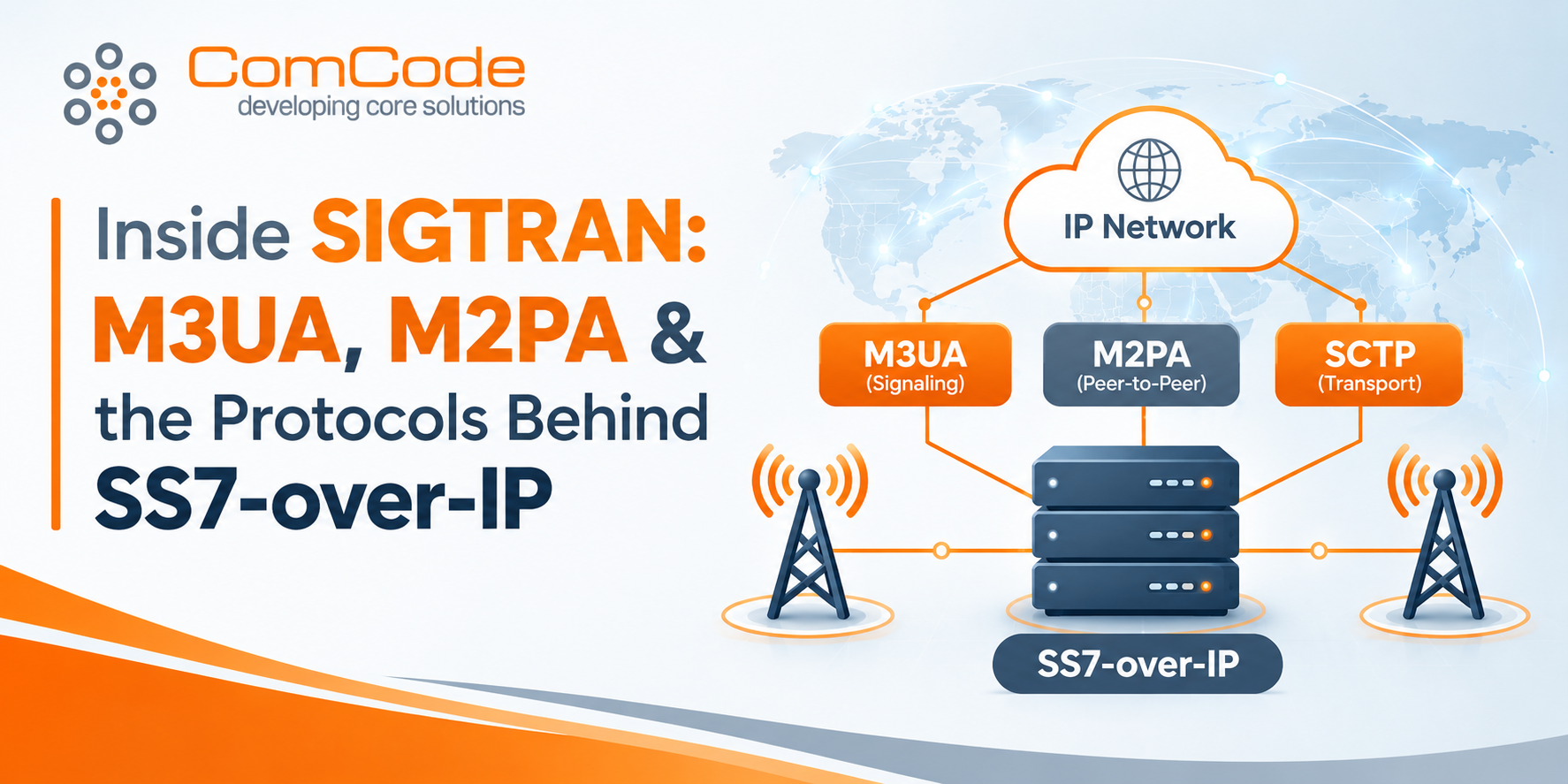
Introduction: Why SS7 Moved to IP
For decade’s, Signaling System No. 7 (SS7) has been the nervous system of telephone network’s. Every call setup, SMS delivery, roaming registration & prepaid balance check relies on signaling message’s travelling between network nodes. Originally, those message’s ran over dedicated 64 kbps TDM link’s.
As traffic grew & operator’s moved toward packet-based infrastructure, TDM links became expensive, rigid & hard to scale. Operator’s needed a way to keep the proven SS7 service’s (ISUP, SCCP, TCAP, MAP, CAP) while replacing the physical transport with IP. The IETF’s answer was SIGTRAN (Signaling Transport), a family of protocol’s that carries SS7 & related signaling over IP network’s.
Today, SIGTRAN is a foundational part of the telecom core network. Even in 4G & 5G-era deployments, it remains essential for 2G/3G service’s, roaming, SMS & interworking with legacy system’s.
The SIGTRAN Protocol Stack
SIGTRAN is not a single protocol. It is a layered architecture with two main building block’s.
SCTP: The Transport Layer
The Stream Control Transmission Protocol (SCTP) replaces the reliability functions of MTP1 & MTP2. It was designed specifically for signaling & offer’s features that neither TCP nor UDP provide together:
- Multi-homing: an association can use several IP addresses per endpoint, so a single network path failure does not drop signaling.
- Multi-streaming: independent stream’s within one association avoid head-of-line blocking.
- Message-oriented delivery: message boundarie’s are preserved, which suit’s signaling.
- Built-in heartbeat’s & failure detection: fault’s are noticed & handled quickly.
Adaptation Layers
On top of SCTP sit the adaptation layer’s, which let SS7 layers work unchanged over IP:
- M3UA (MTP3 User Adaptation): carries MTP3 users such as SCCP & ISUP over IP.
- M2PA (MTP2 Peer-to-Peer Adaptation): emulates an MTP2 link between two peer’s.
- M2UA (MTP2 User Adaptation): backhaul’s MTP2 users to a signaling gateway.
- SUA (SCCP User Adaptation): carries SCCP users directly over IP.
- IUA: carries ISDN Q.921 user signaling.
The upper SS7 layer’s (SCCP, TCAP, MAP, CAP, ISUP) are largely untouched. That is the whole point: existing application’s keep working while the transport change’s underneath.
M3UA: Replacing MTP3
M3UA, defined in RFC 4666 is the most widely deployed SIGTRAN adaptation layer. It let’s IP-based nodes exchange SS7 user-part message’s without implementing MTP3 themselve’s.
Key Concepts
- Signaling Gateway (SG): the node that connect’s the SS7 network & the IP network.
- Application Server Process (ASP): an IP-based process, such as an instance of an HLR or MSC server.
- Application Server (AS): a logical entity made up of one or more ASPs that handle traffic for a given routing key.
- Routing key & routing context: identify which traffic belongs to which AS, typically based on point code’s, service indicators & other parameter’s.
State Management
M3UA manage’s the state of each ASP (ASP-DOWN, ASP-INACTIVE, ASP-ACTIVE) & each AS (AS-DOWN, AS-INACTIVE, AS-ACTIVE, AS-PENDING). Message’s such as ASP Up, ASP Active & Notify coordinate these transition’s.
Traffic Mode’s
M3UA supports three traffic modes within an AS:
- Override: one ASP is active; a new activation replaces it.
- Loadshare: traffic is distributed across active ASPs.
- Broadcast: traffic is sent to all active ASPs.
These mode’s give operators flexible redundancy & capacity design. M3UA typically use’s SCTP port 2905.
M2PA: Replacing MTP2 Peer-to-Peer
M2PA, defined in RFC 4165, takes a different approach. Instead of backhauling signaling to a gateway, it lets two full SS7 node’s (SP to SP, or STP to STP) connect over IP as if they were joined by a traditional signaling link.
Both endpoints keep their own MTP3 layer, with its point code’s, routing table’s & link set’s. M2PA simply replace’s the MTP2 link layer & carrie’s MTP3 messages over SCTP. M2PA commonly use’s SCTP port 3565.
This make’s M2PA attractive when migrating an STP network to IP. Routing design & point code architecture can stay largely the same, while the physical link’s are replaced by IP association’s.
M2PA vs. M2UA
M2UA is client-server: a signaling gateway terminate’s MTP2 & hand’s everything above it to a remote MTP3 user. M2PA is peer-to-peer: both side’s run full MTP3. M2PA is therefore more common between STPs & large signaling node’s, while M2UA suits case’s where a gateway fronts simpler endpoint’s.
M3UA vs. M2PA at a Glance
| Aspect | M3UA | M2PA |
| Replace’s | MTP3 & below | MTP2 |
| Model | Client-server (SG to AS/ASP) | Peer-to-peer |
| MTP3 on IP endpoint | No | Yes |
| Routing | Routing key’s & contexts | Standard MTP3 point code routing |
| Typical use | Core node to Signaling Gateway | STP-to-STP, SP-to-SP |
In practice, many network’s use both: M2PA between STPs for the backbone & M3UA from core node’s (MSCs, HLRs, SMSCs) to those STPs or signaling gateway’s.
Gateway Connection: Bridging TDM & IP
A Gateway Connection is where legacy & modern signaling meet. The Signaling Gateway terminate’s SS7 links on the TDM side & exposes the traffic over SIGTRAN on the IP side.
A typical design includes:
- Redundant gateways: at least two SGs, deployed on separate site’s or chassis, so a single failure does not isolate the core.
- Multiple SCTP association’s: each ASP maintains associations to more than one SG.
- Multi-homed paths: each association use’s two network path’s (for example, two VLANs or two switches).
- Consistent configuration: point code’s, network indicator’s, routing context’s & SCTP ports must match on both side’s of every association.
When a gateway connection is designed well, a link, interface, or even a whole gateway can fail with no visible impact on subscriber’s.
SIGTRAN in the Telecom Core Network
SIGTRAN touches nearly every signaling-dependent element in the core. Two examples show how.
Home Subscriber Server (HSS) & HLR
The Home Subscriber Server holds subscriber profile’s, authentication data & service permissions. In 2G & 3G network’s, the equivalent function is the HLR, which communicate’s using MAP over TCAP & SCCP. With SIGTRAN, MAP message’s such as Update Location, Send Authentication Info & Insert Subscriber Data ride over M3UA & SCTP.
In 4G, the HSS uses Diameter instead, but SIGTRAN does not disappear. Combined HLR/HSS deployment’s, interworking functions, circuit-switched fallback, SMS & international roaming with legacy partner’s all still depend on SS7-over-IP signaling.
CAMEL Gateway
CAMEL (Customised Applications Mobile network Enhanced Logic) enables intelligent network service’s such as prepaid charging, virtual private network’s & special number handling. The CAMEL Gateway, acting as or connecting to the gsmSCF, exchange’s CAP message’s with the MSC or SGSN. These message’s travel over TCAP, SCCP, M3UA & SCTP.
When a prepaid subscriber places a call, the switch pauses call processing, send’s a CAP query to the CAMEL Gateway & waits for instruction’s to continue, modify, or release the call. Low latency & high availability are critical, which is why SCTP multi-homing & redundant gateway connection’s matter so much here.
Other Core Elements
MSC servers, SMSCs, STPs & number portability databases all use the same SIGTRAN transport, which gives operator’s a single IP-based signaling fabric across the network.
Design & Troubleshooting Tips
- Plan point codes & routing early. Mismatched point code’s are among the most common causes of undeliverable traffic.
- Tune SCTP timers carefully. Heartbeat interval, retransmission timeout (RTO) & path max retransmissions affect how quickly failure’s are detected. Too aggressive causes flapping; too lax delays failover.
- Monitor AS & ASP states. An AS stuck in AS-PENDING or AS-INACTIVE usually points to an activation or routing context problem.
- Check the basics first when an association is down: IP reachability, firewall rule’s for the SCTP port’s & matching local & remote addresses.
- Capture & decode traffic. Packet captures filtered on SCTP, with M3UA or M2PA decoding, quickly reveal ASP Up/Active failure’s, Notify message’s & error code’s.
- Secure the signaling network. SS7-over-IP expands the attack surface. Use signaling firewalls, network segmentation & access controls & consider IPsec or DTLS where supported.
Conclusion
SIGTRAN is the bridge that lets decades of proven SS7 service’s run on modern IP infrastructure. SCTP provides robust, multi-homed transport, M3UA connects core applications to signaling gateways & M2PA lets signaling node’s peer over IP while keeping MTP3 intact. Together, they connect gateway’s, the Home Subscriber Server, the CAMEL Gateway & the rest of the telecom core network.
For engineers & architects, understanding these protocol’s is still essential. Even as 4G & 5G take over, SIGTRAN carrie’s the signaling that keeps legacy service’s, roaming & interconnect working.
READ ALSO: Wireless Charging Without the Guesswork: Getting the Best Results From Your Charging Pad


