


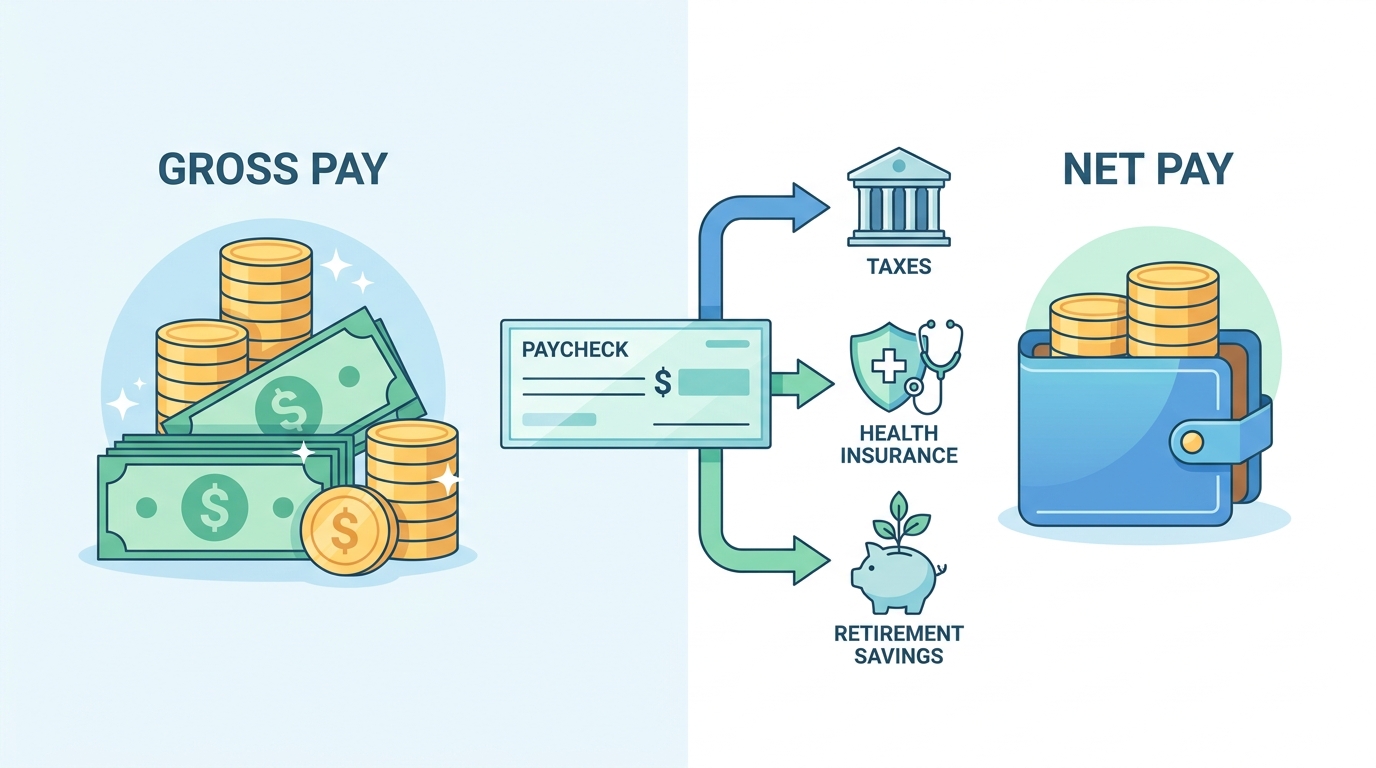
Gross pay is the total amount you earn before anything is taken out, and net pay is the smaller amount you actually receive after taxes, insurance, retirement contributions, and other deductions. Gross pay is the number in your job offer, while net pay, often called take-home pay, is the number you can spend. Understanding both is the foundation of good budgeting, salary negotiation, and reading your pay stub with confidence.
What Is Gross Pay?
Gross pay is your full compensation for a pay period before any money is withheld. If your employer agrees to pay you an annual salary of $60,000, that figure is your gross annual pay, and dividing it by the number of pay periods gives you your gross pay for each check. Gross pay is the figure that employers, recruiters, and job listings usually quote, because it is the simplest and most consistent way to describe what a role pays.
Gross pay is more than just base salary or hourly wages. It can include overtime pay, bonuses, commissions, tips, shift differentials, holiday pay, paid time off, and certain allowances or stipends. If you are paid hourly, your gross pay is your hourly rate multiplied by the hours you worked, with overtime calculated at the higher rate where the law or your contract requires it. For salaried employees, gross pay stays the same from one period to the next unless a bonus or other extra payment is added.
What Is Net Pay?

Net pay is the money left over after all required and voluntary deductions have been subtracted from your gross pay. It is the amount deposited into your bank account or printed on your paycheck, which is why most people call it take-home pay. Net pay is always lower than gross pay, unless you have no deductions at all, which is very rare for regular employees.
Because net pay reflects your real spending power, it is the number that matters most when you pay rent, buy groceries, or plan savings. Two people with the same gross pay can have very different net pay, since their tax situation, benefit choices, and retirement contributions are rarely identical.
The Simple Formula
The relationship between the two is easy to remember:
Net Pay = Gross Pay − Total Deductions
The formula sounds simple, but the deductions part is where most of the confusion comes from, so it helps to understand what those deductions usually are.
What Gets Deducted From Gross Pay?
Deductions fall into two broad groups: those required by law and those you choose. The exact list depends on your country, your state or region, and your employer, but the categories are similar almost everywhere.
Mandatory deductions are amounts your employer must withhold. In the United States, these include federal income tax, Social Security tax, and Medicare tax, along with state and local income taxes where they apply. Social Security and Medicare are together known as FICA taxes, and employees generally pay 6.2% of wages toward Social Security, up to an annual wage limit, and 1.45% toward Medicare. Court-ordered payments such as child support or wage garnishments can also be mandatory. Other countries have their own versions, such as income tax withheld at source on salaries in Pakistan, or income tax and National Insurance contributions under the PAYE system in the United Kingdom.
Voluntary deductions are the ones you opt into, often through your employer’s benefits program. Common examples include health, dental, and vision insurance premiums, contributions to a retirement plan such as a 401(k), contributions to a health savings account or flexible spending account, life or disability insurance, union dues, and charitable giving through payroll.
Pre-Tax and Post-Tax Deductions
Not all deductions affect your taxes in the same way, and this detail explains why your net pay does not always fall by the full amount you contribute. Pre-tax deductions, such as traditional 401(k) contributions and many health insurance premiums, are taken out before income tax is calculated, which lowers your taxable income and therefore the income tax you owe. Post-tax deductions, such as Roth retirement contributions or union dues, come out of money that has already been taxed and do not reduce your tax bill.
This is why putting $250 into a traditional retirement plan usually reduces your take-home pay by less than $250. The tax savings partly cushion the impact, although the rules differ by country and by the type of account.
A Worked Example of Gross Pay to Net Pay
The following example is illustrative only, since real amounts depend on your tax status, location, and benefits. Imagine an employee with a gross monthly pay of $5,000, which equals a $60,000 annual salary.
| Item | Monthly Amount |
|---|---|
| Gross pay | $5,000.00 |
| Federal income tax (estimated) | −$450.00 |
| Social Security tax (6.2%) | −$310.00 |
| Medicare tax (1.45%) | −$72.50 |
| State income tax (estimated) | −$200.00 |
| Health insurance premium | −$150.00 |
| Retirement contribution (5%) | −$250.00 |
| Net pay | $3,567.50 |
In this example, the employee’s total deductions come to $1,432.50, so the take-home pay is about 71% of the gross amount. Someone in a higher tax bracket, or with larger benefit contributions, would keep a smaller share, while someone with lower income or fewer deductions would keep more.
Gross Pay vs Net Pay: Key Differences at a Glance
| Feature | Gross Pay | Net Pay |
|---|---|---|
| Meaning | Total earnings before deductions | Earnings after all deductions |
| Also called | Gross income, gross wages | Take-home pay, net income |
| Where you see it | Job offers, contracts, top of pay stub | Bank deposit, bottom line of pay stub |
| Includes taxes? | Taxes not yet removed | Taxes already removed |
| Best used for | Comparing salaries, loan applications | Budgeting, saving, daily spending |
| Size | Always the larger figure | Always the smaller figure |
Why the Difference Matters

Knowing the gap between gross and net pay protects you from a common mistake: planning your life around a number you never actually receive. If you budget your rent, bills, and savings based on your gross salary, you will almost certainly come up short each month. Building your budget from net pay keeps your expectations realistic and helps you avoid unnecessary debt.
The distinction also matters when you evaluate a job offer. A higher gross salary in a region with steep taxes might leave you with a similar take-home amount to a lower salary somewhere else, and benefits like employer-paid health insurance can make a lower gross offer more valuable than it first appears. Comparing offers using estimated net pay, plus the value of benefits, gives you a far clearer picture.
Lenders, landlords, and mortgage providers, on the other hand, often ask for your gross income, because it is a standardized measure that is easier to verify. So you will use both figures, but for different purposes.
How to Read Your Pay Stub
Your pay stub, sometimes called a payslip, shows exactly how gross pay becomes net pay. It normally lists your gross earnings at the top, followed by a breakdown of each tax and deduction, and ends with your net pay. Many stubs also show year-to-date totals, which let you track how much you have earned and how much tax has been withheld so far this year. Reviewing your stub regularly helps you catch errors, such as a wrong tax code, a deduction you did not approve, or missing overtime.
Can You Increase Your Net Pay?
You cannot avoid legally required taxes, but you can sometimes influence how much of your gross pay you keep. Reviewing your tax withholding is a good starting point: in the United States, for example, the W-4 form tells your employer how much federal income tax to withhold, and an incorrect setting can cause you to overpay throughout the year or face a bill at tax time. You can also look at whether your benefit elections still fit your needs, since dropping coverage you do not use will raise your take-home pay. Finally, remember that lowering your net pay through retirement savings is not necessarily a loss, because that money still belongs to you and often grows over time.
Common Misunderstandings
Many people assume net pay is simply gross pay minus one flat tax rate, but income tax is typically progressive, meaning different portions of your income are taxed at different rates. Another frequent mistake is thinking that a raise can push you into a bracket that makes you earn less overall. In a progressive system, only the income above the bracket threshold is taxed at the higher rate, so a raise generally still increases your take-home pay.
People also confuse gross pay with the total cost of an employee to a company. Employers often pay extra amounts on top of your gross pay, such as their share of payroll taxes and benefits, and these are not part of either your gross or net pay.
Frequently Asked Questions
Is gross pay the same as salary?
Not exactly. Salary is usually your base pay, while gross pay includes salary plus any extras like bonuses, overtime, and commissions.
Is net pay the same as take-home pay?
Yes, the two terms mean the same thing.
Should I negotiate based on gross or net pay?
Salary negotiations are almost always based on gross pay, but it helps to estimate the net result so you know what the increase really means for you.
Why is my net pay lower than expected?
Common reasons include higher tax withholding, new benefit deductions, or a bonus that was taxed at a higher withholding rate than your regular pay.
Can net pay ever equal gross pay? Only if no taxes or deductions apply, which is highly unusual for regular employment.
Final Thoughts
Gross pay tells you what you earn, and net pay tells you what you keep. Using gross pay to compare salaries and net pay to plan your monthly life is the most practical way to think about your income. Once you understand how the deductions between the two numbers work, your pay stub stops being a puzzle and becomes a useful tool for managing your money.
Disclaimer: This article is provided for general educational and informational purposes only and does not constitute financial, tax, legal, or payroll advice. Tax rates, deduction rules, and payroll practices vary by country, state, and individual circumstances, and they change over time. The example figures are illustrative and not a prediction of your actual pay. Please consult a qualified tax professional, accountant, or your employer’s payroll department for advice about your own situation.
Explore More
Savings Accounts Typically Offer More Interest Than What Type of Account?

I’m Muhammad Ubaid, founder of YBR Magazine. I research and write detailed guides on America’s National Parks — covering entry fees, permits, best times to visit, and planning tips — using official NPS sources and up-to-date information.

